


Natural gas markets opened the Friday session on the back foot as inventories are close to their seasonal norm and the weather outlook in the United States could delay the stronger heating demand impulse that we typically see this time of year. The latest storage report provides neither a clear shortage signal nor an overwhelming surplus. This leaves the timing and reaches of colder weather especially important.
Yesterday’s EIA Report
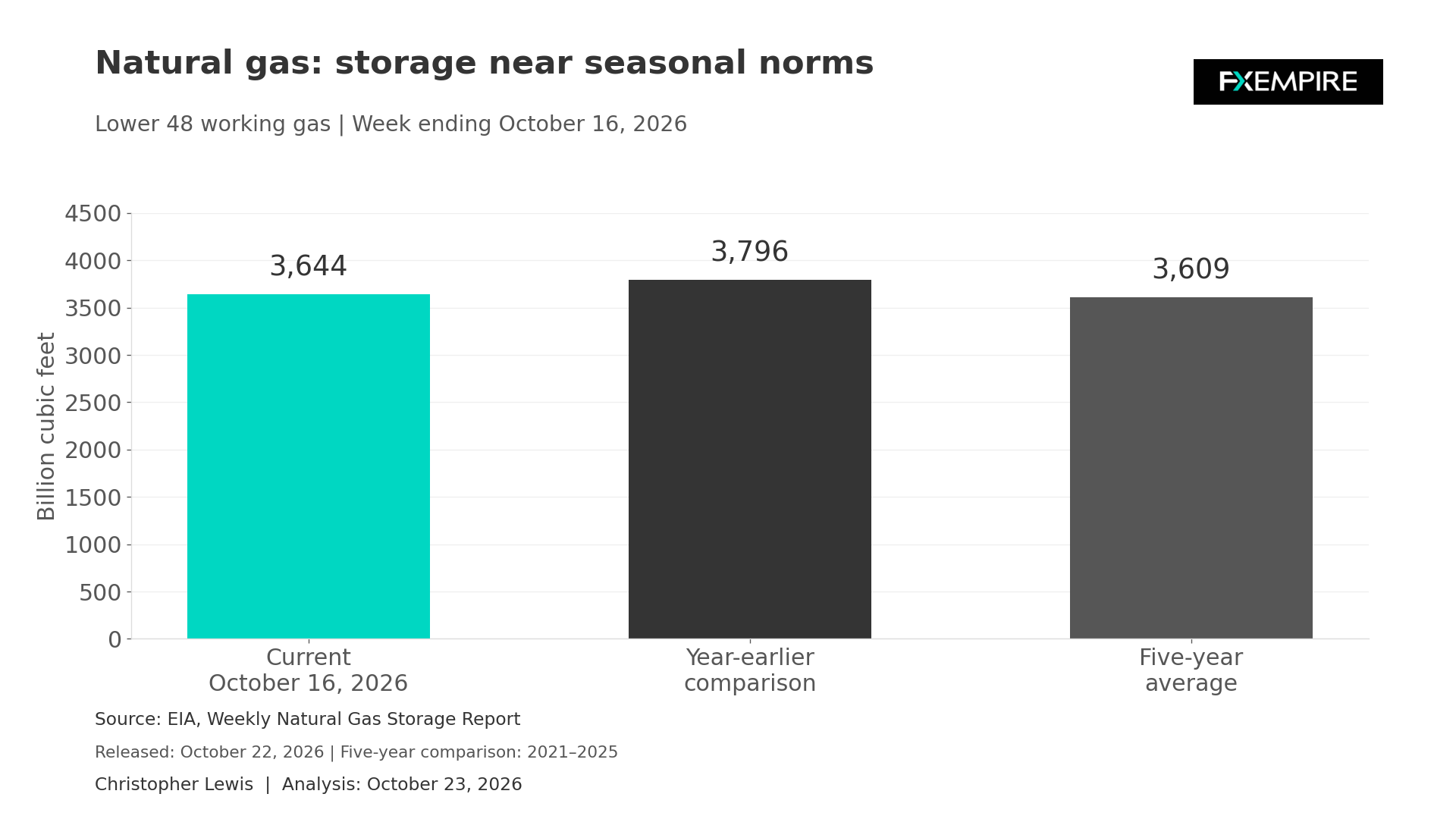
The EIA report yesterday suggested that Lower 48 working gas stood at 3,644 billion cubic feet for the week ending October 16, following a 77 billion cubic feet injection. Stocks were 35 billion cubic feet, or 1%, above the 5-year average and 152 billion cubic feet, or 4%, below the year-earlier comparison.
The national cushion seems adequate, but it is not particularly large. A small surplus to the seasonal average gives the system some flexibility, but it does not eliminate sensitivity to sustained cold or supply disruption. The year-over-year deficit is a separate comparison, and it should not be thought of as proof of a shortage.
Regional Distribution Is Mixed
Regional composition adds quite a bit of clarity to the picture as well. South Central stocks came in at 1,125 billion cubic feet, below the region’s 5-year average of 1,165 billion cubic feet. In that region, salt storage held 251 billion cubic feet against an average of 295 billion cubic feet. Inventories nationally can therefore appear comfortable while a particular part of the system may be a bit more threatened.
The location of available gas and the ability to move it are relevant alongside the overall total. The national stock number does not necessarily establish the availability of supply at every delivery point. Nor does a regional deficit by itself establish an immediate constraint at Henry Hub.
Natural Gas Price Forecast
Every new Natural Gas analysis as it publishes, today's technical signal and key levels, live price — on one page.
See all Natural Gas forecastsWeather Isn’t Cooperating With the Bulls
The latest official weather outlook leans against an immediate broad heating surge. NOAA’s Climate Prediction Center, in its October 22 memorandum, favored above-normal temperatures across most of the eastern contiguous United States for October 28 through November 1. Its October 30 through November 5 outlook also favored warmth across the eastern half of the country, which ends up being very bearish for pricing in general, as we have seen on the chart.
If this pattern remains true, then heating demand could be lighter than normal under late-autumn conditions across important population centers such as New York, Boston, Pittsburgh, and Columbus. This would give storage more opportunity to build and reduce early withdrawal pressure. These are the demand implications of a probabilistic forecast, not necessarily something that is measured yet, but it does tend to stand the test of time.
End-October Inventories
The EIA’s October 6 outlook projected end-October inventories of approximately 3,850 billion cubic feet, around 2% above the 5-year average. It also forecast dry gas production averaging 112.20 billion cubic feet per day in 2026 and 116.13 billion cubic feet per day in 2027, against LNG exports of 17.6 and 18.6 billion cubic feet per day, respectively.
This frames the broader competition between growing supply and growing export demand. Expanding LNG demand can absorb some additional domestic production, but it does not automatically create a shortage in the natural gas-rich United States.
The Next EIA Storage Report
The next EIA storage release is scheduled for October 29. Between now and then, changes in the weather outlook will foster close attention, especially their effect on major consuming regions. One single model change will not necessarily move the markets drastically, but a gradual shift toward colder temperatures certainly can give pricing power a bit of a boost. Inventories are near normal at the moment; regional weaknesses do remain, but forecast warmth continues to limit natural gas bulls.
Technical Outlook
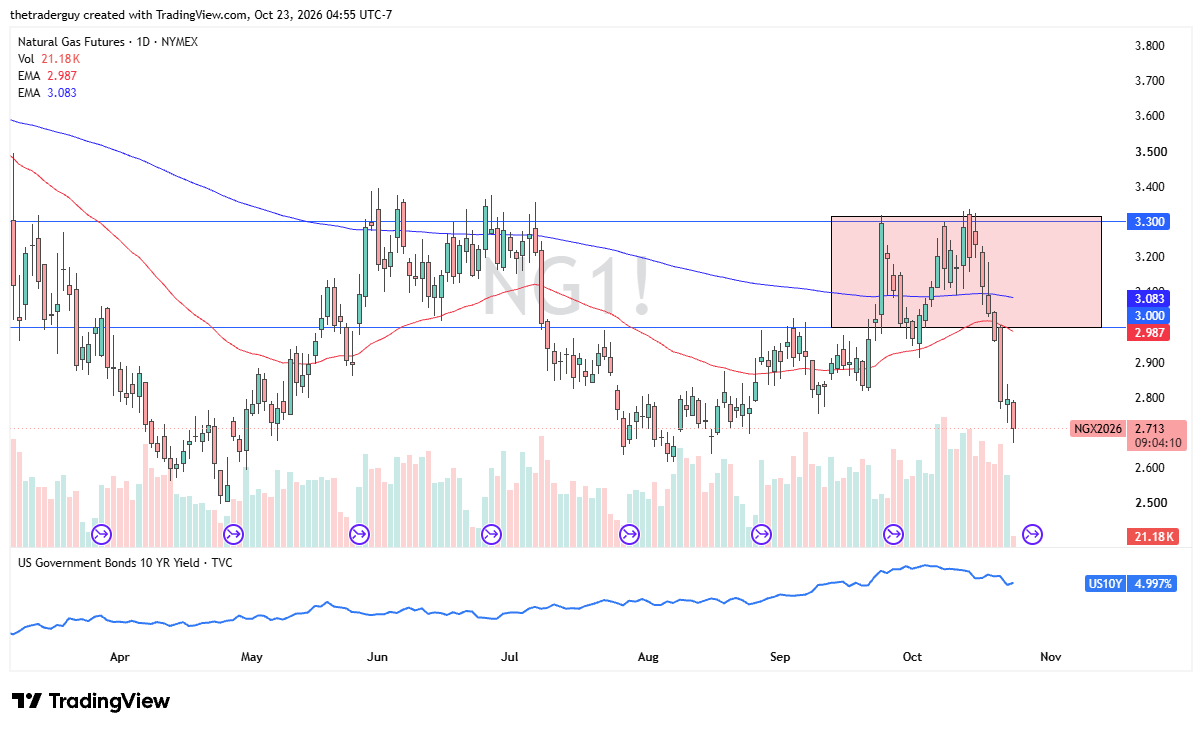
The technical setup has seen natural gas dropping precipitously as these warmer temperatures are forecast. That being said, the market is trying to bounce from the crucial $2.70 level and is setting up for a strong bounce sooner or later.
Unfortunately, it is watching the weather and its forecast that will drive where this market goes next. Historically speaking, this is typically a somewhat bullish time of year, and as a result, buyers are certainly looking for their opportunity.