


U.S. natural gas has kicked off the month of November with a modest national storage surplus against seasonal norms and a weather outlook that does not necessarily suggest that we are going to get a heating surge anytime soon. NOAA’s November 1 forecast favors above-normal temperatures across much of the country for November 7–11. For Henry Hub, it’s a forecast that could restrain near-term heating demand if it does, in fact, play out.
NOAA Favors Warmth
NOAA favors warmth across the Northern Plains and much of the Northeast, while near-normal temperatures are favored across substantial parts of the Southeast and the Gulf Coast. Its November 9–15 outlook also favors warmer temperatures across most of the contiguous United States. These are probabilities relative to seasonal norms, not necessarily measured temperatures or a forecast of gas consumption.
This prevents a common analytical error by traders, as a warm forecast can change expectations before it changes the actual withdrawal of gas, but it can’t be counted as realized demand destruction. Therefore, one will have to continue to keep an eye on the weather itself. Forecast revisions, the distribution of population-weighted temperatures, and eventual heating requirements all have to be measured.
Latest EIA Storage Numbers
The latest EIA storage report was October 29 and covers all the way to October 23. Working gas totaled 3,724 billion cubic feet after an 80 billion cubic feet weekly injection. Stocks were 38 billion cubic feet above the five-year average, but 147 billion cubic feet below the corresponding year-earlier level. They describe different reference points, but both of these should be paid close attention to.
Against seasonal norms, a national cushion reduces the urgency of a general scarcity argument at the moment. Against last year, the smaller inventory base means that the market does not have the same starting buffer that it did back then. The practical issue is how quickly that cushion will change.
Natural Gas Price Forecast
Every new Natural Gas analysis as it publishes, today's technical signal and key levels, live price — on one page.
See all Natural Gas forecastsRegional Stocks
Regional stocks make the picture much less uniform, with South Central inventories coming in at 1,168 billion cubic feet compared to its five-year average of 1,196 billion cubic feet. Salt cavern stocks in that region were 274 billion cubic feet against the 310 billion cubic feet seasonal average. The chart just below shows the contrast between regional shortfall and above-average stocks elsewhere.
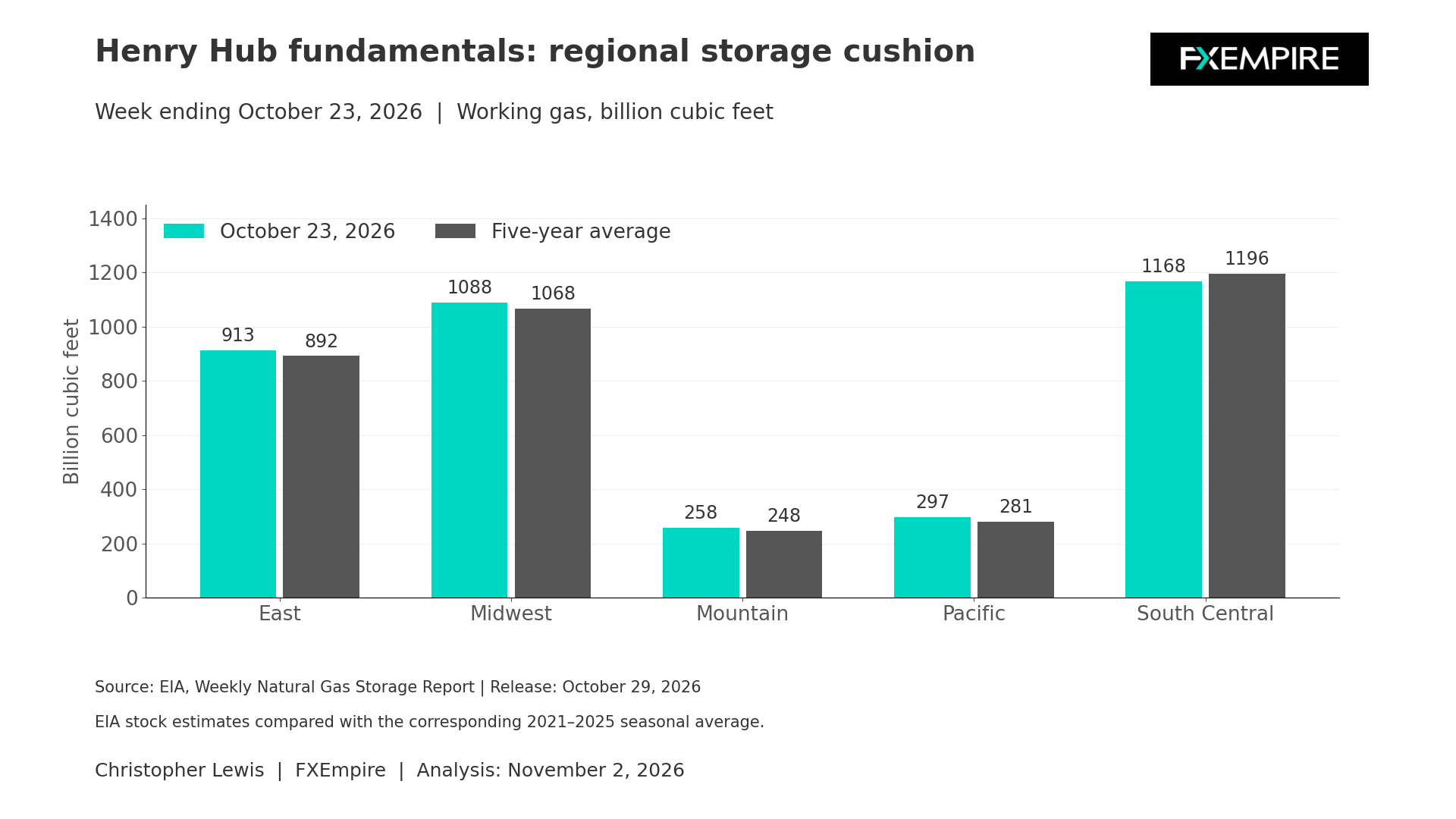
In Henry Hub, the inference is that national abundance doesn’t automatically eliminate regional sensitivity. Weather, storage, access, and changes in nearby demand all come to the forefront, even when the Lower 48 total looks comfortable.
Medium-term Supply Numbers
The medium-term supply backdrop comes from EIA’s October Short-Term Energy Outlook, released October 6 and completed October 1. It forecasts dry production averaging 112.2 billion cubic feet per day this year and 116.13 billion cubic feet for next year. LNG exports are forecast to be 17.6 billion cubic feet per day this year and 18.6 billion cubic feet per day next year.
The combination illustrates the balancing problem that we have with natural gas. More production can replenish inventories and meet consumption, while higher LNG exports can absorb part of that increase. Annual averages cannot reveal the terminal intake or confirm that a particular expansion has reached sustained operation. It simply measures what’s gone on recently.
Next Storage Release
The next storage date is scheduled for Thursday, November 5. Its value will lie in the change in seasonal surplus, the regional balance breakdown, and what it says about the balance during its own reporting week. It cannot directly measure weather forecasts for the following week. It simply gives us a starting point as far as supply is concerned.
The softer demand scenario will gain credibility if NOAA maintains its warm outlook in subsequent reports and storage reports preserve or widen the national surplus. A colder forecast revision, weaker supply, or stronger verified LNG exports could challenge that narrative.
Technical Analysis Shows Support
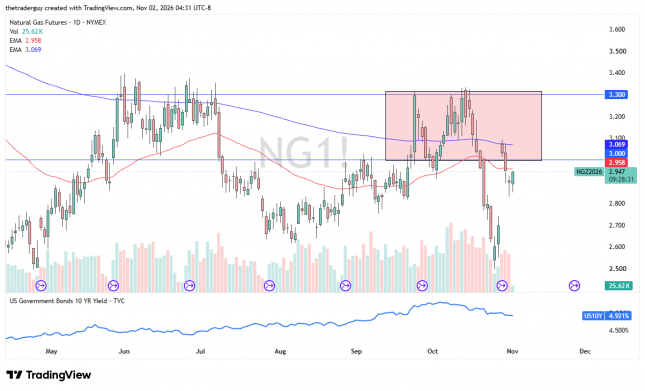
On Monday, we initially dipped and then turned around to rally. I suspect that the next move will be choppy and bullish, but I also recognize that the weather is not cooperating, hence the choppiness.
Typically speaking, I’m very bullish on the December contract, which we are now trading, and I more likely than not will be soon again, but the weather is a little bit of a drag. I would say modestly bullish is how I look at this.