


WTI Crude Oil
The fundamental starting point for WTI crude needs to be thought of through a U.S. inventory cushion that remains relatively thin, while at the same time a newly authorized response to a specific refinery and its issues. The developments support attention to actual physical availability, but they do not necessarily establish that crude must rise.
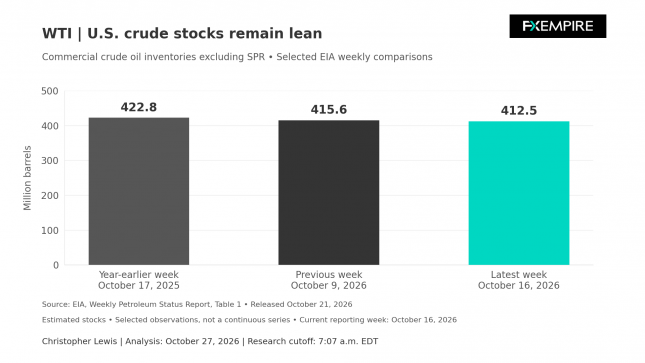
The latest EIA petroleum report was released October 21 and covers the week of October 16. Commercial crude stocks were estimated at 412.5 million barrels, down 3.1 million from the week and roughly 3% below the five-year average. Gasoline stocks fell 3 million barrels, while distillates rose 1.7 million. With refinery utilization coming in at 93.4%, it suggests that crude drawdowns should be assessed alongside refinery demand and finished-product availability.
Exchange of Barrels
October 23 saw the Department of Energy authorize an emergency exchange of up to 400,000 barrels for Phillips 66’s Lake Charles refinery, supplied from West Hackberry. It addresses a disrupted crude delivery region and requires repayment with premium barrels. Successful implementation of this delivery and refining could reduce a local feedstock constraint and protect fuel output. It does not represent new domestic production, nor does it change the overall picture.
DoE Report
The October 14 report by the Department of Energy said production had recovered offshore in the United States to nearly 90% of normal. This is a return to normalcy after a hurricane had hit the Gulf of Mexico. The next scheduled EIA petroleum release is Wednesday, October 28, at 10:30 Eastern, and traders should watch whether crude draws persist, refinery activity holds up, and gasoline and distillate rebuilding becomes more convincing. A broader rebuilding of inventories would weaken the scarcity story that we have been hearing.
Technical Outlook

From a technical analysis side, the WTI crude oil market is pulling back a little bit after trying to rally early on Tuesday, as traders may have gotten a little overstretched. Short-term pullbacks should continue to attract buyers, with particularly interesting technical confluences building near the $95 level, including previous support, previous resistance, and now the 50-day EMA heading to that area. The chart below therefore separates the components instead of treating a near-flag global total as proof that supply conditions have normalized.
Brent
Brent’s outlook remains shaped by the difference between oil being produced, oil in transit, and oil available where refiners need it. The IEA’s October 14 report estimated that September global observed inventories declined 10 million barrels. Beneath that small net change, on-land inventories fell 113 million barrels, while oil on water increased 103 million. This is an important composition to pay close attention to because more crude at sea can signal recovering exports by the major players while providing limited immediate relief to consumers waiting for deliveries. Transit times, routes, and access to suitable crude grades determine how quickly those barrels become usable refinery feedstock.
Brent Oil Price Forecast
Every new Brent Oil analysis as it publishes, today's technical signal and key levels, live price — on one page.
See all Brent Oil forecasts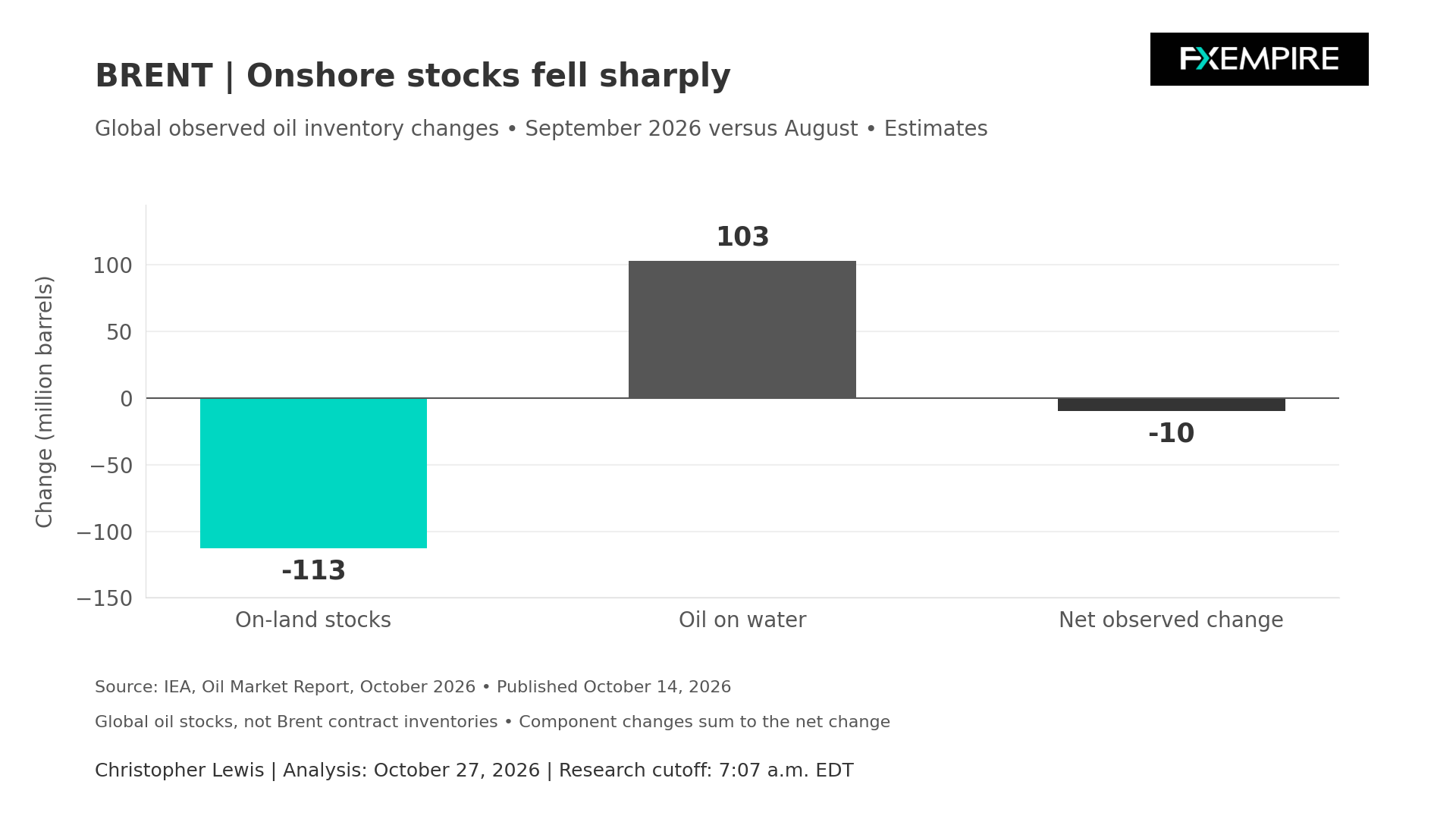
This does leave a bit of a two-sided story here. Faster, reliable deliveries and rebuilding onshore stocks would weaken the case for persistent scarcity and elevated pricing. Renewed disruption, perhaps coming out of the Middle East, or disappointing product availability would reinforce it.
EIA Report Timing
Forecast timing also adds another constraint when it comes to sorting out the price, as the EIA’s October outlook was released October 6 with inputs finalized October 1. It specifically excludes additional supply arising from the October 2 G7 announcement. Its annual price projections therefore cannot be thought of as the final word.
Going forward, the question will be whether or not additional crude actually arrives and whether or not refiners can process it quickly enough, and perhaps most importantly, whether or not products can reach end users. The inventory data on Wednesday in the United States can illuminate Atlantic Basin availability, while Thursday’s U.S. GDP release may inform traders on what demand expectations might be.
Technical Setup
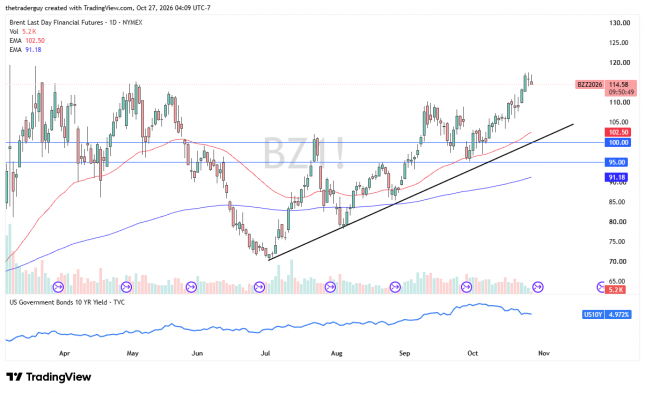
From a technical analysis standpoint, Brent looks overbought, and it does look like it is pulling back from the $116 region, an area that caused a bit of resistance back in the early part of the year. Nonetheless, there does seem to be real concern about availability and the perhaps expanding conflict in the Middle East, as Saudi Arabia continues to be attacked by the Houthis and the Americans look to be preparing for another strike on Iran by pulling diplomats out of Saudi Arabia. With this being the case, it becomes a very tenuous situation, but one that, more likely than not, will have enough supporting factors to have dip buyers out in force.