



Crude Oil Edges Higher as Iran Tensions Keep Supply Premium Intact
U.S. West Texas Intermediate (WTI) crude oil futures are inching higher on Tuesday after recovering from early session weakness. The price action suggests traders are monitoring the potential for supply disruptions but don’t want to jump in too fast due to oversupply issues and the possibility of a diplomatic breakthrough in talks between Iran and the United States.
At 14:40 GMT, March WTI Crude Oil Futures are trading $57.35, down $0.81 or -1.39%.
U.S. Issues Guidance for Vessels in Strait of Hormuz
Bullish traders are riding the coattails of the issuance of U.S. guidance for vessels transiting the Strait of Hormuz. Today, traders are showing some follow-through interest after a 1% jump the previous session, fueled after the U.S. Department of Transportation’s Maritime Administration advised commercial vessels to stay as far from Iran’s territorial waters as possible and to verbally decline Iranian forces permission to board if asked, CNBC reported.
The tight trading range suggests investors are assessing the information to determine if this warning is a precursor to a military attack from the U.S. or just a courtesy to commercial users. The Strait of Hormuz is important because 20% of the oil consumed globally passes through it. If the U.S. were to attack Iran, traders fear it would shut down the Strait to traffic, directly impacting global supply.
There is a presumption, however, that there won’t be an attack as long as the U.S. and Iran are talking, but I haven’t seen any news saying that they were after an Iranian official said the talks were “good” on Friday.
Supply Disruption Premium Holds the Market Bid
Taking everything into consideration, there is enough not known to keep the market bid with the supply disruption premium and not quite enough information to be preparing for military activity.
Brent Oil Price Forecast
Every new Brent Oil analysis as it publishes, today's technical signal and key levels, live price — on one page.
See all Brent Oil forecastsTechnical Picture: Uptrend Intact, Watch the Trend Line
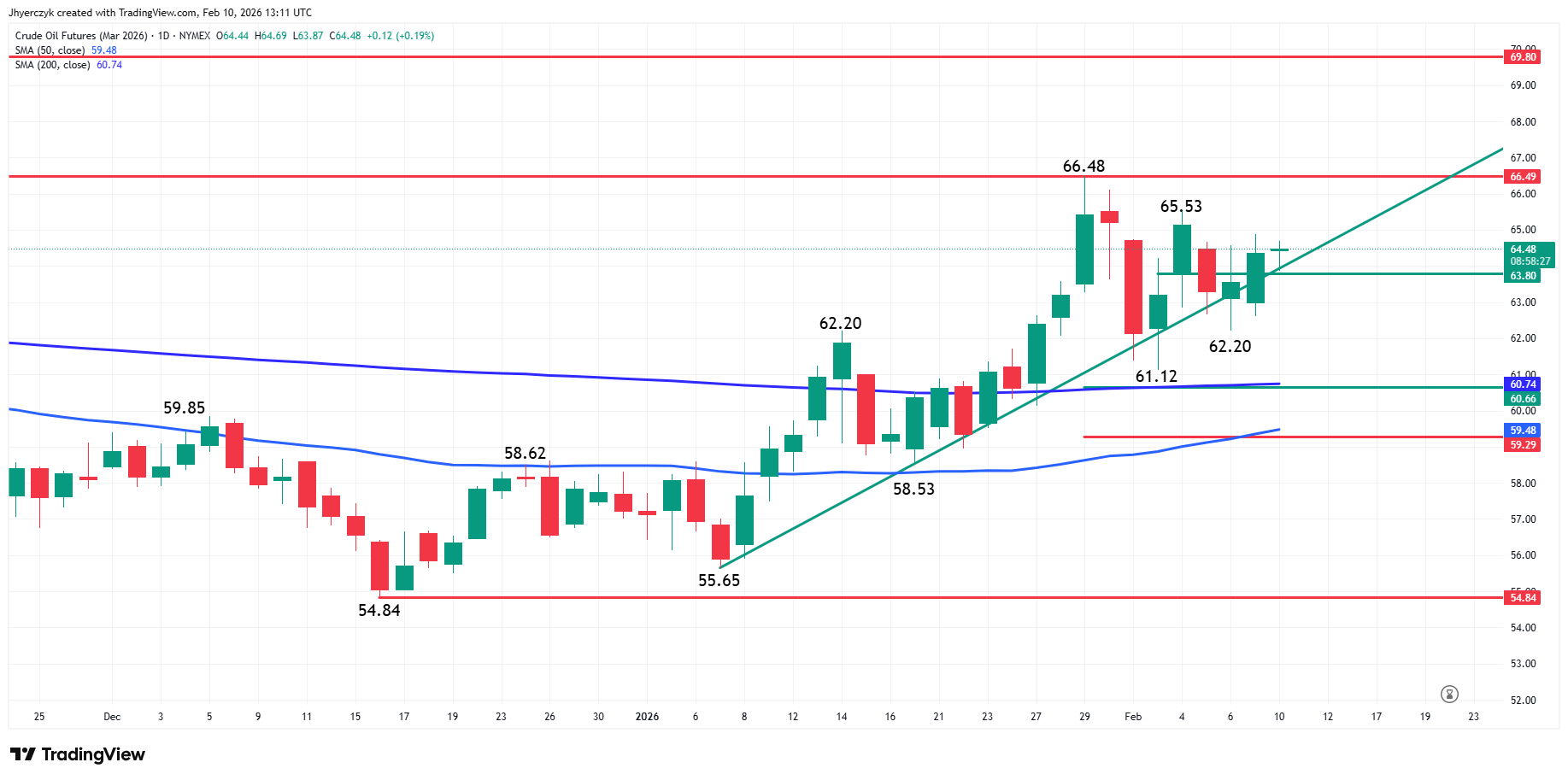
Technically, the trend is up according to three metrics I follow: the trend line, swing chart, and moving averages.
The market is trading on the strong side of the trend line at $63.96 today and above a pivot at $63.80. I think a failure to hold the trend line will be the first sign of weakness. Taking out minor swing bottoms at $62.20 and $61.12 will shift momentum to down, but the long-term picture will remain supported as long as the 200-day moving average at $60.74 holds as support and the 50-day moving average at $59.48 remains intact. Joining those two trend indicators is retracement zone support at $60.66 and $59.29.
Continue to monitor the price action and the moving averages because the 50-day moving average is starting to creep higher. If it crosses over the 200-day moving average, prices could pop higher.
More Information in our Economic Calendar.