



Geopolitical Concerns Lift Crude Early, But Gains Fade
West Texas Intermediate (WTI) crude oil futures and Brent crude oil futures are nearly flat on Friday after giving up earlier gains. Supply disruption concerns were behind the quick rise in prices following the Christmas holiday.
Two factors contributed to the supply issues: worries over Venezuelan oil shipments and production risks at Nigerian oil fields. Regarding Venezuela, the U.S. is ramping up economic pressures rather than escalating military action.
In Nigeria, the U.S. carried out airstrikes against Islamic State militants in northwest Nigeria, however, Nigeria’s oilfields are mainly in the south. Nonetheless, the bombings fell under the “geopolitical risks” umbrella, which was enough to spook some shorts into covering positions.
Venezuelan Pressure Campaign Extends Supply Worries
The attack in Nigeria appears to be a one-time show of force, while the Venezuelan situation is expected to last a while with reports saying that the White House is more interested in economic pressure rather than military. CNBC wrote that the Trump administration has ordered its military force in the region to focus on a ‘quarantine’ of Venezuelan oil for at least two months.
WTI Fades After Failing to Hold Overnight Rally
At 12:31 GMT, Light Crude Oil Futures (WTI) are trading $58.41, up $0.06 or +0.10%. This is down from an earlier high of $58.88.
Light crude oil futures surged to $58.88 overnight before returning to unchanged. The early rally managed to overcome the 50-day moving average at $58.74, but thin-holiday volume likely thwarted an even bigger move.
Oil Prices Forecast Still Controlled by 50-Day and 200-Day Moving Averages
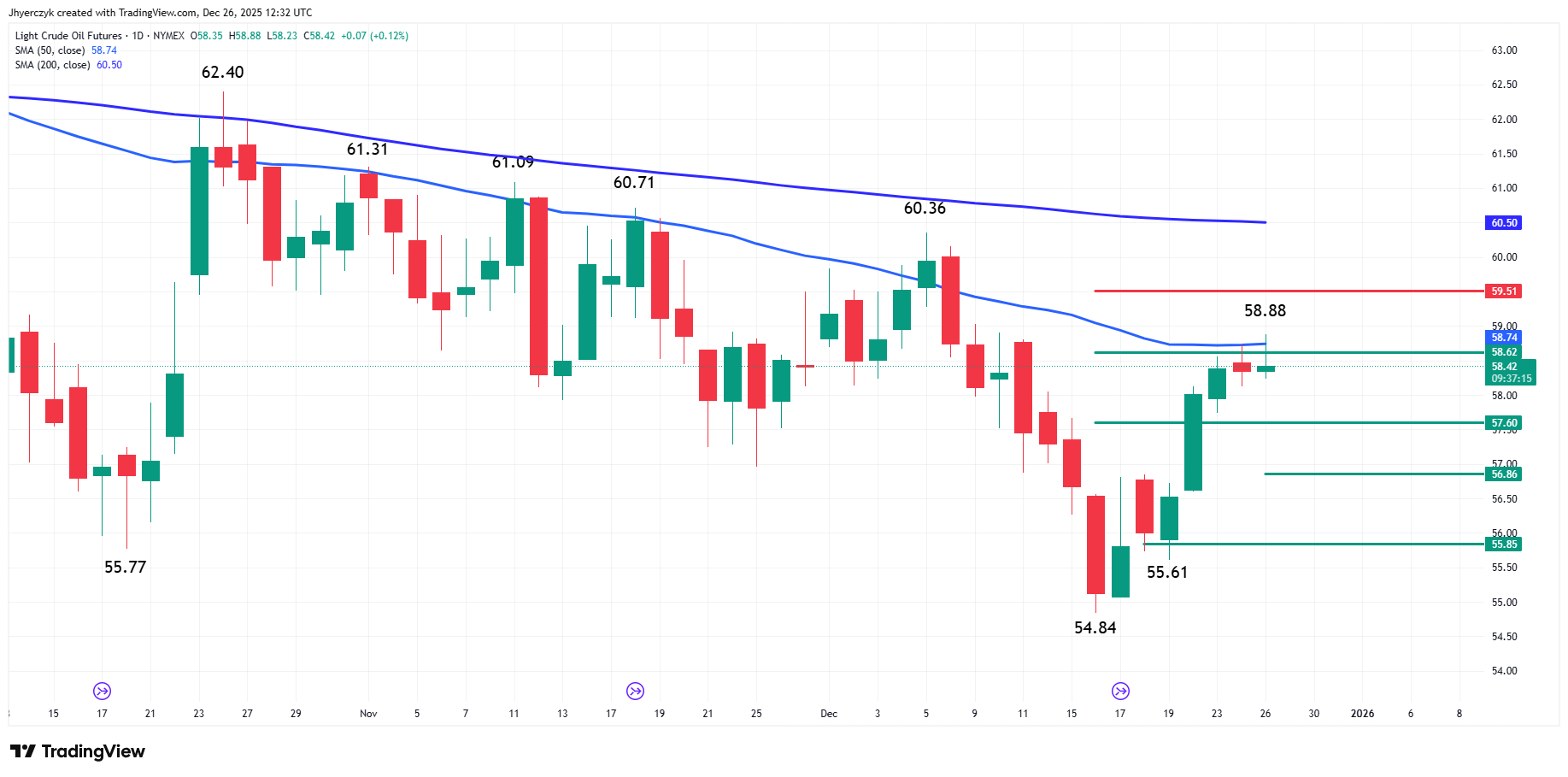
Although there are other technical levels and indicators, in my opinion, the 50-day and the 200-day moving averages are controlling the trend in crude oil. Since the October 25 main top at $62.40 and the subsequent crossover to the weakside of the 50-day moving average, this indicator has essentially stopped rallies at $61.31, $61.09, $60.71 and $60.36. Each move subsequently led to a lower-low. And isn’t lower-tops and lower-bottoms the very definition of a downtrend.
Brent Oil Price Forecast
Every new Brent Oil analysis as it publishes, today's technical signal and key levels, live price — on one page.
See all Brent Oil forecastsLower Highs Complicate Bottoming as Shorts Reassess Positions
So what we have here is a moving average which has been providing resistance for three months, and a series of lower tops and lower bottoms. This means the bottoming process is going to be complicated.
Our work indicates we’re still in a downtrend, but it is becoming a little weaker due to the geopolitical risks. Essentially what we are looking at is demand weakness and oversupply clashing with potential supply disruptions. With the trend down technically due to the series of lower tops and lower bottoms, big money is likely looking for new shorting opportunities, while speculative traders are chasing the counter-trend rally.
Short-Term Volatility Dominates as Oil Prices Projections Target Value Levels
The short-term angle is where the volatility is. Longer-term, the market is bearish with time needed to build a base that could support a rally. The first move of any rally is usually short-covering. We’re seeing that now. The next move is a 50% correction of the short-covering rally. This puts $56.86 back on the radar, which is our value level if this rally fails and normal trading conditions resume after the holiday. Suggestion: Don’t chase strength or dump weakness during low-volume periods, you’ll get whip-sawed.
More Information in our Economic Calendar.