



Crude Oil Struggles for Direction After Sharp Weekly Selloff
Light crude oil futures closed slightly lower on Friday, settling at $57.44, down $0.16 or 0.28%. Price action stayed locked inside Thursday’s range, a sign that traders are hesitating after a sharp weekly decline. While the day’s move was modest, the bigger picture shows sellers still holding the upper hand.
Both WTI and Brent finished the week down more than 4%, reinforcing the idea that supply pressure continues to outweigh geopolitical headlines that might normally support prices.

Oil Prices End the Week Lower as Oversupply Dominates Trade
Brent crude settled Friday at $61.12 a barrel, also down 16 cents. Thursday’s 1.5% slide across both benchmarks set the tone for the week, as traders continued to price in excess supply rather than focusing on demand recovery stories.
According to Andrew Lipow of Lipow Oil Associates, crude prices remain weighed down by supply conditions. That view appears to be widely shared, with traders showing little urgency to buy dips while surplus expectations remain firmly in place.
Venezuela Tensions Fail to Spark Buying Interest
Geopolitical risk briefly entered the picture after the U.S. seized a sanctioned oil tanker near Venezuela. President Donald Trump said the move was part of broader enforcement efforts, and sources indicated additional vessels could be targeted.
Despite the headlines, the market reaction was muted. Traders largely brushed off the development, citing ample global supply and limited immediate impact on physical flows. The lack of follow-through buying confirmed that geopolitical events alone are not enough to shift sentiment in the current environment.
Brent Oil Price Forecast
Every new Brent Oil analysis as it publishes, today's technical signal and key levels, live price — on one page.
See all Brent Oil forecastsConflicting Supply Outlooks Add to Bearish Tone
Fresh data from major agencies added fuel to the downside bias. The International Energy Agency forecast global oil supply exceeding demand by 3.84 million barrels per day next year, roughly 4% of global consumption. That projection reinforced concerns that the market is heading into a prolonged surplus.
OPEC offered a more balanced outlook, suggesting global supply and demand could be closely aligned in 2026. Retail traders, however, appear to be siding with the IEA’s nearer-term numbers, keeping pressure on prices.
Price Levels Highlight Trader Hesitation
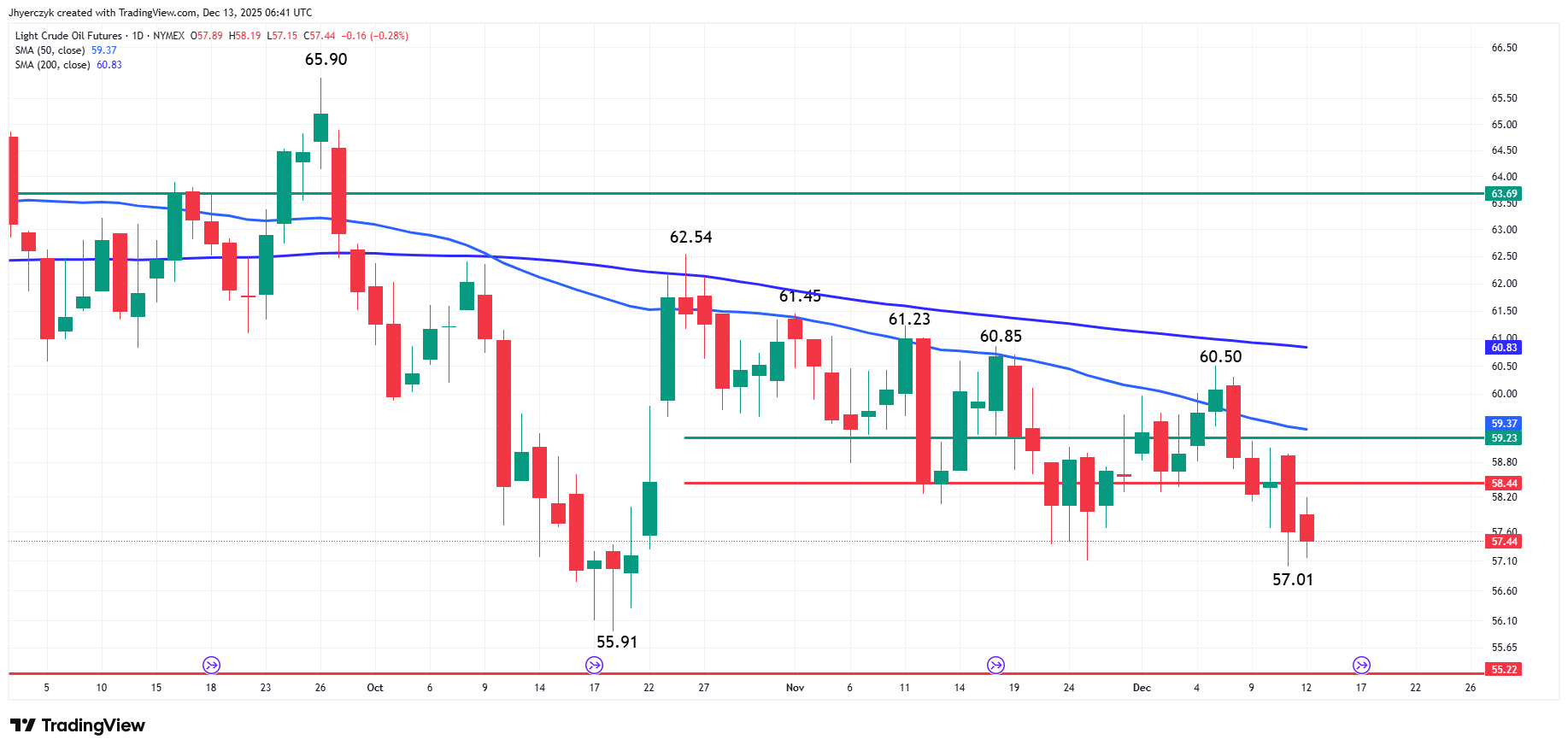
From a trading perspective, Friday’s close leaves WTI vulnerable early next week. The market is now positioned to test this week’s low at $57.01. The daily chart shows little structural support below that level until $55.91.
On the upside, resistance remains well-defined. Sellers are likely to defend the Fibonacci retracement at $58.44, followed by the 50% retracement at $59.23 and the 50-day moving average at $59.37. Long-side interest is unlikely to improve unless price can hold above the 50-day moving average.
Market Forecast: Bearish Bias Holds Near Term
The short-term outlook remains bearish. Oversupply expectations, reinforced by IEA data and weak reactions to geopolitical risk, continue to cap rallies. Until buyers can reclaim key resistance levels, oil prices are likely to remain under pressure, with sellers maintaining control into the early part of next week.
More Information in our Economic Calendar.


