



Oil Slides Below Key Fibonacci Levels as Geopolitical Focus Re-Centers on Ukraine Talks
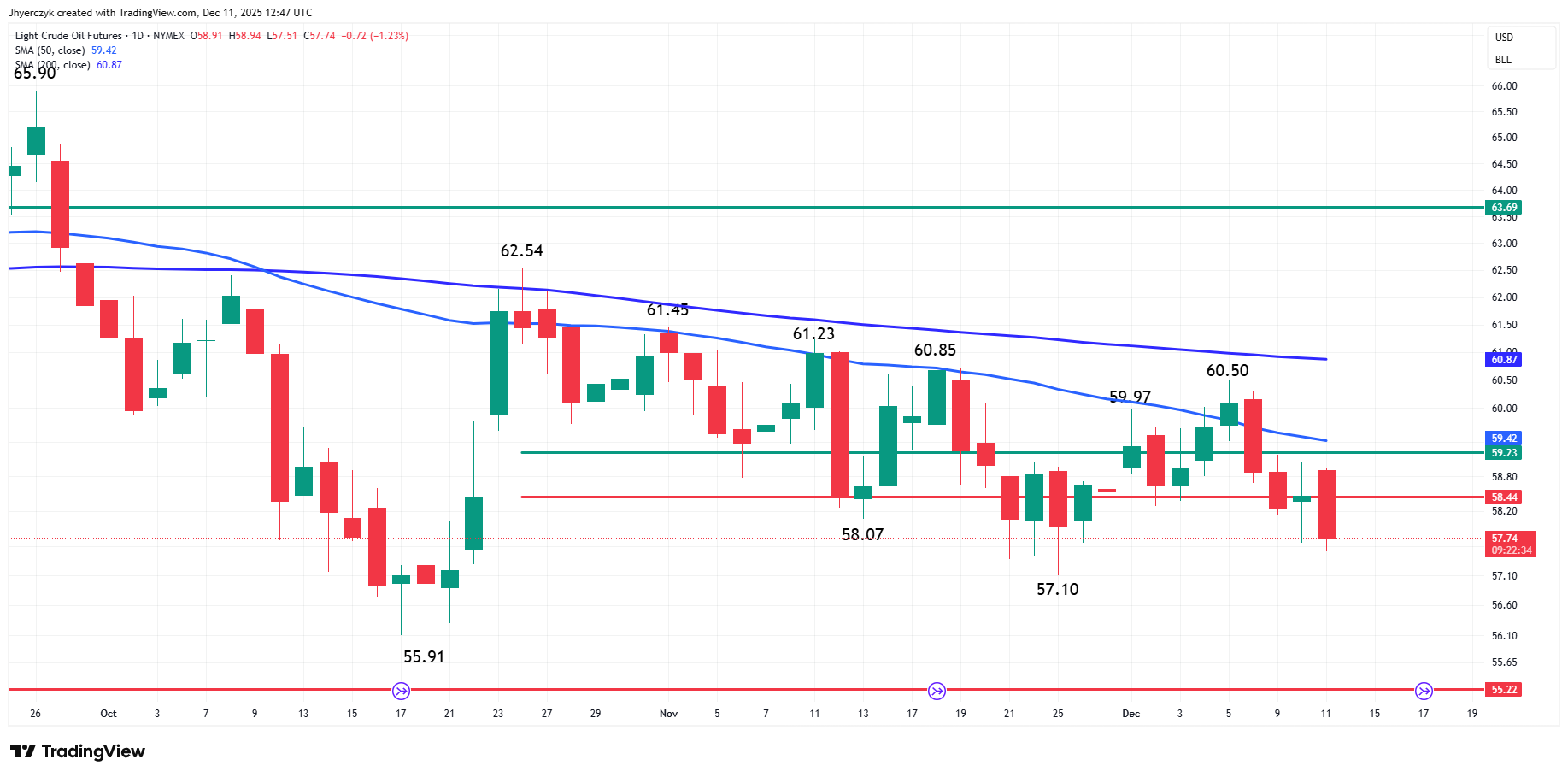
Light crude oil futures extended losses on Thursday, breaking below the 61.8% level at $58.44, which now acts as resistance. Prices also face overhead pressure at the 50% level at $59.23, while the 50-day moving average at $59.43 remains the most important resistance and short-term trend indicator for traders.
The continued downside momentum has heightened expectations of a test of the November 25 main bottom at $57.10, with a drop through that mark exposing the October 20 main bottom at $55.91.
At 12:44 GMT, Light Crude Oil Futures are trading $57.75, down $0.71 or -1.21%.
Geopolitical Pressures Reassert Control on Crude Oil News Today
Oil prices eased as attention shifted back to ongoing Russia-Ukraine peace negotiations. Comments from Russian Foreign Minister Sergei Lavrov suggested improved communication following a visit by U.S. envoy Steve Witkoff, with Moscow formally submitting new security proposals to Washington. Traders viewed the remarks as a temporary de-escalation driver, weighing on the latest oil prices forecast.
The retracement comes after both Brent and WTI settled higher the previous day, supported by supply concerns tied to a U.S. seizure of a sanctioned tanker off Venezuela. While the event briefly lifted market sentiment, analysts cautioned that the impact has yet to materialize in flows. According to LSEG’s Emril Jamil, any further escalation tied to the seizure could inject substantial volatility into crude benchmarks.
Market Reaction to Tanker Seizure and Shifting Trade Flows
U.S. President Donald Trump confirmed the operation, though officials withheld the vessel’s name. Maritime intelligence firm Vanguard identified the tanker as the Skipper. Industry sources said Asian refiners are demanding steep discounts on Venezuelan grades, pressured by heavy volumes of sanctioned Russian and Iranian crude and rising logistical risks as U.S. military activity increases in the Caribbean.
Ukraine Conflict Developments Add New Supply Concerns
Investor focus intensified after Ukrainian drones struck a Russian-operated oil rig in the Caspian Sea, halting production. The incident introduced a new geopolitical risk that traders must incorporate into their oil prices projections. Western leaders held fresh discussions with Washington to advance a resolution to the conflict, describing the talks as a pivotal moment.
Brent Oil Price Forecast
Every new Brent Oil analysis as it publishes, today's technical signal and key levels, live price — on one page.
See all Brent Oil forecastsDemand Outlook Improves as the Fed Cuts Rates
The International Energy Agency (IEA) upgraded its 2026 global demand growth estimate while trimming supply expectations in its latest monthly report—signals that point toward a slightly tighter market balance next year. A divided Federal Reserve added another boost by cutting its benchmark interest rate, lowering borrowing costs and supporting consumption-linked oil demand.
Short-Term Market Forecast: Bearish Bias Holds
With WTI trading below the 61.8% level and capped by the 50-day moving average, technical pressure favors further downside. Unless buyers defend the November 25 main bottom at $57.10, the market risks extending toward the October 20 main bottom at $55.91. The forecast remains bearish in the near term.
More Information in our Economic Calendar.