



Trump’s Iran Threats Fail to Lift Oil Markets Early Monday
Light crude oil futures are edging lower early Monday, suggesting traders aren’t yet pricing in the breaking story from over the weekend that President Trump is considering military action in Iran. Trump first mentioned the idea on Friday when he warned that if the Iranian government began “killing people like they have in the past, we would get involved.”
“We’ll be hitting them very hard where it hurts,” he said at the White House. “And that doesn’t mean boots on the ground, but it means hitting them very, very hard where it hurts.”
Last week, Light crude oil futuresLight crude oil futures settled at $59.12, up $1.80 or +3.14%.
Military Options Against Iran Under Review
These comments were on Friday. Fast-forward to Sunday and we learned that Trump has been briefed on a number of options against Iran, according to a military spokesperson.
It’s definitely the story to monitor this week since it involves oil, China, and Russia, both major allies of Iran.
Technical Analysis: Support Base Forms Amid Downtrend
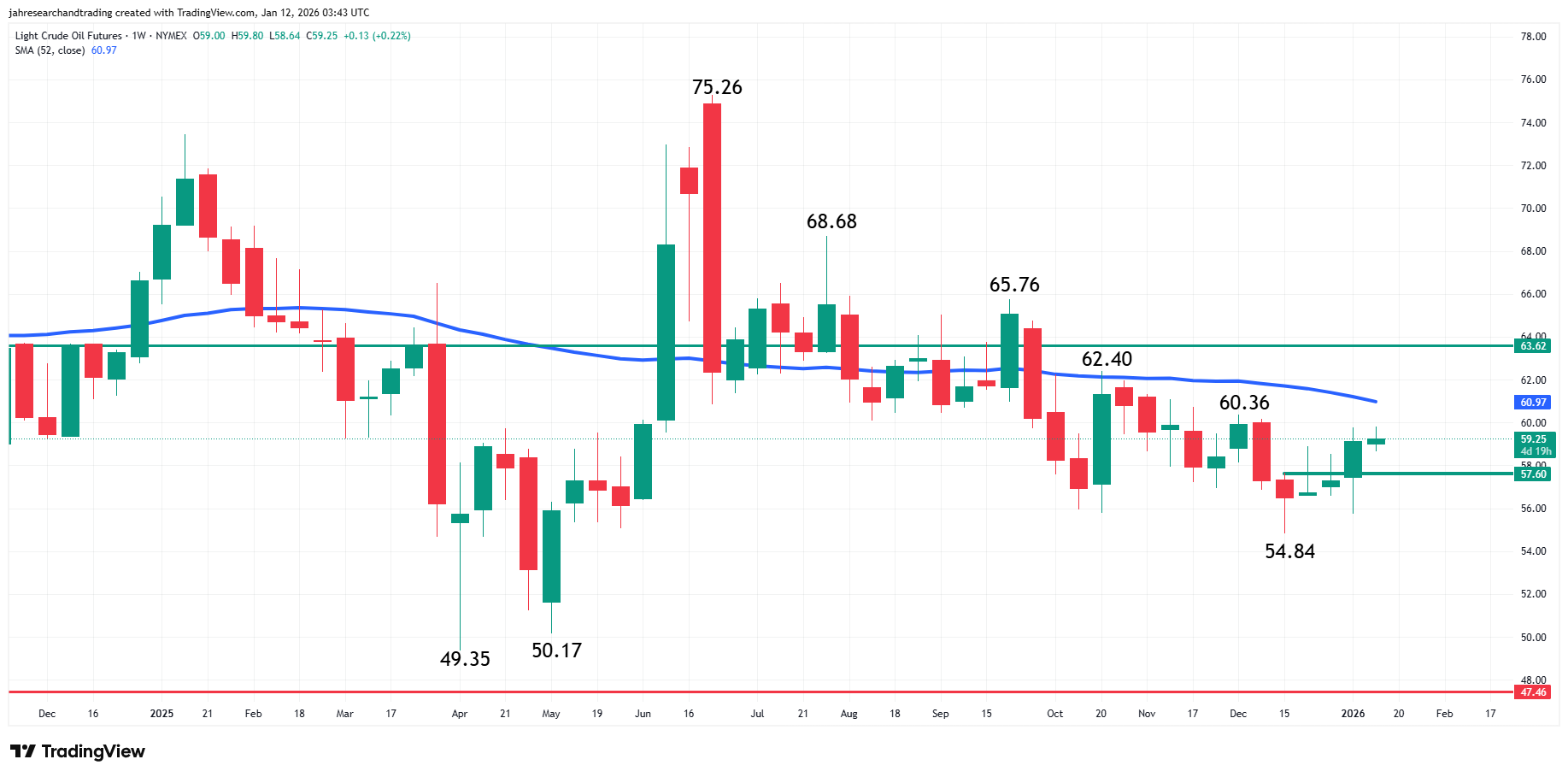
Technically speaking, on the weekly chart, the trend is down, but the market has been forming a support base, highlighted by three consecutive weekly higher closes and two closes over a short-term pivot at $57.60.
Taking out the minor top at $60.36 will shift momentum to the upside, while a move through $62.40 changes the main trend to up on the weekly chart. A breakdown below $54.84 will reaffirm the downtrend, with $50.17 to $49.35 the next likely targets.
Brent Oil Price Forecast
Every new Brent Oil analysis as it publishes, today's technical signal and key levels, live price — on one page.
See all Brent Oil forecasts52-Week Moving Average Remains Key Resistance
The major trend indicator in my opinion is the 52-week moving average at $60.97. It’s been capping gains since late September. If there is a strong fundamental catalyst such as military action in Iran, then buyers could trigger a breakout through this indicator, with a long-term pivot at $63.62 the next major target. This is another potential trigger point for an acceleration to the upside.
Venezuela Capture Fails to Spark Rally
To recap, the single biggest story last week was President Trump’s military operation that resulted in the capture of Venezuelan President Nicolás Maduro on Saturday, January 3. After the Maduro arrest, Trump announced the U.S. would “run the country” during a transition period and invited American oil companies to invest billions to rebuild Venezuela’s infrastructure. This story is likely to continue to build over the near-term until there is stabilization in the region and U.S. oil companies decide when and how to spend billions.
Supply Concerns Trump Geopolitical Risk—For Now
Despite the aggressive move by the United States, it failed to move oil prices above any major thresholds as traders continued to worry about oversupply. But if a real supply disruption develops in the Middle East over Iran, then we should see prices skyrocket, likely beginning with a breakout above the 52-week moving average.
More Information in our Economic Calendar.