



Crude Oil Slips as Traders Lean Lower — But Key Levels Still in Play
Light crude futures are a touch softer early Monday, and the market is telling you all you need to know: two straight inside sessions and a market that can’t quite pick a direction. Traders are leaning lower, though, with last week’s floor at $57.01 now exposed. A clean break there opens the door to the October 20 main bottom at $55.91 — and that’s where the real test of conviction sits.
At 11:44 GMT, Light Crude Oil Futures are trading $57.22, down $0.22 or -0.38%.
Crude Oil News Today: Supply Fears Collide With Surplus Worries
Fundamentally, the market is caught between competing narratives. On one side, Venezuelan supply risk is keeping a bid under the complex. Fresh U.S. sanctions, tanker seizures, and talk of further interceptions have sharply reduced Venezuela’s export flow. Traders aren’t dismissing it — disruptions like this tend to ripple through physical markets quickly.
At the same time, a possible Russia-Ukraine peace path adds uncertainty in the other direction. If negotiations gain real traction, the market will start gaming out how much sanctioned Russian supply could eventually return. For now, it’s more of a headline watch than a price driver, but the risk is on the table.
Oil Prices Forecast: Market Hesitates as Surplus Outlook Lingers
The bigger weight is the medium-term surplus story. JPMorgan flagged widening global oversupply through 2026 and 2027, with supply growth running roughly triple demand growth. That’s the kind of backdrop that keeps sellers pressing on rallies — and explains why both Brent and WTI dropped more than 4% last week. Traders aren’t willing to chase strength when the forward balance looks this heavy.
Still, Venezuelan tensions are preventing a deeper slide. As one analyst put it, prices probably would’ve traded lower last week if not for the geopolitical squeeze. Buyers are stepping in — just lightly — whenever headlines hint at further disruptions.
Brent Oil Price Forecast
Every new Brent Oil analysis as it publishes, today's technical signal and key levels, live price — on one page.
See all Brent Oil forecastsOil Prices Projections: Technical Ceilings Still Keeping Bulls Honest
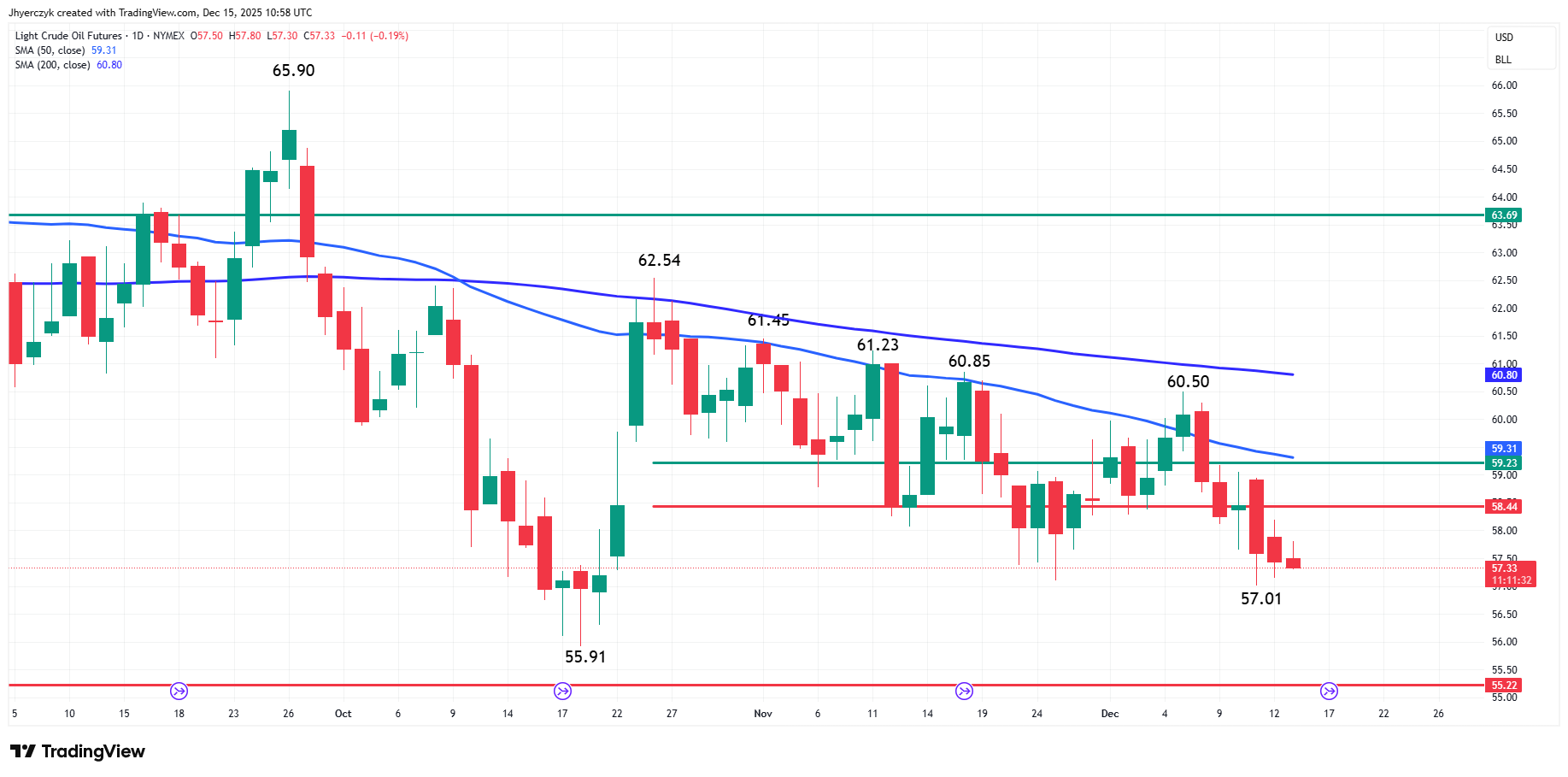
Technically, the market is boxed in. The Fibonacci level at $58.44 is the first hurdle, and unless buyers can reclaim it, momentum stays with the sellers. Even if crude manages a bounce, it runs straight into two bigger ceilings: the 50% retracement at $59.23 and the 50-day moving average at $59.31. That 50-day moving average is the level that matters — it’s the trend signal, the obstacle, and the trigger for any upside acceleration if it finally gives.
For now, the market isn’t treating those levels as invitations. More like warning signs.
Bottom Line: Bias Tilts Bearish Unless Crude Reclaims the 50-Day
The market feels hesitant, but the weight is still to the downside. A break of $57.01 would likely draw out more sellers and put $55.91 into play. Bulls need a move back above the 50-day moving average to flip sentiment. Until then, rallies look like selling opportunities in a market wrestling with surplus expectations and headline-driven supply risk.
More Information in our Economic Calendar.