



WTI Crude Oil Drifts Lower in Holiday Trade, Tests Key Support Zone
U.S. WTI crude oil futures are drifting lower in Monday’s holiday trade. The market is currently testing a key retracement zone, while holding above moving average support. The market is also being capped by a longer-term retracement zone and another moving average, giving it the appearance of a rangebound trade. A supply disruption premium is helping to put a floor under the market, while the ongoing supply glut is capping gains.
At 12:25 GMT, March WTI crude oil futures are trading $58.89, down $0.45 or -0.76%.
Iran Supply Disruption Risk Diminishes as Civil Unrest Subsides
While the supply disruption risk still exists, Reuters is reporting that other analysts believe it could be weakening “as civil unrest in Iran subsided, lowering the chance of a U.S. attack that could disrupt supply from the major Middle Eastern producer.” Nonetheless, the area remains a hotbed that could reignite at any time, making it something to keep an eye on.
Greenland Tariff Threats Spark Trade War Fears, Weigh on Demand
The major event over the weekend that could be exerting the most pressure on oil prices today is the risk-off trade fueled by a possible trade war between the U.S. and Europe. On Saturday, President Trump threatened European nations who opposed his potential purchase of Greenland with 25% tariffs, starting February 1. This was met with severe opposition by the European Union (EU), opening the door to a potential trade war.
The impact of a trade war would be devastating to both the U.S. and European economies since it would likely lead to slower growth and consequently lower demand for crude oil.
Russian Infrastructure Risk and Venezuela Timeline Provide Support
Helping to provide some support for the market today is the risk of damage to Russian infrastructure and distillate supplies. Traders are also downplaying the potentially bearish impact of new oil from Venezuela. Initially, the market thought a ramped up Venezuelan oil industry would add to the global supply glut, but it now looks as if it is going to take more time and money to get facilities up to speed.
Brent Oil Price Forecast
Every new Brent Oil analysis as it publishes, today's technical signal and key levels, live price — on one page.
See all Brent Oil forecastsTechnical Outlook Points to Continued Range-Bound Trade
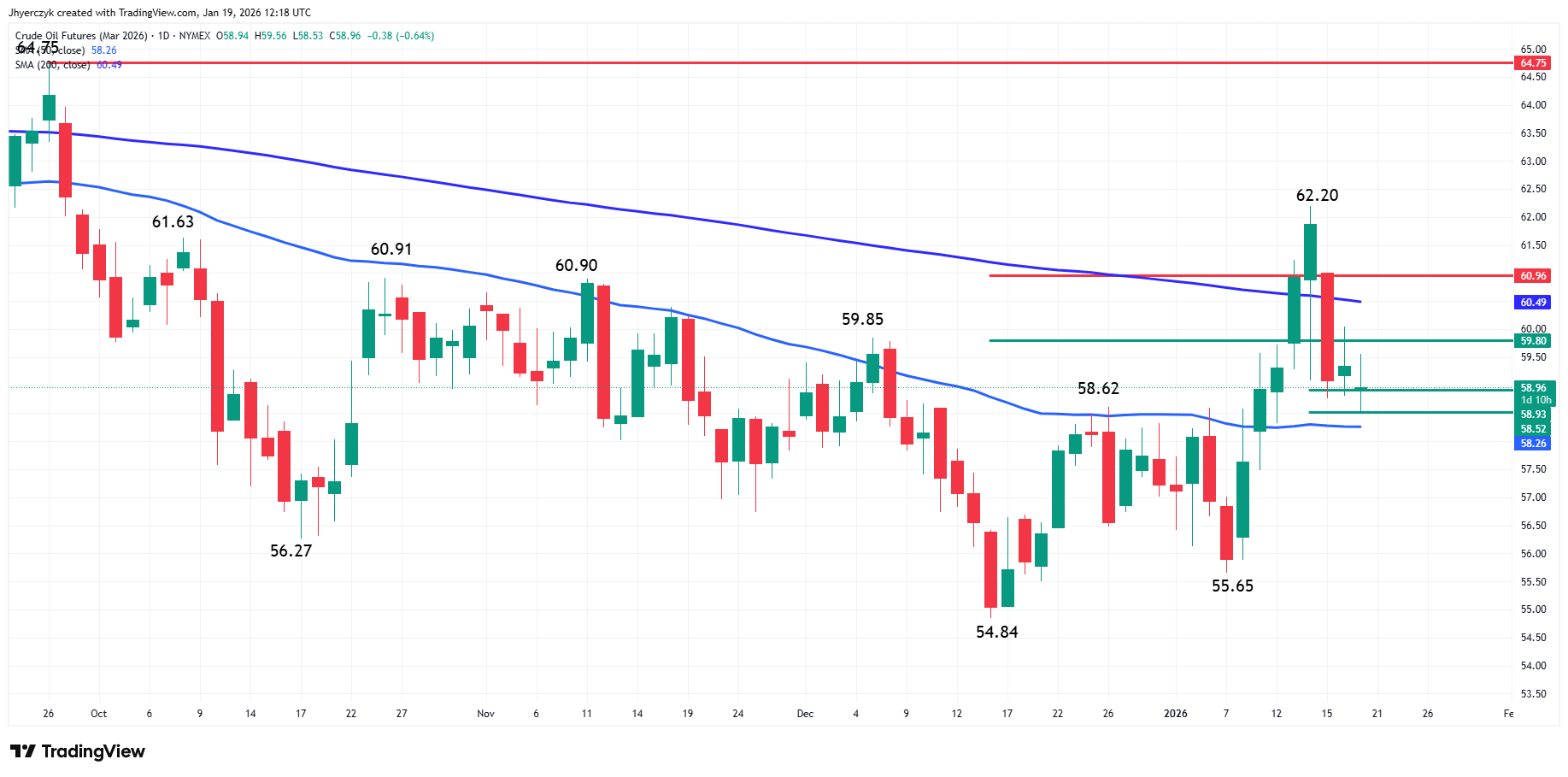
Technically, the trend is up, but momentum is down. This is leading to a sideways forecast, especially with traders finding support inside a pair of 50% levels at $58.93 and $58.52 as well as holding above the 50-day moving average at $58.26.
On the upside, near term resistance is the retracement zone at $59.80 to $60.96 combined with the 200-day moving average at $60.49.
We’re going to maintain our call for a rangebound trade unless there is a sustained move under the 50-day moving average or over the 200-day moving average.
More Information in our Economic Calendar.