



Crude Oil Prices Hold Steady as Markets Enter 2026
Light crude oil futures are nearly flat on Friday, the first day of the new year. We’re not expecting much movement today with the major players likely extending the holiday break into the weekend. After the December 16 to December 26 range of $54.84 to $58.88 was formed, the market has settled into a trading range. Light-volume, end-of-the-year position-squaring and the lack of fresh news have contributed to the rangebound trade. The good thing is that out of a tight trading range, volatility usually emerges.
At 11:37 GMT, Light Crude Oil Futures are trading at $57.36, down $0.06 or -0.10%.
Oil Price Forecast: Key Technical Levels to Watch
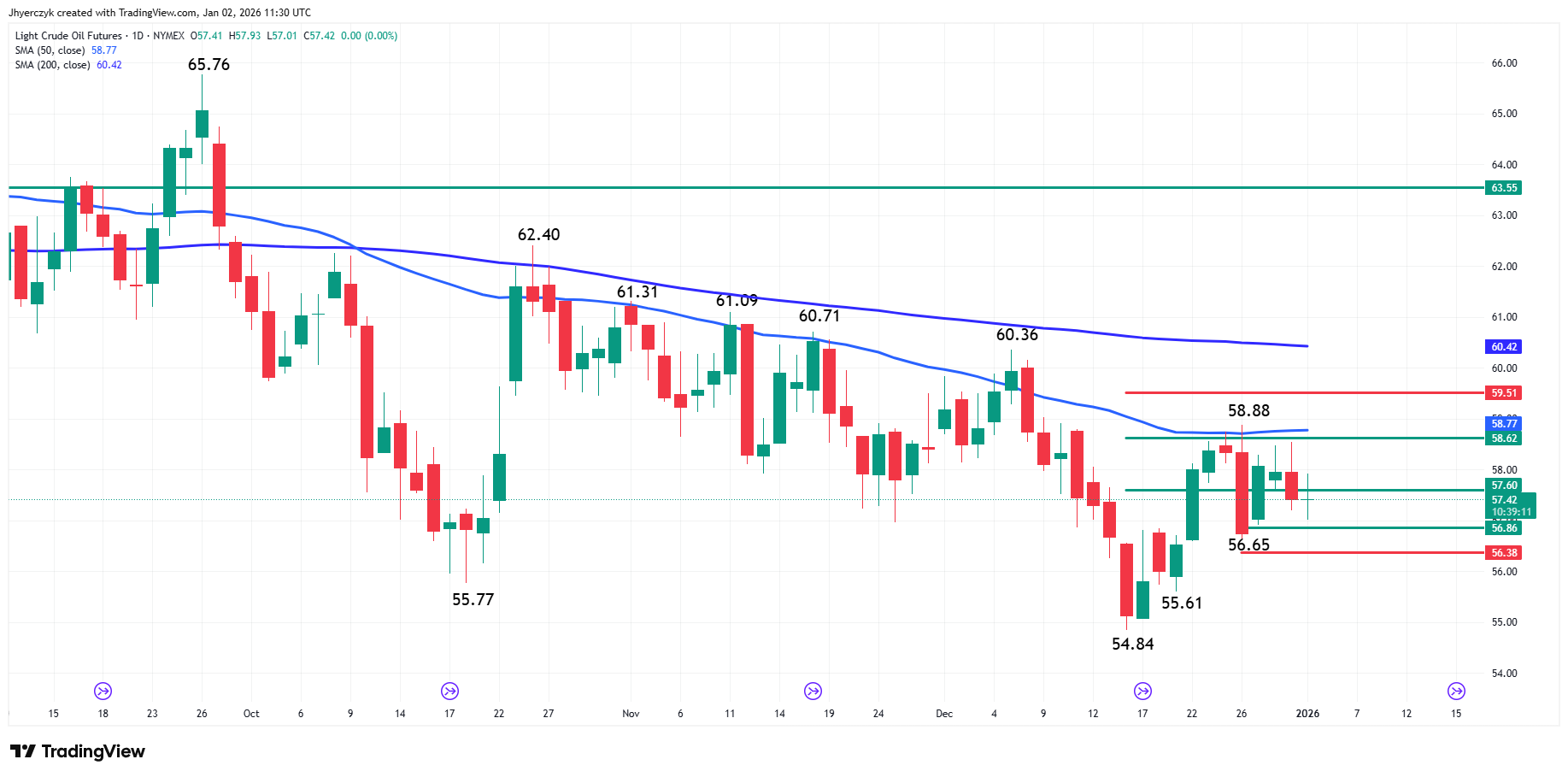
Technically, the main trend is down according to the daily swing chart, but momentum is trending higher. A trade through $58.88 will change the main trend to up. Taking out $56.65 will shift momentum to the downside.
The market is currently straddling a 50% level at $57.60. Reaction to this indicator will set the tone into the close.
Bullish Oil Scenario: Path to $58.77 Resistance
A sustained move over $57.60 will indicate the presence of intraday buyers. Strengthening upside pressure could drive light crude oil futures into another 50% level at $58.62 and the 50-day moving average at $58.77, which is actually the long-term trend indicator.
Bearish Oil Scenario: Risk of Drop to $54.84
The failure to overcome $57.60 will signal the presence of sellers. This could drive the market into the minor retracement zone at $56.86 to $56.38. If counter-trend buyers don’t show up to support the market in this area, prices could collapse under $56.38, putting $55.61 and $54.84 back on the radar.
Brent Oil Price Forecast
Every new Brent Oil analysis as it publishes, today's technical signal and key levels, live price — on one page.
See all Brent Oil forecastsWhat’s Driving Oil Prices? Oversupply vs. Geopolitical Risk
Fundamentally, gains are being capped by oversupply worries, but the market is getting a little support from geopolitical risks tied to the ongoing war between Russia and Ukraine. The seizure of Venezuelan tankers by the U.S. is raising red flags over the country’s exports.
Russia-Ukraine War Threatens Global Oil Supply
Despite the efforts of President Trump, the war between Russia and Ukraine appears to be escalating, with Kyiv intensifying attacks against Russian energy infrastructure in recent months. The goal is to hurt Russia’s means of financing the war. Ukraine is hoping these strikes, combined with sanctions, could bring Russia to the negotiating table.
U.S. Sanctions Target Venezuela Oil Exports
Meanwhile, the Trump administration continues to find ways to pressure Venezuelan President Maduro to leave office. These efforts include sanctions and the seizing of oil tankers.
Middle East Tensions: Saudi Arabia and UAE Clash Over Yemen
Traders now have their eyes on escalating tensions between OPEC producers, Saudi Arabia and the United Arab Emirates, over Yemen.
OPEC+ Meeting January 4: Production Cuts Expected to Continue
In other news, OPEC+ is scheduled to convene on January 4. It is widely expected to continue to pause on output increases in the first quarter.
Oil Market Outlook: Light Volume Expected Ahead of Weekend
Ahead of the weekend, we’re expecting volume to remain light and the price action choppy as traders continue to weigh geopolitical risks against the supply glut. Bullish traders are betting on the geopolitical risks to trigger supply disruptions, while bearish traders are siding with oversupply to drive prices lower.
More Information in our Economic Calendar.