



Crude Futures Retreat After Early Morning Strength
Light crude oil futures are edging lower on Monday after giving back earlier gains. Shortly after the opening at $61.22, the market jumped to $61.71, falling short of the two-week high at $62.20 before retreating into a Fibonacci level at $60.96.
At 10:57 GMT, March WTI Crude Oil futures are trading $61.18, up $0.11 or -0.18%.

Technical Outlook: Key Support and Resistance Levels
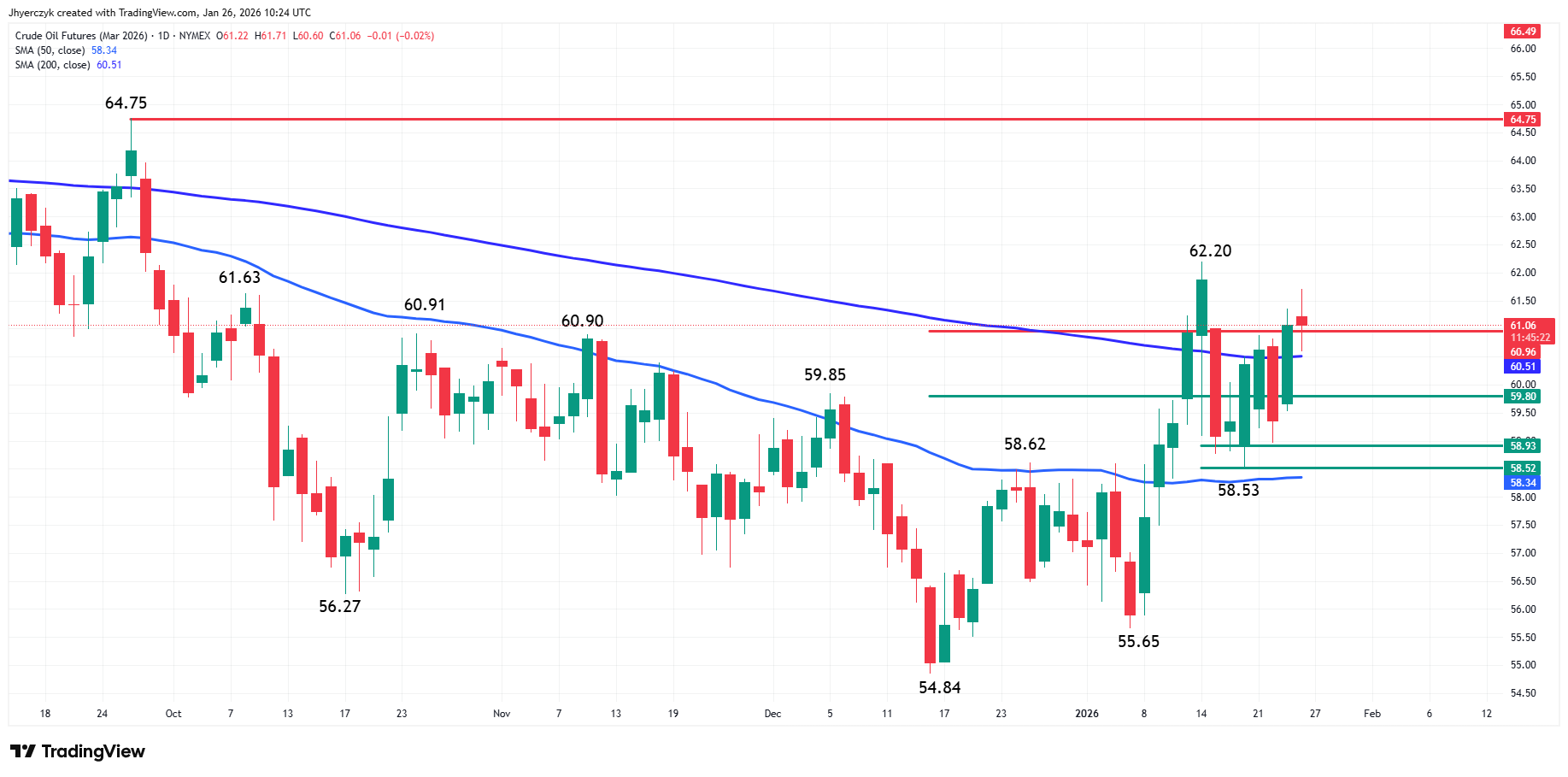
The key support today is the 200-day moving average at $60.51. If it fails to hold then buyers will have another opportunity to re-enter at 50% levels at $59.80, $58.93 and $58.52. This entire support base is being propped up by the 50-day moving average at $58.34.
With the main trend up according to both the swing chart and the moving averages, the market is currently in “buy the dip” mode.
On the upside, if momentum continues to build above the 200-day moving average, then look for a run into the main top at $62.20. This is a potential trigger point for an acceleration into the September 26 main top at $64.75.
Weather Disruptions and Geopolitical Tensions Drive Early Strength
Two of the drivers of the early session strength are the weather and the simmering tensions between the U.S. and Iran. Both drove the market higher on Friday ahead of the weekend and both are expected to continue to impact prices this week.
Brent Oil Price Forecast
Every new Brent Oil analysis as it publishes, today's technical signal and key levels, live price — on one page.
See all Brent Oil forecastsAs far as the weather is concerned, winter storm Fern is punishing a major portion of the United States from Texas to Maine, “forcing shut-ins in major crude and natural gas producing regions, and adding stress to the power grid,” said Prynka Sachdeva, senior market analyst at Phillip Nova. Prices are being underpinned because the outages are tightening physical flows.
Backing this claim is JPMorgan analysts who said in a note on Monday that about 250,000 barrels per day of crude production has been lost in the U.S. due to harsh weather, Reuters reported. This includes declines in the Bakken field in Oklahoma and parts of Texas.
U.S.-Iran Standoff Escalates Risk Premium
In addition to the weather, oil traders are also monitoring the situation between the U.S. and Iran, which is in danger of escalating the already strained geopolitical risks.
At this time, there is a risk of a sudden flareup in the region after President Trump said late last week the U.S. has an ‘armada” heading toward Iran but hoped he would not have to use it. On Friday, Iran responded by saying it would treat any attack “as an all-out war against us.”
The Weather-and-War Premium
Looking ahead, there is an upside bias today because of the weather and the potential for a supply-destroying war between the U.S. and Iran. Let’s just call it a weather and war premium.
The weather and war premium is providing a floor for prices, but we’ve seen very limited upside action because the weather situation will improve and production will begin again shortly, while there hasn’t even been a shot fired in this latest saber-rattling between the U.S. and Iran.
Obviously, the threats toward Iran are the most important development. Since the U.S. “armada” is expected to stay in the region, we’re likely to see the war premium remain over the near-to-intermediate terms.
More Information in our Economic Calendar.


