


Venezuela Crisis Puts Oil Markets on High Alert
Following the dramatic events over the weekend, the financial markets are likely to be glued to the crude oil market this week because the impact could influence inflation, industrial demand, and energy sector performance.
If you missed this weekend’s headlines, the United States arrested and removed Venezuelan President Nicolás Maduro from Caracas early Saturday. President Trump followed the move by announcing Washington would take control of the oil-producing nation.
Last week, Light Crude Oil Futures settled at $57.32, up $0.58 or +1.02%.
Critical Technical Levels: $61.40 and $63.62 in Focus
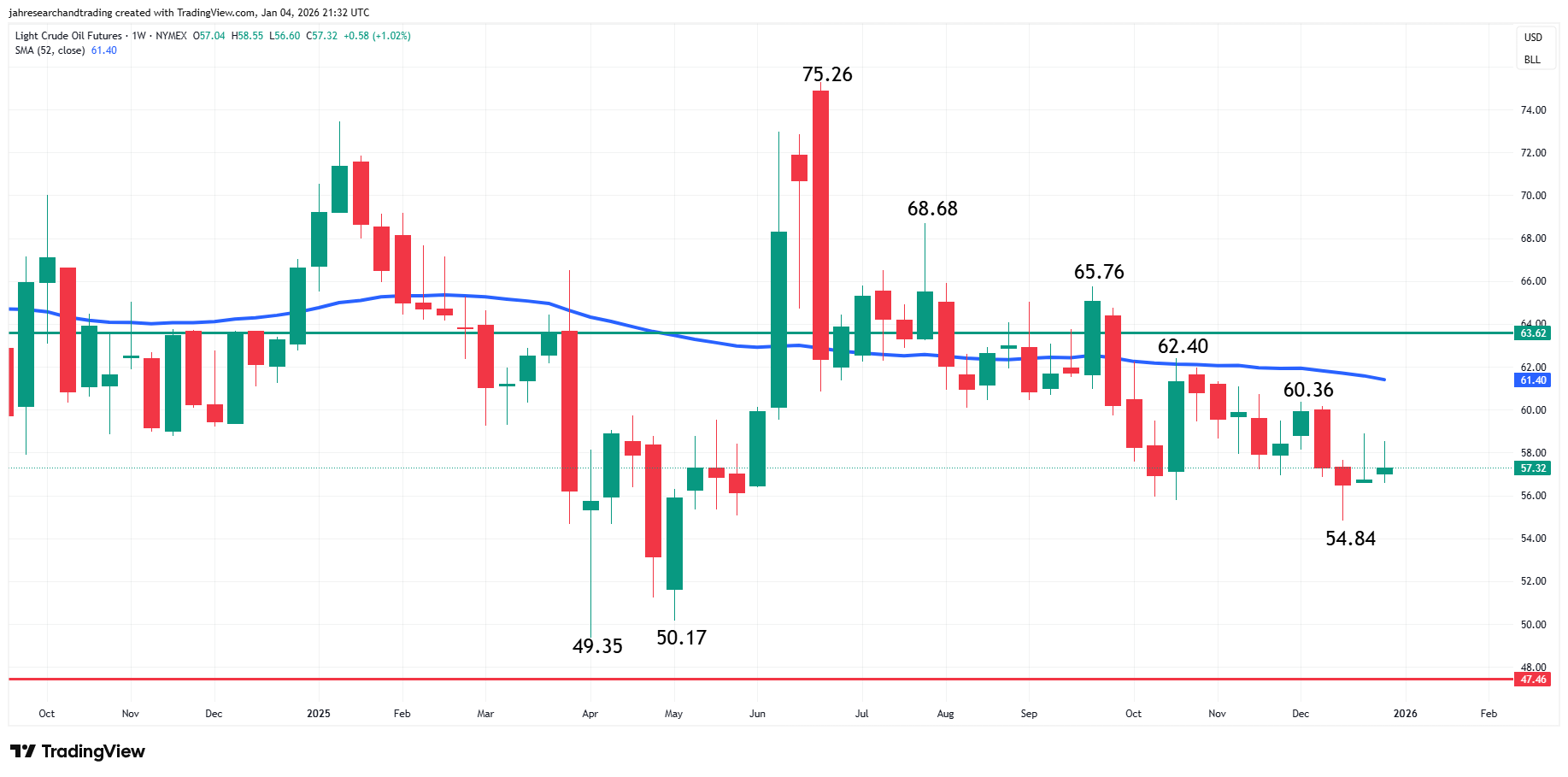
Technically, the key levels to watch will be the 52-week moving average at $61.40 and the long-term 50% level at $63.62. I’m convinced that trader reaction to the $61.40-$63.62 zone will set the near-term tone.
From what I’ve seen in the recent past (Russia’s attack on Ukraine in February 2022), traders are initially expected to focus on the supply side. If you recall, when the war started, prices shot up to over $120.00 a barrel before crashing. If they react the same way this time, they’ll push prices toward the 50-day moving average and the long-term pivot. But once the immediate supply concerns ease and Venezuela’s production situation stabilizes, prices will retreat.
Ample Supply Should Limit Long-Term Impact
There is plenty of oil supply, according to global reports, meaning any further disruption to Venezuelan exports would have little chance to impact prices over the long run. However, in the short run, traders tend to overreact at the very mention of supply disruption. Typically, short-sellers cover aggressively and speculative buyers chase the momentum. I expect to see a similar response this week.
In addition to the supply glut, the U.S. strike on Venezuela to arrest the president did not result in any damage to the country’s oil production and refining industry. That isn’t my assessment—those are words from two Reuters sources with knowledge of operations at state oil company PDVSA.
Brent Oil Price Forecast
Every new Brent Oil analysis as it publishes, today's technical signal and key levels, live price — on one page.
See all Brent Oil forecastsExpert Views: Short-Term Spike, But Supply Cushion Remains
Market experts echo this sentiment. Neil Shearing, group chief economist at Capital Economics, said, “In any case, any short-term disruption to Venezuelan output can easily be offset by increased production elsewhere. And any medium-term recovery in Venezuelan supply would be dwarfed by shifts among the many producers.”
Ole Hansen, head of commodities research at Saxo Bank, said, “Prices may see modest upside on heightened geopolitical tensions and disruption risks linked to Venezuela and Iran, but ample global supply should continue to cap those risks for now.”
Embargoed Oil Could Add Bearish Pressure
Another factor that I am watching that could actually drive prices lower is the oil that the U.S. military embargoed recently. What’s going to happen when they release the estimated millions of barrels captured by the U.S. and floating in tankers in Venezuelan waters?
Outlook: Medium-Term Bearish Despite Initial Volatility
Conditions could turn bullish at some time in the future if there is an actual supply disruption, or if other producers don’t pick up the slack, but my immediate assessment is medium-term bearish.
More Information in our Economic Calendar.