



Crude Sells Off Friday but the Weekly Rally Says More
Crude gave back ground Friday and nobody should be surprised. Brent ran from the mid-$80s to above $100 in five sessions and WTI went from $80 to above $92. That kind of move draws in late money and leaves the market stretched heading into a weekend where nobody knows if the next headline is a ceasefire or a wider war. Pakistan reportedly working with China to restart U.S.-Iran talks gave sellers the excuse they needed. The excuse is not the same as a solution.
September Brent crude futures settled at $96.78, down $3.01 or -3.88%. September WTI crude futures finished at $89.31, down $2.88 or -3.12%.
For the week, WTI gained 9.21% and Brent added 9.85%. That is the number that matters, not Friday’s pullback.
Diplomacy Knocked Crude Lower but the Strikes Continued
China has a direct interest in ending this fight because the Hormuz disruption is hurting Chinese energy security and trade flows. Pakistan is trying to broker something on China’s behalf. The market heard that and booked profits after a week where every session added to the premium.
The U.S. military completed a thirteenth consecutive night of strikes on Iranian targets the same day, hitting command centers, drone storage and maritime capabilities. The strait is technically open with U.S. naval support but the market is not trading “technically open.” It is trading vessels that need military escorts, insurance costs that keep climbing, cargoes rerouting around Africa and fewer ships willing to enter the region at all.
Trump’s Decision Hangs Over the Weekend
Trump said he is close to deciding on a massive attack against Iran. Rubio described the approach as a head for an eye. The Houthis struck two Saudi tankers near Bab el-Mandeb this week. Iran is still responding to every round of U.S. strikes. Friday’s pullback lowered the temperature but one tanker attack, one halt in Saudi Red Sea exports or one broader U.S. strike over the weekend and the premium is back Monday morning.
UBS Says Recovery Takes Longer Than the Market Expects
UBS does not see Middle East shipping recovering quickly even if the fighting eases. The process depends on more vessels entering the region and those flows are depressed. Saudi Arabia has spare production capacity but spare capacity sitting behind two impaired chokepoints is not the same as barrels reaching buyers. The Red Sea was the workaround when Hormuz went bad and that workaround took fire this week.
Brent Oil Price Forecast
Every new Brent Oil analysis as it publishes, today's technical signal and key levels, live price — on one page.
See all Brent Oil forecastsUBS has Brent at $85 by year-end if everything normalizes. Friday was not about year-end. Friday was about surviving the weekend after a 10% weekly rally with a president who has not decided whether to escalate or negotiate.
Daily September WTI Crude Oil Futures
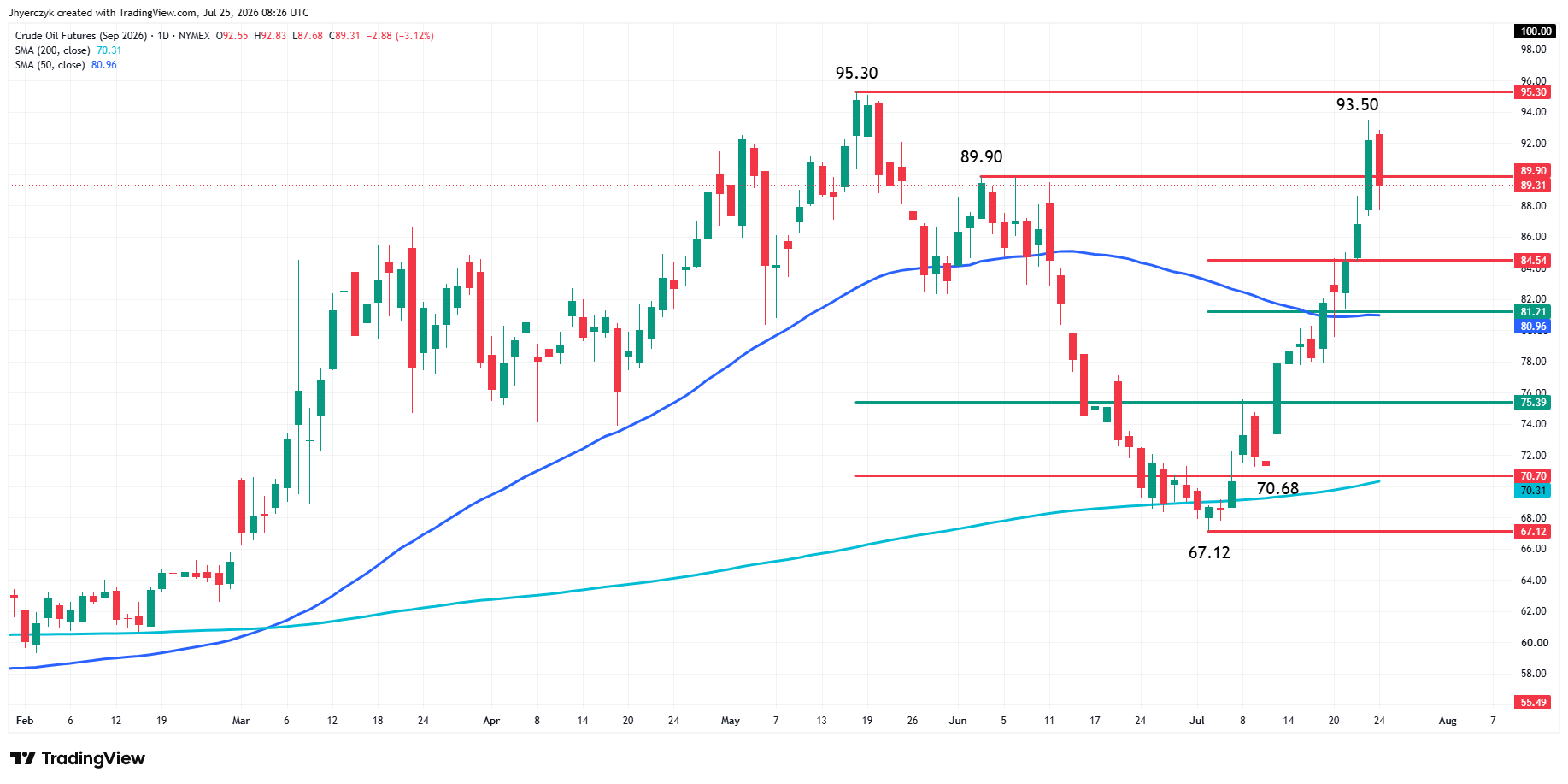
September WTI Crude Oil futures finished inside Thursday’s trading range, but below the previous main top at $89.90. This is the first sign of weakness because that top was the trigger point that launched the rally into $93.50 the previous session.
If the selling pressure continues, the U.S. crude oil benchmark could weaken further with the next target a short-term retracement zone at $84.54 to $81.21. The 50-day moving average at $80.96 would be the next target price. It is controlling the short-term trend.
On the upside, a trade through $93.50 will signal a resumption of the uptrend with the next potential breakout level at $95.30.
Daily September Brent Crude Oil Futures
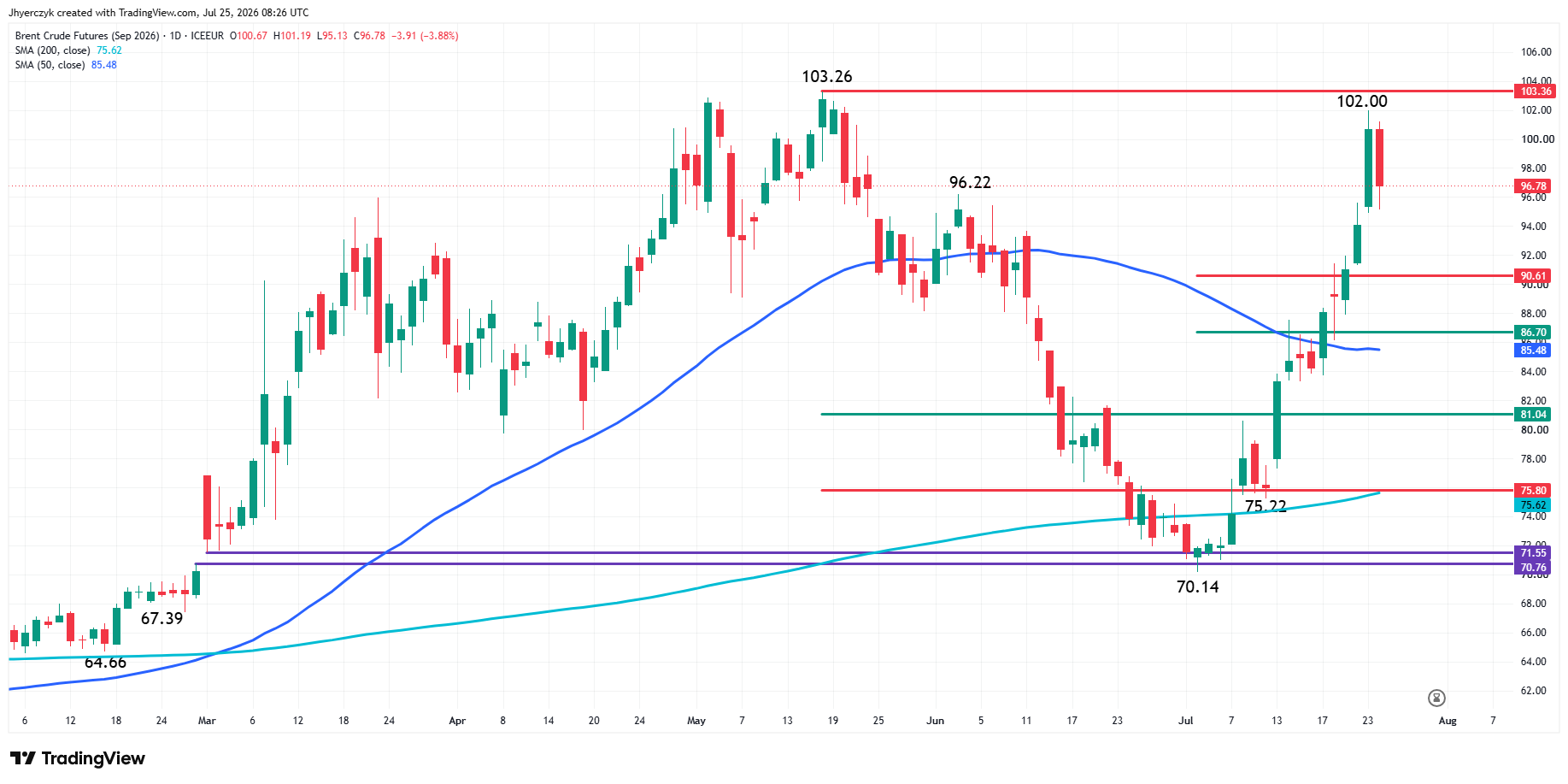
September Brent crude oil futures settled inside the previous days trading range on Friday, indicating investor indecision and impending volatility. The main trend is up. Taking out $102.00 then the May 18 main top at $103.26 will signal a resumption of the uptrend.
On the downside, a trade through $94.89 will be the first sign of weakness, but not a change in trend. If this move creates enough downside momentum then look for the selling to possibly extend into the intermediate retracement zone at $90.61 to $86.70. The major support and trend indicator is the 50-day moving average at $85.48.
What to Watch
Tanker traffic and military decisions are the signals, not the Friday close. Regular Hormuz transits, lower insurance costs and Saudi cargoes moving through the Red Sea without diversion would give sellers a real reason to press. None of those things happened this week. The market sold the diplomatic headline Friday but the war premium came out of positioning, not out of the supply picture. Both contracts still finished the week up roughly 10% and the route has to actually reopen before that premium leaves for good.
If you’d like to know more about how to trade crude oil, please visit our educational area.