


Oil prices have dropped sharply in 2025 and now trade near the $55 pivotal zone. This move mirrors past breakdowns and signals broader market weakness. In my view, this sets the stage for a deeper decline in 2026, with technical and macro drivers aligning for sustained pressure. This article presents the examination of the 2025 trend and the underlying macro, supply-demand, and technical factors to assess the next move in 2026.
Key Macro Forces Driving the Oil Market into 2026
U.S. Oil Production Peaks as Prices Face Downward Pressure
The U.S. Energy Information Administration (EIA) expects crude oil production to decline slightly in 2026. After years of consistent growth, output is projected to decrease from 13.6 million barrels per day in 2025 to 13.5 million barrels per day in 2026. This marks a turning point for U.S. producers, particularly after years of aggressive growth driven by shale and offshore projects.
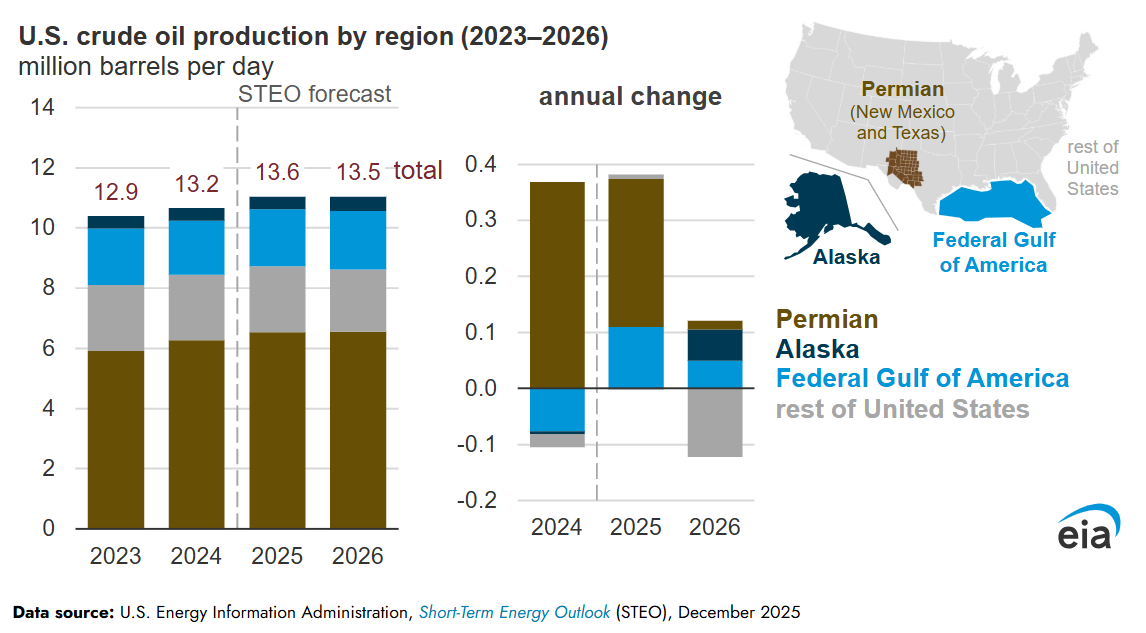
The slowdown stems from weaker growth in key regions and falling prices. The Permian Basin remains dominant, but it is no longer sufficient to sustain national expansion. Moreover, infrastructure limits and tighter capital discipline weigh on new investments.
Meanwhile, older basins, such as the Eagle Ford and Bakken, continue to decline due to lower drilling activity and natural depletion. Offshore gains from Alaska and the Gulf of Mexico remain modest and slow-moving, adding little support.
Brent Oil Price Forecast
Every new Brent Oil analysis as it publishes, today's technical signal and key levels, live price — on one page.
See all Brent Oil forecastsSupply-Demand Imbalance Caps Oil Price Potential in 2026
According to the EIA, WTI crude oil (CL) is expected to average $51 per barrel in 2026. Brent crude (BCO) is expected to follow closely. This forecast reflects a surplus environment where global inventories continue to build. As of late 2025, stockpiles already exceed the five-year average. With supply growing faster than demand, producers face tighter margins and falling cash flows.
In response, U.S. oil firms are shifting strategies. Instead of expanding output, many now focus on capital discipline and shareholder returns. Lower prices discourage investment in higher-cost regions, especially offshore and frontier shale. Meanwhile, global demand growth remains soft. Efficiency gains and slower transportation fuel usage dampen the outlook, even in recovering economies.
These forces combine to create a fragile setup. Any lack of coordination among producers could worsen the oversupply. At the same time, sustained underinvestment increases the risk of a future shortage. However, the oil market remains under pressure in 206 from rising inventories, flat U.S. production, and cautious spending behaviour across the industry.
Technical Breakdown Points to Further Oil Price Weakness
Bearish Formations Mirror the 2014–2016 Oil Collapse
The long-term outlook for the oil market remains bearish. The monthly chart below shows that oil broke the key $70 level in April 2025. While prices rebounded in May, June, and July, the rally failed to hold after August. Currently, oil trades near the pivotal $55 zone. A break below this level could trigger a deeper decline over the long term.
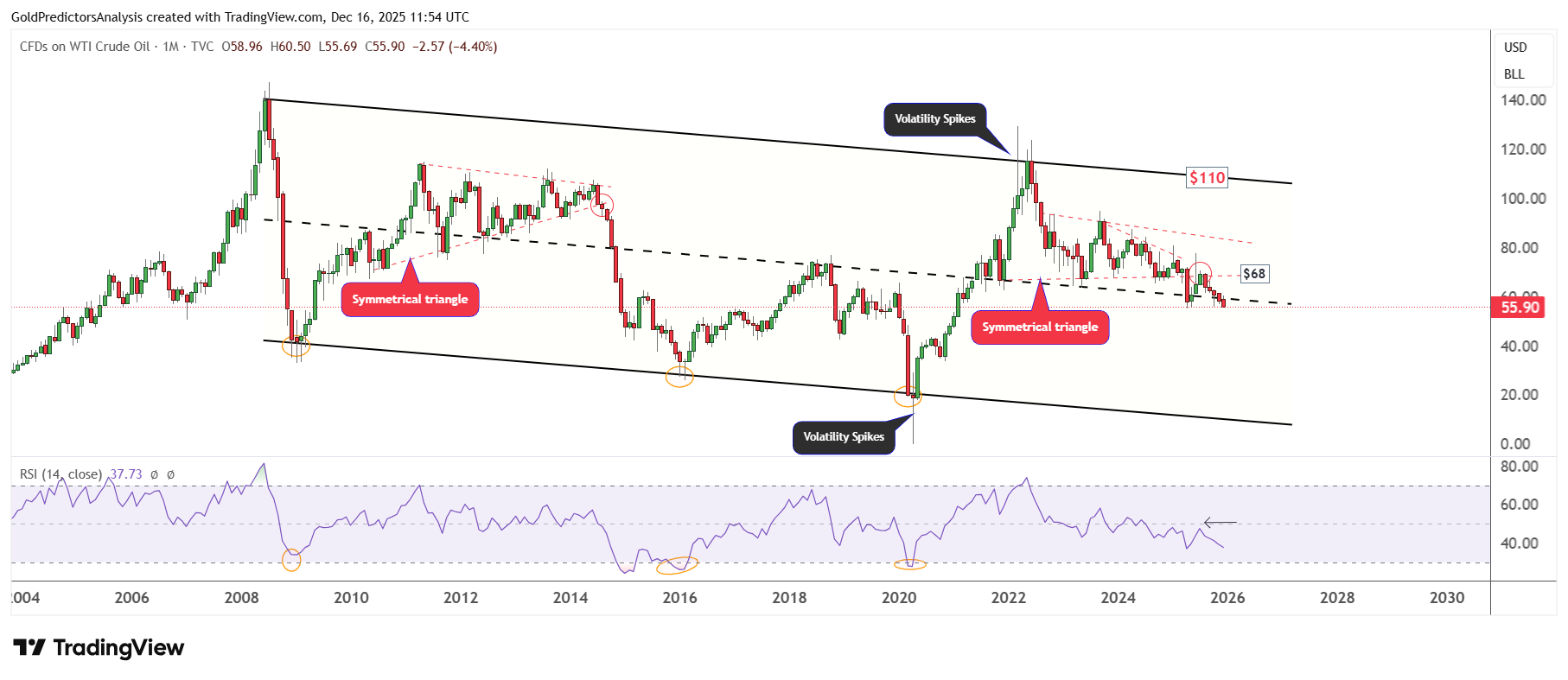
The chart also shows that oil trading has been within a descending channel since 2008. The price has also formed a symmetrical triangle pattern. This structure resembles the triangle formed between April 2011 and July 2014. When the symmetrical triangle was broken in July 2014, oil prices experienced a dramatic decline due to several global and market-specific factors.
OPEC, led by Saudi Arabia, chose not to cut production despite falling prices, aiming to protect market share against U.S. shale producers. At the same time, global demand weakened in China and emerging markets. The combination of rising supply and slowing demand created a sharp imbalance.
The key drivers of the 2014 drop in oil prices were:
- OPEC’s decision to maintain high output despite falling prices
- Rapid growth in U.S. shale oil production
- Sluggish global economic growth and weaker demand
- A strong U.S. dollar, which made oil more expensive globally
These pressures led to a steep drop from over $100 per barrel in mid-2014 to under $30 by early 2016. The crash triggered bankruptcies across the oil sector, forcing producers to cut costs and delay new projects.
The oil market has now broken similar technical formations seen in 2025 and is showing bearish pressure. Additionally, RSI continues to fall from its March 2022 peak and remains below the midline, confirming negative momentum. This technical setup points to a weakness in 2026.
Key Support Levels at Risk as Momentum Weakens
The weekly chart also shows that the oil price is now crossing the pivotal zone of $55. The price has been consolidating within this key area for several months. A triangle pattern is forming within the support zone, suggesting a possible downside breakout. The prices have remained under bearish pressure since Trump’s inauguration.
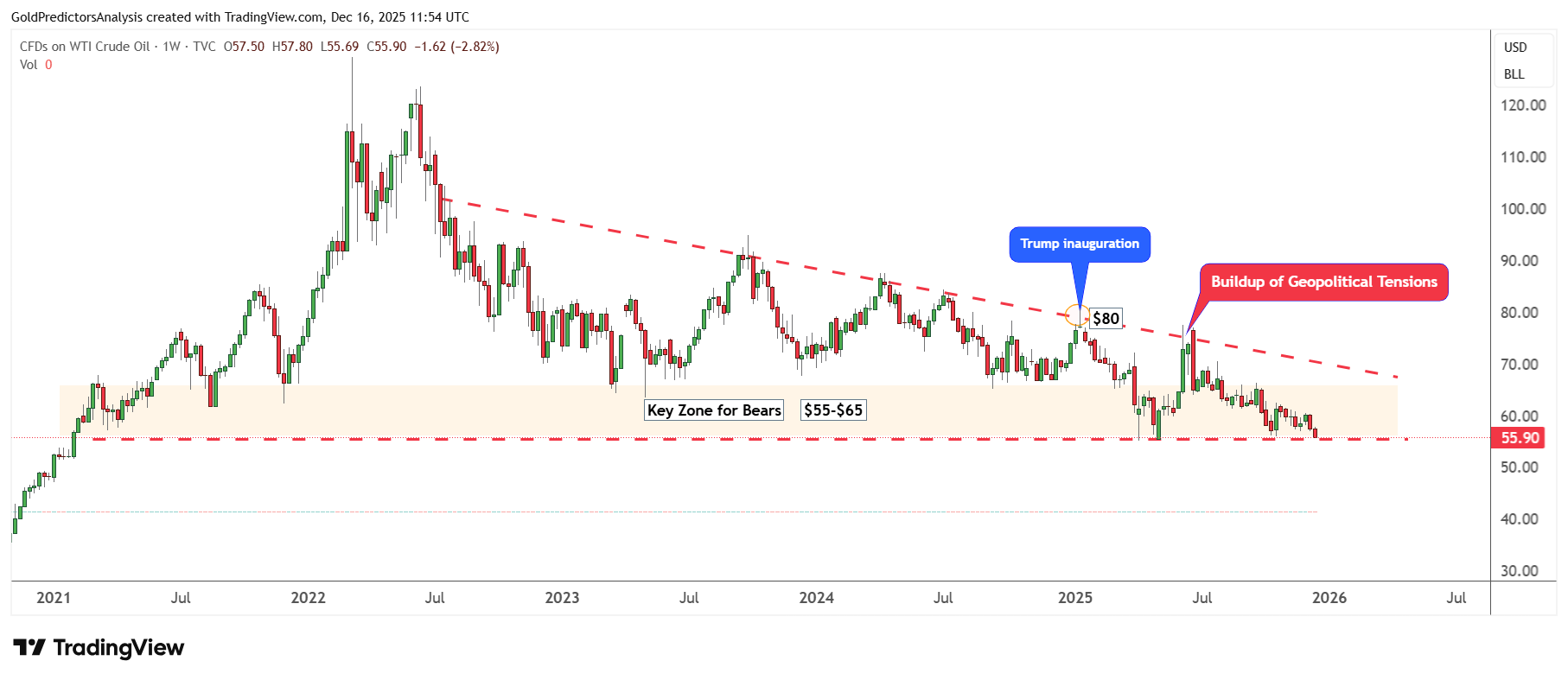
Moreover, the geopolitical tensions in 2025 have added to the bearish momentum. If oil breaks below the $55 level, it could trigger a sharp decline in prices. This level serves as both psychological and structural support, and a breach would confirm a new leg lower.
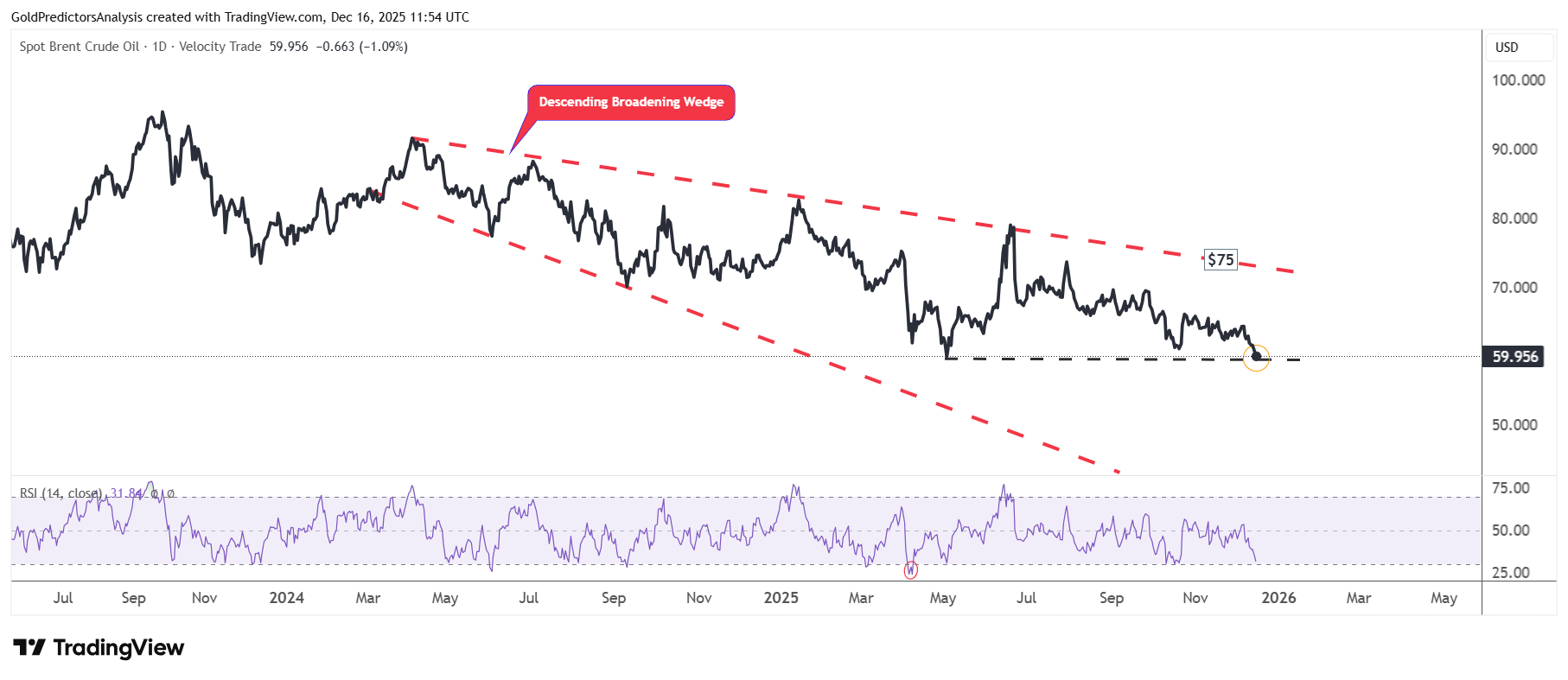
The Brent crude oil chart also shows negative price action, with prices trading within a descending broadening wedge pattern. This formation under sustained bearish pressure suggests that any downside move could be substantial. Brent is currently trading near the pivotal support zone around $59–$59.50. A decisive break below the $59.50 level would likely trigger a sharp decline in Brent prices.
Risk Factors That Could Alter the 2026 Oil Outlook
Several risks could disrupt the bearish outlook for oil in 2026. Geopolitical tensions remain the biggest wildcard. A significant supply shock in the Middle East, Russia, or Venezuela could send prices sharply higher. OPEC+ could also intervene with deeper cuts, especially if Saudi Arabia leads the move. A coordinated supply reduction would tighten the market and support a price rebound.
Moreover, the emerging markets may also surprise on the upside. A stronger recovery in China or India would lift demand and reduce excess inventories. Technical reversals pose another risk. If oil bounces decisively from the $50, momentum could shift and invalidate the bearish setup. A break above $80 in the WTI crude oil market will shift the bearish momentum. While these risks remain, none are currently strong enough to change the base case. The market still faces oversupply, soft demand, and weak price momentum heading into 2026.
In Closing
The oil market remains under bearish pressure as we move into 2026. Technical patterns confirm a breakdown, with momentum weakening below the $55 support zone. The structure closely resembles the 2014–2016 collapse, where prices fell sharply after forming a similar triangle pattern. This historical pattern, combined with persistent oversupply and soft demand, points to further downside risk.
Macro forces continue to exert a significant influence on the outlook. Sluggish global consumption, rising inventories, and cautious investment behaviour cap any recovery. While U.S. production may have peaked, it is not enough to support prices alone. In my view, the base case remains bearish, with WTI crude likely trending towards $50 in 2026. A break below $50 would confirm further downside and signal continued stress across the energy sector. A confirmed breakout above $80 in WTI would ease bearish pressure in the oil market.