
Highlights
- IEA forecasts 1.1M bpd oil demand increase in 2024.
- Federal Reserve’s dovish stance boosts oil prices.
- China’s demand trends impact global oil market.
Oil Prices Rebound
Oil prices have experienced a resurgence, marking their first weekly rise in two months. This uptick is primarily attributed to a favorable demand forecast from the International Energy Agency (IEA) for the upcoming year, coupled with a weakening dollar.

Central Banks’ Influence on the Market
Central banks, particularly the U.S. Federal Reserve, have significantly influenced this market shift. The Fed’s announcement of potential borrowing cost reductions next year has been a key driver. Jerome Powell, the Fed Chair, highlighted the end of the historic tightening of monetary policy, citing a faster-than-anticipated fall in inflation and the emerging discussion on borrowing cost cuts.
Federal Reserve’s Outlook Shift
The Federal Reserve’s stance has notably changed, with most policymakers now expecting lower rates by the end of 2024. This shift reflects a balance between the Fed’s dual mandate of stable prices and maximum employment. Despite high inflation rates last year, Powell expressed confidence in achieving a ‘soft landing’ for the economy, with inflation returning to the Fed’s 2% target without causing a significant economic downturn.
Dollar Weakness and Global Central Banks
The U.S. dollar fell to a four-month low following the Fed’s indication of an end to interest rate hikes, making dollar-denominated oil more affordable for international buyers. Contrasting this, the European Central Bank maintained its stance on high borrowing costs despite lower inflation expectations.
Global Oil Demand and China’s Influence
The IEA forecasts a rise in world oil consumption by 1.1 million barrels per day in 2024, a revision from its previous estimate. This is still significantly lower than OPEC’s projection of 2.25 million bpd growth. Additionally, China, as a major oil consumer, has influenced demand trends. Despite recent economic pressures, including reduced refinery runs and sluggish diesel consumption, there are signs of improvement in industrial output and retail sales, offering a glimmer of hope in the global oil market.
Short-Term Outlook: Bullish
In the short term, the market appears bullish, supported by the Fed’s dovish pivot, a weaker dollar, and gradual improvements in global demand, despite ongoing uncertainties in key economies like China.
Technical Analysis
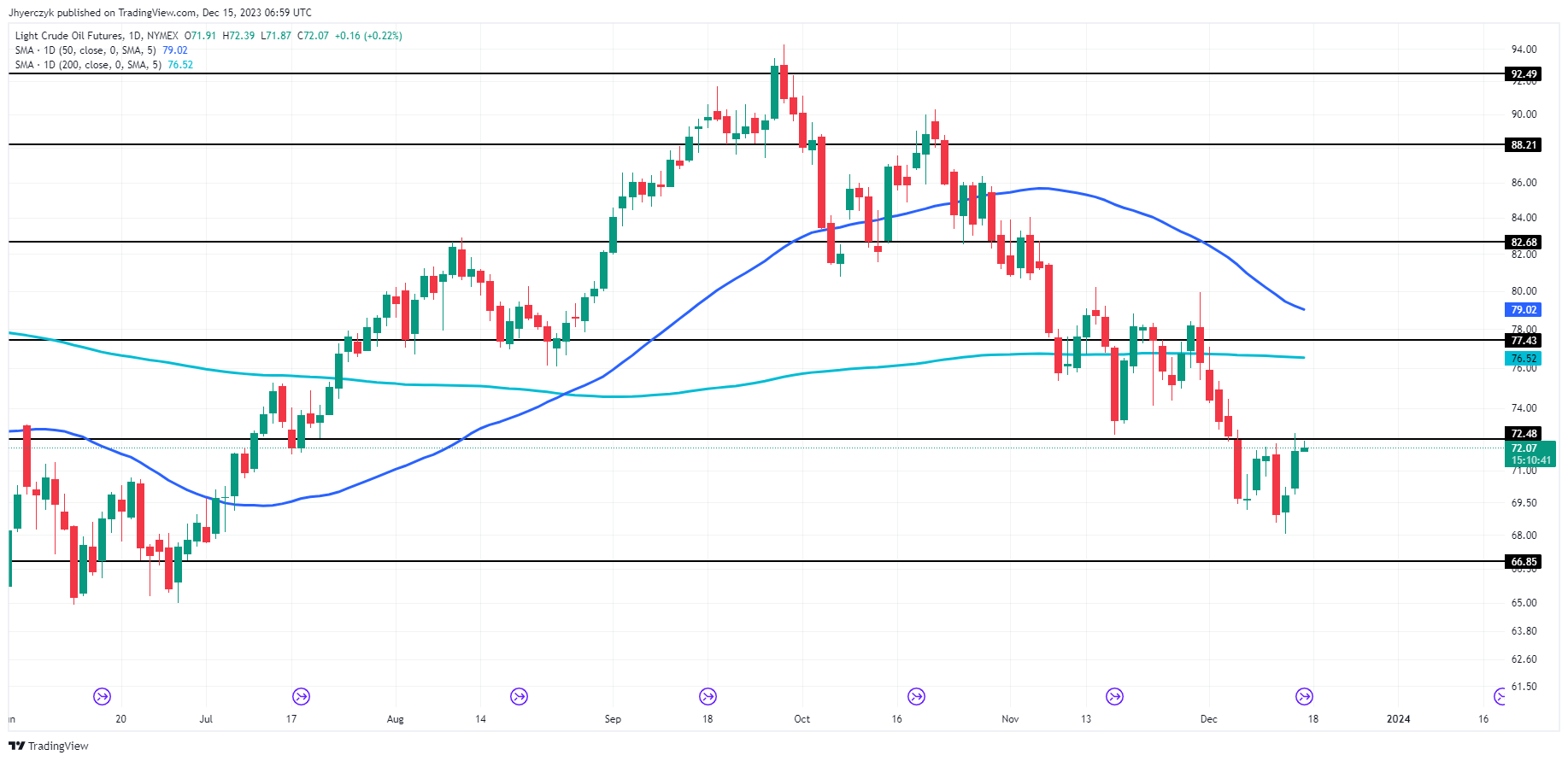
The current daily price of Light Crude Oil Futures at 72.07, marginally up from the previous close of 71.91, reflects a slight upward momentum.
This price hovers just below the minor resistance level of 72.48, indicating a potential for a bullish shift if this resistance is breached. However, the price is still below the key 200-day and 50-day moving averages of 76.52 and 79.02 respectively, signaling an overall bearish trend in the longer term.
The current positioning of the price, close to minor resistance but significantly below the moving averages, suggests a market at a critical juncture, possibly on the cusp of a trend decision.
The market sentiment appears cautiously optimistic, but with a bearish undertone due to the influence of the moving averages.