



Natural Gas Slides to Its Lowest Level Since March 4
U.S. natural gas futures are down on Wednesday after testing their lowest level since March 4 earlier in the session. Prices are falling amid a mixed fundamental backdrop. Currently, traders are weighing mild weather, steady production, and LNG demand against weakening seasonal consumption.
After a volatile start to the month, the price action has been subdued but sensitive to short-term weather forecasts and storage expectations, but I can’t say that one single driver was fully in control.
At 11:40 GMT, April Natural Gas futures are trading $2.981, down $0.052 or -1.71%, but up from the intraday low of $2.923.
Mild Weather Is Taking the Wheel
Despite its sensitivity to short-term weather forecasts, it continues to lose influence as the heating season winds down. A consensus of weather analysts is noting that temperatures across much of the U.S. are trending mild, limiting heating demand and reducing the need for strong withdrawals from storage. The current forecast shows comfortable conditions with highs moving into the 70s and 80s across several typically high demand areas. This is not a supportive outlook for late-season demand.
Typically, in March, natural gas traders look for cold risks, but I haven’t seen many. In my opinion, we’re not seeing any widespread or persistent patterns that have been strong enough to materially tighten supply. I even think demand will stay below normal into the end of the month. This should be enough to put pressure on prices over the near-term. Adding to the developing bearishness, is the start of shoulder season, which is often highlighted by low-volume weakness.
Storage and Production Are Not Doing Bulls Any Favors
Besides the weather, storage remains a central focus. Over the next few weeks, we’re likely to see smaller withdrawals or even early injections relative to historical norms. This is going to cause supply to continue to outpace demand at this time of the year.
Additional factors weighing on prices include inventories that are still above levels that would typically cause concerns, but without a late-season cold snap in the works, supply is expected to continue to outpace demand at this stage in the season.
Natural Gas Price Forecast
Every new Natural Gas analysis as it publishes, today's technical signal and key levels, live price — on one page.
See all Natural Gas forecastsI suggest that traders monitor closely the pace of storage changes over the next couple of weeks. If injections begin earlier than usual, it could develop into a weak scenario. Bearish traders will be looking for confirmation of a loose balance.
Strong and steady production is another factor pressuring natural gas prices. The current bearish setup has U.S. output hovering near high levels, and unlike winter, in the spring, there are usually no major disruptions affecting supply flow. Surprisingly, producers have not significantly pulled back despite the relatively low prices, which suggest the market is still well supplied. This is what is giving the market the ceiling that traders are using to sell rallies.
Unless there is a meaningful decline in output or unexpected supply disruption, I think production will continue to act as a stabilizing but bearish force in the market.
Can LNG Demand Save the Day?
The real question is whether LNG demand can pick up the slack from weak domestic consumption. Export facilities are running hard and that’s helping absorb some of the excess supply. But LNG alone is not enough to turn this market around.
It provides a steady baseline of demand, but it doesn’t create upward momentum unless supply tightens or weather drives consumption higher. Global demand and export capacity are worth watching, but right now LNG is a floor, not a catalyst.
The Technical Picture Points Lower
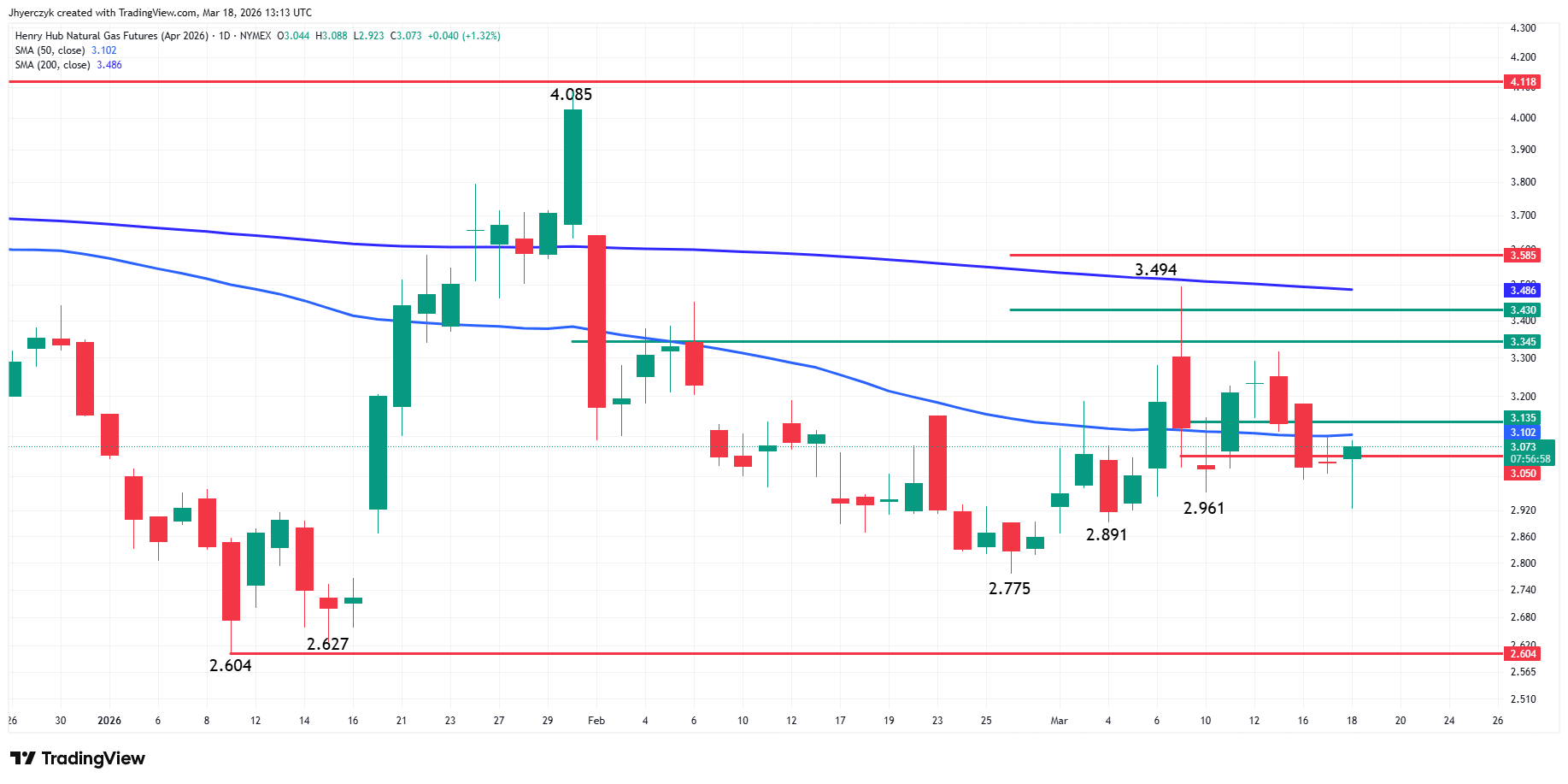
In my opinion, the short-term fundamentals lean slightly bearish. Mild weather, steady production and comfortable storage levels all point to limited upside. The market is in “sell the rally” mode. LNG is offering some support but it’s not enough to shift sentiment on its own.
Right now April natural gas is trading on the weak side of the 50-day moving average at $3.102. Until buyers can take that level back with conviction, expect a sideways-to-lower grind with downside risks in control.
This technical tool is both resistance and the short-term trend indicator. In order to attract the bulls, we’re going to need to see this level overcome by high volume buying. It is going to have to be more than short-covering.
Once the 50-day MA is taken out with conviction, the market could be free to run into the major long-term pivot at $3.345. Yesterday, sellers were able to take out the last swing bottom at $2.961, but dip buyers took advantage of the relatively cheap prices and turned the market around. This move is exactly what I mean when I say “sideways-to-lower.”
More Information in our Economic Calendar.