



Crude oil is trading like the only question left is whether the barrels make it out of the Persian Gulf. U.S. strikes hit Iranian infrastructure over the weekend, the president called the ceasefire dead on the record, and vessel traffic through the Strait of Hormuz keeps slowing down with no one working on a fix. The demand bears have a case and none of them want to press it right now. You do not short crude when bombs are landing near loading terminals and consuming nations are sitting on the thinnest stockpiles in years.
Strikes Are Getting Closer to the Oil
WTI climbed toward $74 on weekend trading platforms while Brent pushed toward $78. CENTCOM confirmed another round of strikes over the weekend and the targets keep moving closer to the oil. Qeshm Island and Bandar Abbas both took hits this time. Iran lost roughly 4,200 megawatts of generating capacity off the electrical grid. That is infrastructure-level damage that takes weeks to bring back online, not a warning shot.
Trump killed the ceasefire publicly and did not hedge the statement. The diplomatic track had been losing credibility for weeks but as long as it was technically alive, some traders were still fading the risk premium. That trade is dead now. Once the president buries the ceasefire on the record, nobody on a desk is going to short crude on the assumption negotiations resume quietly. Risk premium stays and it probably grows from here because Washington is not signaling any kind of pause.
The inventory situation is the reason every escalation matters more than it normally would. Trump referenced tight stock levels across consuming nations during the Memorandum of Understanding discussions. Reserves never fully rebuilt after the last cycle of drawdowns and there is no strategic release that covers a sustained disruption. Every dip in crude right now is attracting buyers who are not playing a bounce trade. They are positioning against barrels that might never reach the loading dock. The market has no cushion and the strikes keep landing closer to export infrastructure that cannot be replaced quickly.
Hormuz Is the Floor Under This Market
Nobody on a crude desk cares about the IEA surplus forecast right now. The Agency maintained projections for excess supply and crude did not move a tick. That tells you exactly where this market’s head is. The surplus math only works if barrels reach the port, and right now vessel traffic through the Strait of Hormuz is slowing with no timeline for recovery. Crude is pricing off that restriction and ignoring everything else.
WTI Crude Oil Price Forecast
Every new WTI Crude Oil analysis as it publishes, today's technical signal and key levels, live price — on one page.
See all WTI Crude Oil forecastsThe Red Sea makes this worse than a single chokepoint problem. The Houthis are still positioned and Tehran does not need to commit Iranian naval assets to activate them. Hormuz restricted and the Red Sea under pressure simultaneously would leave exporters with nowhere to reroute. That combination is not in the price yet. It should be, because the trigger is a phone call, not a military operation.
Prediction markets have turned bullish on crude with positioning for higher prices as long as the conflict continues. The crowd is not betting on a ceasefire.
Daily August WTI Crude Oil Futures Technical Analysis
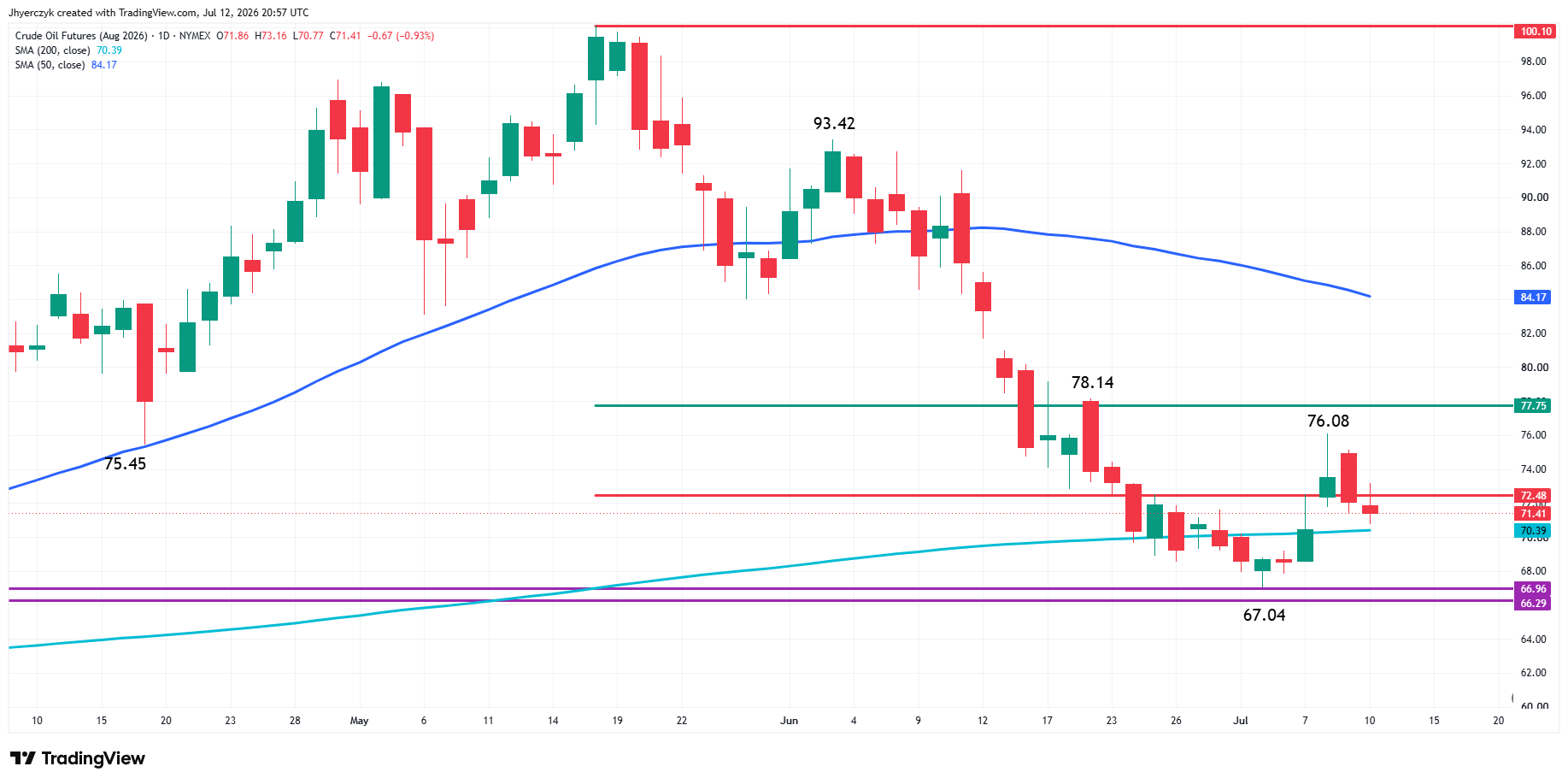
August WTI crude oil futures are expected to open higher Sunday night. The main trend is down according to the swing chart, but the price action last week suggested traders may be trying to form a support base, which could eventually lead to a change in the trend.
The current short-term range is $67.04 to $76.08. Inside this range is the 200-day moving average at $70.39. Early last week, there was a strong short-covering rally. Aggressive speculators didn’t really chase the rally, but seemed to want to play for a pullback into the 200-day MA. Based on the early opening calls, it looks like the chase could be on.
The best bottoming signal would have been the establishment of support on the 200-day MA and a breakout over the swing top at $76.08. There may be some headwinds at $77.75 and $78.14, but overcoming those levels could create the momentum needed to drive the market into the 50-day MA at $84.17.
On the downside, a failure to hold the 200-day MA could drive sellers to test the swing bottom at $67.04 and the February/March gap at $66.96 to $66.29. If buyers don’t stop this slide, WTI could drop to $55.00 before the end of the year.
Daily September Brent Crude Oil Futures Technical Analysis
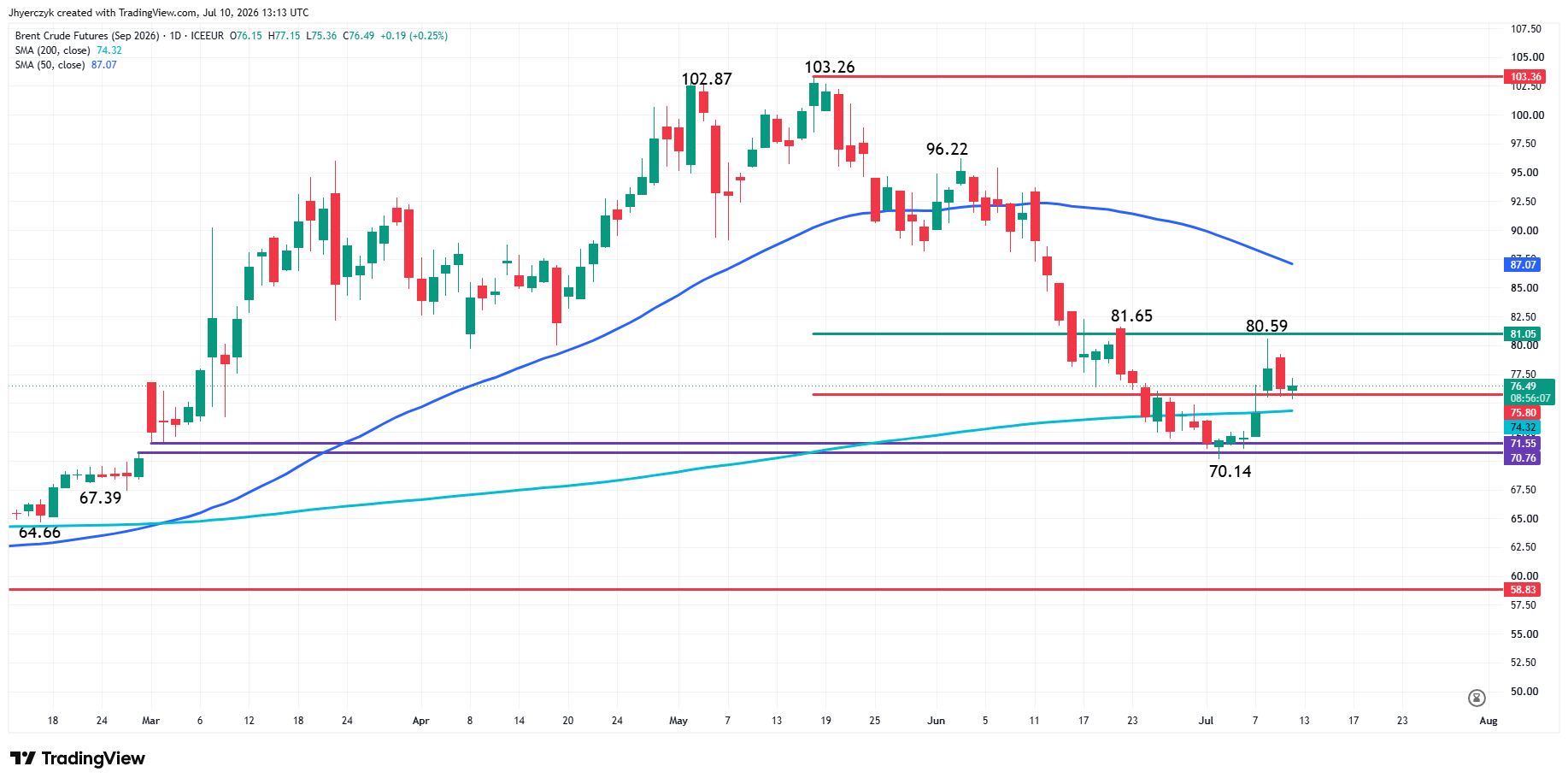
September Brent crude oil futures are also in a downtrend, but could be in a position to rally early Sunday if traders chase the potentially bullish headlines. Following a short-covering rally early last week that took the market from $70.14 to $80.59, the market settled into a range with the 200-day moving average at $74.38, a key support target. The over-the-weekend calls, however, indicate speculators may not be waiting for the pullback anymore.
Holding the 200-day MA then challenging the two swing tops at $80.59 and $81.65 is now the early call on Sunday. A combination of short-covering and aggressive buying will be needed to possibly drive the market into the 50-day MA at $86.53.
The bullish outlook goes away if the 200-day MA fails again. If this move generates renewed downside pressure, sellers will try to take out the swing bottom at $70.14. If this generates enough downside momentum then the December bottom at $58.83 will hit everyone’s radar.
What to Watch
The strikes are landing closer to export terminals every round and Tehran still has not retaliated against actual oil infrastructure. That restraint is the only thing standing between this market and a genuine supply crisis. There is no diplomatic channel left to walk this back, the Strait is still partially closed, and stockpiles across consuming nations are running too low to absorb a real disruption. My read on this is crude stays bid on every dip because all three would need to reverse before the premium comes off, and none of them look close to reversing.
The 200-day moving average on both contracts is where the base holds or breaks. Buyers defending that level keeps the 50-day moving averages in play as the next upside target. Losing it hands the market back to sellers and reopens the swing lows.
If you’d like to know more about how to trade crude oil, please visit our educational area.