



Crude is hanging on to its war premium while the Gulf ships more oil than at any point since the fighting started. On paper, those two things shouldn’t go together. They do because of how the oil is getting out. It’s being rerouted, passed ship to ship off the coast of Oman and pushed through a Strait of Hormuz that is still one escalation away from trouble. Traders aren’t calling that normal supply.
At 10:07 GMT, November WTI crude oil futures are trading at $92.82, up $0.22 or +0.24%. The more actively traded December Brent crude oil futures are at $97.94, up $0.11 or +0.11%. November Brent crude oil futures are trading at $105.47, up $0.19 or +0.18%.
Daily November WTI Crude Oil Futures Technical Analysis
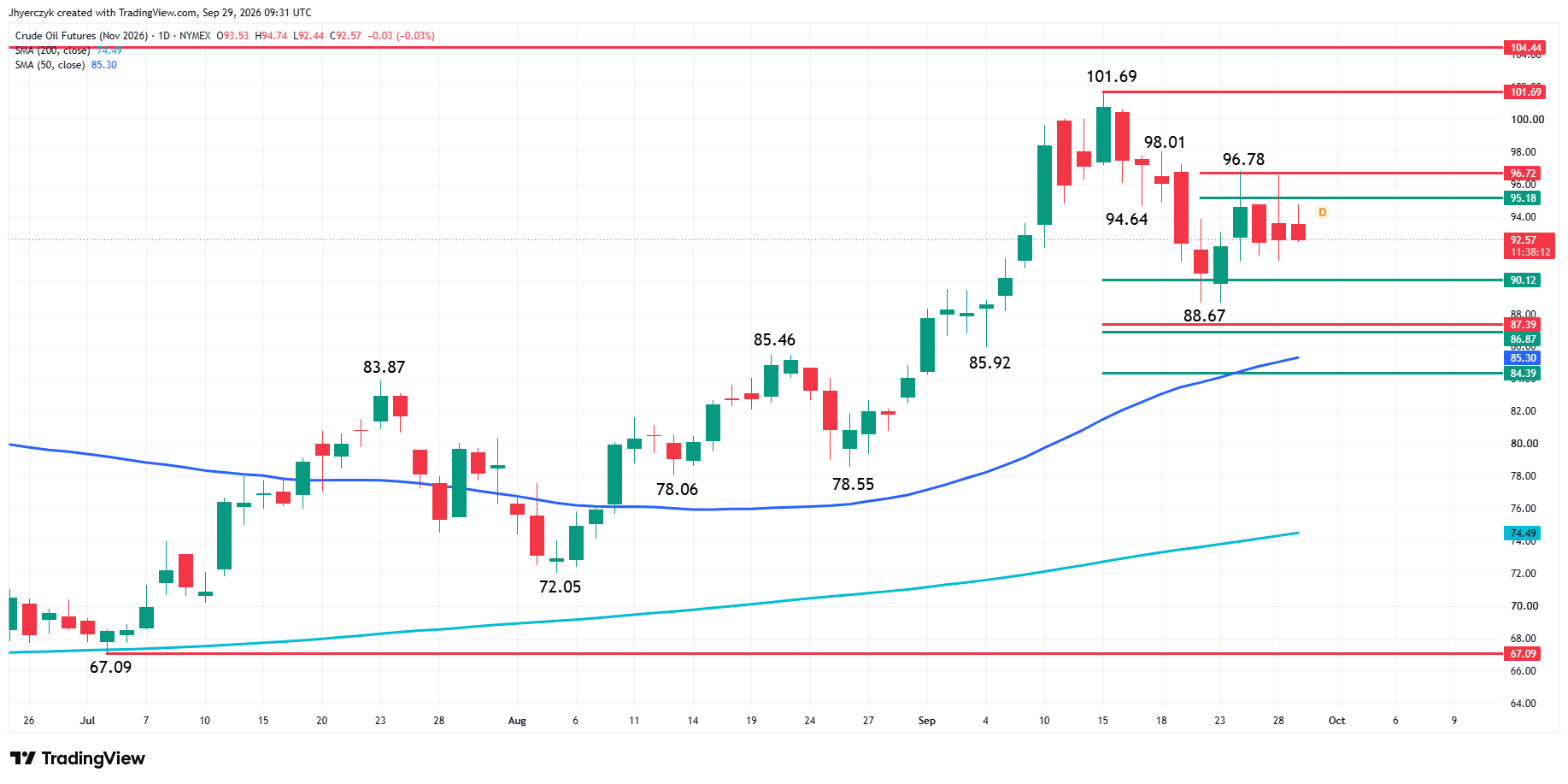
November WTI crude oil futures are slightly lower early Tuesday. The main trend is up according to the daily swing chart. A trade through $101.69 will signal a resumption of the uptrend. The main trend will change to down if the main bottom at $78.55 fails.
The minor trend is down. This is controlling the downside momentum. The minor trend will change to up on a move through $98.01.
Retracement zone resistance is $95.18 to $96.72. Retracement zone support is $90.12 to $87.39. Last week’s low at $88.67 was formed inside this zone. Additional support is a pair of 50% levels at $86.87 and $84.39.
The 50-day moving average at $85.30 is major support and a key trend indicator.
Brent Oil Price Forecast
Every new Brent Oil analysis as it publishes, today's technical signal and key levels, live price — on one page.
See all Brent Oil forecastsDaily December Brent Crude Oil Futures Technical Analysis
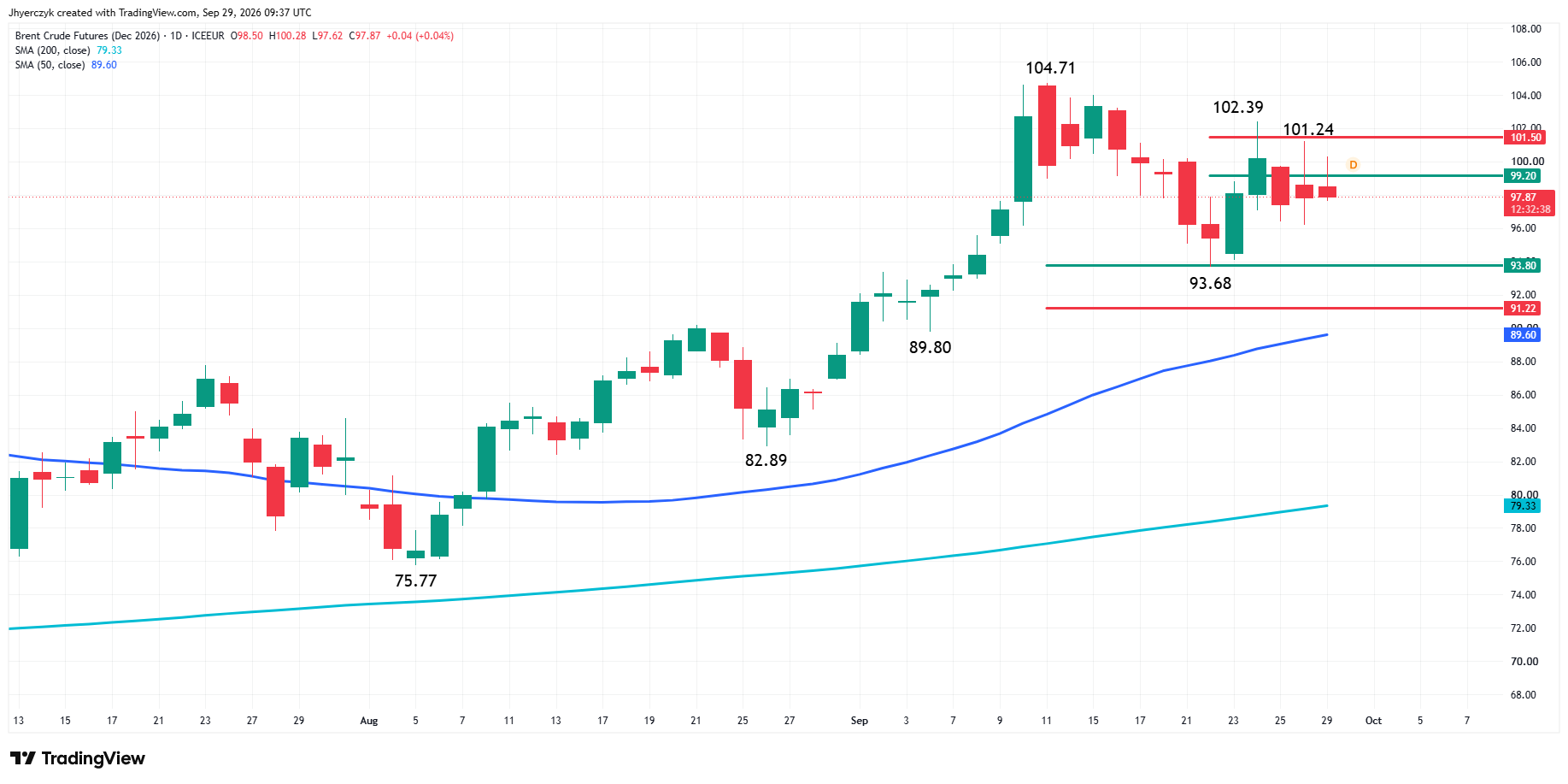
December Brent crude oil futures are putting in a mixed performance early Tuesday. The main trend is up, however, the minor trend is down. The minor trend is currently controlling the momentum.
The main top is $104.71. A trade through this level will signal a resumption of the uptrend. The main trend will change to down on a move through $93.68.
The new minor top is $101.24. A trade through this level will change the minor trend to up and shift momentum back to the upside.
The secondary lower top is $102.39. This indicates sellers came in before Brent could retest the main top at $104.71.
Retracement zone resistance is $99.20 to $101.50. Traders have been probing this zone for four days. Retracement zone support is $93.80 to $91.22. This zone stopped the selling at $93.68 on September 22.
The major support and trend indicator is the 50-day moving average at $89.60.
Gulf Exports Hit a War High and Are Still Short of Normal
Kpler put September crude exports from the major Middle East producers at 16.328 million barrels per day. That’s the highest since the war began in February. Crude barely moved on it early Tuesday.
The reason is in the rest of the Kpler data. The region is still shipping about 3.2 million barrels per day less than it did in February, or just under 80% of pre-conflict levels. Hormuz flows were running at about 9.719 million barrels per day. Saudi Arabia and the United Arab Emirates did most of the heavy lifting.
Ship-to-ship transfers in the Gulf of Oman are covering part of the gap. So are exports from terminals outside Hormuz. None of that looks like a supply chain traders can lean on if the Strait gets hit again.
Saudi Arabia Is Carrying the Recovery Through Ras Tanura
Saudi exports were on track for about 5.4 million barrels per day in September. August was 2.446 million. That’s more than double in a month. Most of the increase came through one port.
Ras Tanura shipped about 3.25 million barrels per day, up from 929,000 barrels per day in August. Attacks damaged the East-West Pipeline and restricted exports from Yanbu, so the Saudis leaned on the Gulf coast instead. Even with that jump, Ras Tanura is running at roughly half of the 6.411 million barrels per day it moved before the war.
Nineteen VLCCs carrying Saudi crude exited Hormuz last week. That count leaves out any vessels running with their transponders off. Before the war, the Strait handled about 125 large commercial vessels a day. The market is working much harder to move fewer barrels. Crude is still carrying the premium because of it.
Trump’s Denial Took the Concrete Part Out of the Peace Story
U.S. and Iranian officials spoke separately with mediators again. President Trump denied offering Tehran sanctions relief or frozen funds in exchange for nuclear concessions. That was the most concrete piece of the peace story, and it’s gone.
Crude is steady early Tuesday. Traders have been through enough truce headlines to know what they’re looking at. Negotiators talking through intermediaries isn’t an arrangement that restores normal transit through Hormuz. There may be more talks. There’s still no agreement to price.
Washington’s Diesel and Reserve Moves Say Supply Stays Tight
Washington is looking at allowing broader sales of red-dyed diesel to ease domestic prices. It’s being weighed as an alternative to a diesel export ban. An administration that is still working on diesel policy is not expecting Middle East product flows to get back to normal soon.
The Strategic Petroleum Reserve fell to 283.8 million barrels last week, its lowest level since 1982. The drawdown is part of the agreement to release 172 million barrels. The International Energy Agency said member countries could discuss further reserve releases if product markets need help.
Reserve barrels can take the edge off a squeeze. None of it changes the shipping risk, and that’s what’s holding the premium in crude.
Inventories Won’t Outweigh the Next Gulf Headline
The market is looking for U.S. crude oil and gasoline inventories to have fallen last week. Distillate stocks are expected to be little changed. A draw in crude and gasoline would back up the idea that the market can absorb whatever barrels are still getting through the Gulf.
Diesel is still the pressure point. It has been since the war began, and it’s the reason the export-ban talk hasn’t gone away.
The weekly inventory reports can move crude for a session. They won’t carry the weight of the next Iran, Houthi or Saudi infrastructure headline.
What to Watch
Crude is stuck in a two-sided trade. An escalation brings buyers in fast and forces shorts to take offers. Peace-talk headlines take the urgency away and leave passive bids underneath. Neither side has enough to break the range yet.
WTI has the minor trend working against it and the main trend still up. A sustained move over $96.72, the top of the retracement resistance zone, would show buyers are returning. They still need to take out $98.01 to change the minor trend up and put the $101.69 contract high back into view. Underneath, the 50-day moving average at $85.30 is the line. Losing it moves the focus to the 50% level at $84.39 and the $78.55 main bottom.
Brent is the chart with the conflict. Buyers have been leaning on the $99.20 to $101.50 resistance zone for four days without getting through. They need the $101.24 minor top first, then the $102.39 secondary lower top. The real question is whether a rally can hold together all the way to the $104.71 main top. On the downside, a break under $93.68 turns the main trend down. It also drops Brent into the $93.80 to $91.22 retracement zone, where aggressive counter-trend buyers will try to defend the 50-day moving average at $89.60.
If you’d like to know more about how to trade crude oil, please visit our educational area.