



The market keeps waiting for somebody to put oil back on the water. Nobody has. The Saudi pipeline bypass is still down. The Strait of Hormuz dropped to four vessel transits Monday. Washington is draining a reserve that has not been this low since 1982. China is pulling crude out of storage faster than it can import. None of that has changed since Friday and the list of things that can go wrong is getting longer, not shorter.
Saudi Pipeline Loss Leaves Buyers in Control
At 08:58 GMT, October WTI crude oil futures traded at $103.59, up $2.20 or 2.17%. November Brent crude oil futures traded at $107.87, up $2.19 or 2.07%. Both contracts pushed higher for a second session.
The East-West pipeline is still down after Friday’s drone strike hit a pumping station. Saudi buyers and traders have warned the kingdom could run short of oil for export within days if the line does not come back. That is not a forecast. The pipeline carried about 4 million barrels per day and right now there is no other way to move those barrels around the Strait.
Kpler data showed four commodity vessels made it through Hormuz on Monday. Four. Down from 10 a day earlier. Before the war that waterway averaged 125 vessel movements and handled one-fifth of global crude and product flows. The pipeline was the bypass and the bypass is down.
Monday’s Houthi strikes hit the Khamis Mushait military airbase in southern Saudi Arabia. The market is not pricing a repair schedule. It is pricing the next target. Every few days another piece of Saudi export infrastructure takes a hit. That is why crude keeps pushing higher and nobody is fading the rally.
Brent Oil Price Forecast
Every new Brent Oil analysis as it publishes, today's technical signal and key levels, live price — on one page.
See all Brent Oil forecastsThe SPR Is Too Thin to Change the Story
The Strategic Petroleum Reserve dropped to 285 million barrels last week. That is 1982. A 172-million-barrel release is already underway and the draws keep chipping away at what is left. Washington can push more barrels out of storage. The market already knows how many are left. A reserve that traders are measuring by what remains instead of what is flowing has lost its ability to talk prices down.
China Is Burning Through Its Own Cushion
China processed 13.91 million barrels per day in August. That is up 11.2% from July and the highest run rate since March. Beijing eased fuel-export restrictions in mid-July and refiners went straight after the diesel and gasoline margins overseas. Distillate exports hit 975,000 barrels per day with Kpler expecting them above 1 million barrels per day in September.
The imports are not keeping up. China brought in 8.93 million barrels per day in August and produced 4.34 million domestically. That gave refiners 13.27 million barrels per day. They processed 13.91 million. The gap came from storage at roughly 640,000 barrels per day. Reuters calculations showed similar draws in May and June before a small July build that August reversed.
Onshore crude inventories stood near 1.23 billion barrels as of September 9. That sounds like a large cushion until you see that stored volumes dropped 24.05 million barrels since the end of August.
China can keep drawing to protect domestic supply. It cannot keep drawing to maintain higher refinery runs, expand fuel exports and avoid buying seaborne crude at the same time. At some point refiners have to come back to the market.
Rystad Energy has said export restrictions could return after October if Middle East conditions get worse. That would slow the refinery pull on crude. Until then, China is running plants harder than imports can support and the storage cushion is absorbing the gap. Absorbing is not the same as solving.
Daily October WTI Crude Oil Technical Analysis
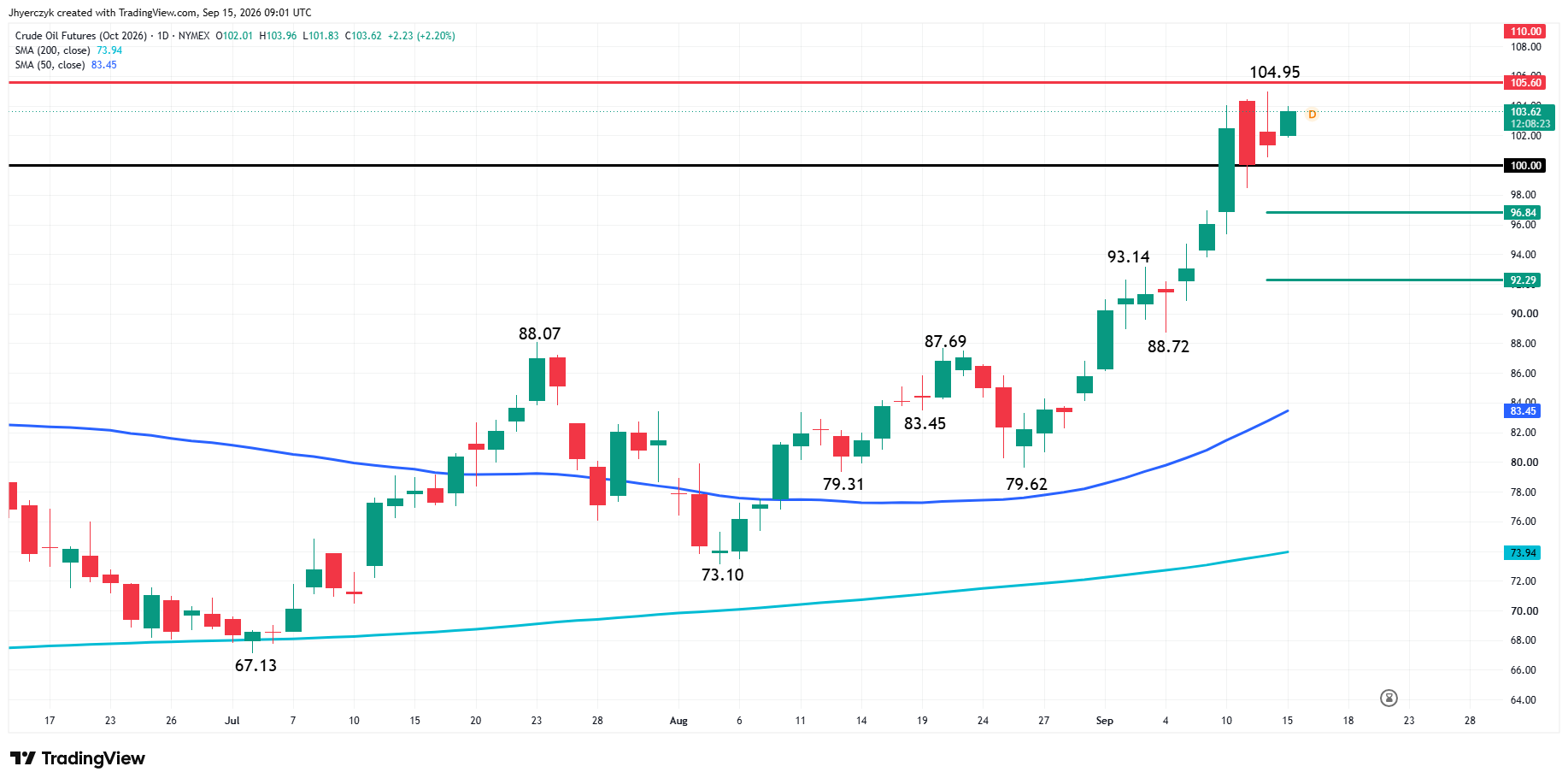
October WTI crude oil futures are edging higher for a second session. The main trend is up according to the daily swing chart. Yesterday’s rally to $104.95 negated Friday’s closing price reversal top. Taking out $104.95 will signal a resumption of the uptrend. The nearest minor bottom is $88.72. The closest main bottom is $79.62.
Short-term support is the psychological $100.00 level, followed by a pair of 50% levels at $96.84 and $92.29. On the upside, potential targets come in at $105.60 and $110.00.
Daily November Brent Crude Oil Technical Analysis
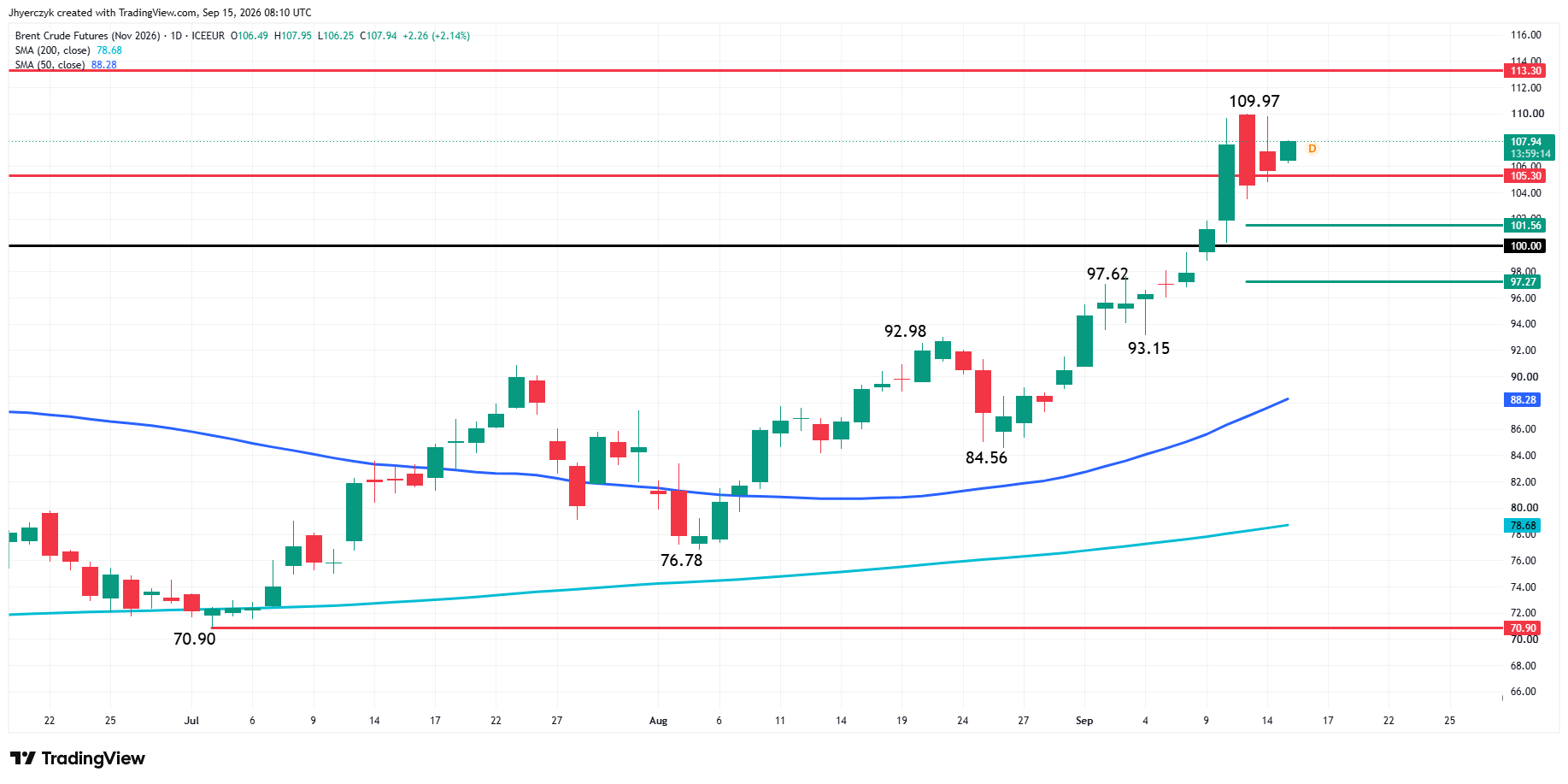
November Brent crude oil futures are higher on Tuesday. The chart pattern is a little different from the WTI chart pattern. The main trend is up according to the daily swing chart, however, Friday’s potentially bearish closing price reversal top remains intact.
A trade through $109.97 will negate the closing price reversal top and signal a resumption of the uptrend. Taking out $103.50 will confirm the closing price reversal top. It won’t change the main trend, however, it will shift momentum to the downside with the targets a minor 50% level at $101.56, the psychological $100.00 level and the main 50% level at $97.27.
What to Watch
The pipeline is the first headline that matters. A repair schedule with evidence that barrels are moving takes pressure off. Hormuz traffic is the second. Four transits in a day is not commerce. China is the slower story. The storage cushion has kept refiners from chasing cargoes but every month of draws brings that cushion closer to the level where they have to come back to the market.
Ukraine’s ceasefire offer on energy sites is the only thing in the current mix that could ease the broader supply picture. It matters only if Russia agrees and Washington can verify it. Until then, the supply story has no relief valve.
The bias leans bullish on WTI with the main trend up and Friday’s reversal top already negated at $104.95. Taking out that level resumes the uptrend toward $105.60 and $110.00. Support sits at $100.00 and the 50% levels at $96.84 and $92.29. Brent’s reversal top is still alive. $109.97 clears it with a former top at $113.30 above. $103.50 confirms the downside toward $101.56 and $97.27.
If you’d like to know more about how to trade crude oil, please visit our educational area.