



Crude got knocked down Tuesday on a release headline, and buyers were waiting for it. The market is trying to price two opposing facts at once: Gulf exports are recovering, but the inventory cushion that used to absorb a disruption is getting smaller. The Energy Information Administration raised its oil-price outlook again. Industry executives are saying the oil left in storage is either unavailable, politically restricted or needed to keep the system running. A release can knock crude down for a session without settling the supply problem.
Crude Sold the Release Headline Into Major Support
Crude sold off on the diesel-release headline Tuesday, but buyers showed up when WTI reached a major support cluster and Brent slipped below its short-term retracement zone.
At 19:10 GMT, November WTI crude oil futures are trading at $89.62, up $0.19 or +0.21%. December Brent crude oil futures are at $100.58, up $0.26 or +0.26%.
Daily November WTI Crude Oil Futures Technical Analysis
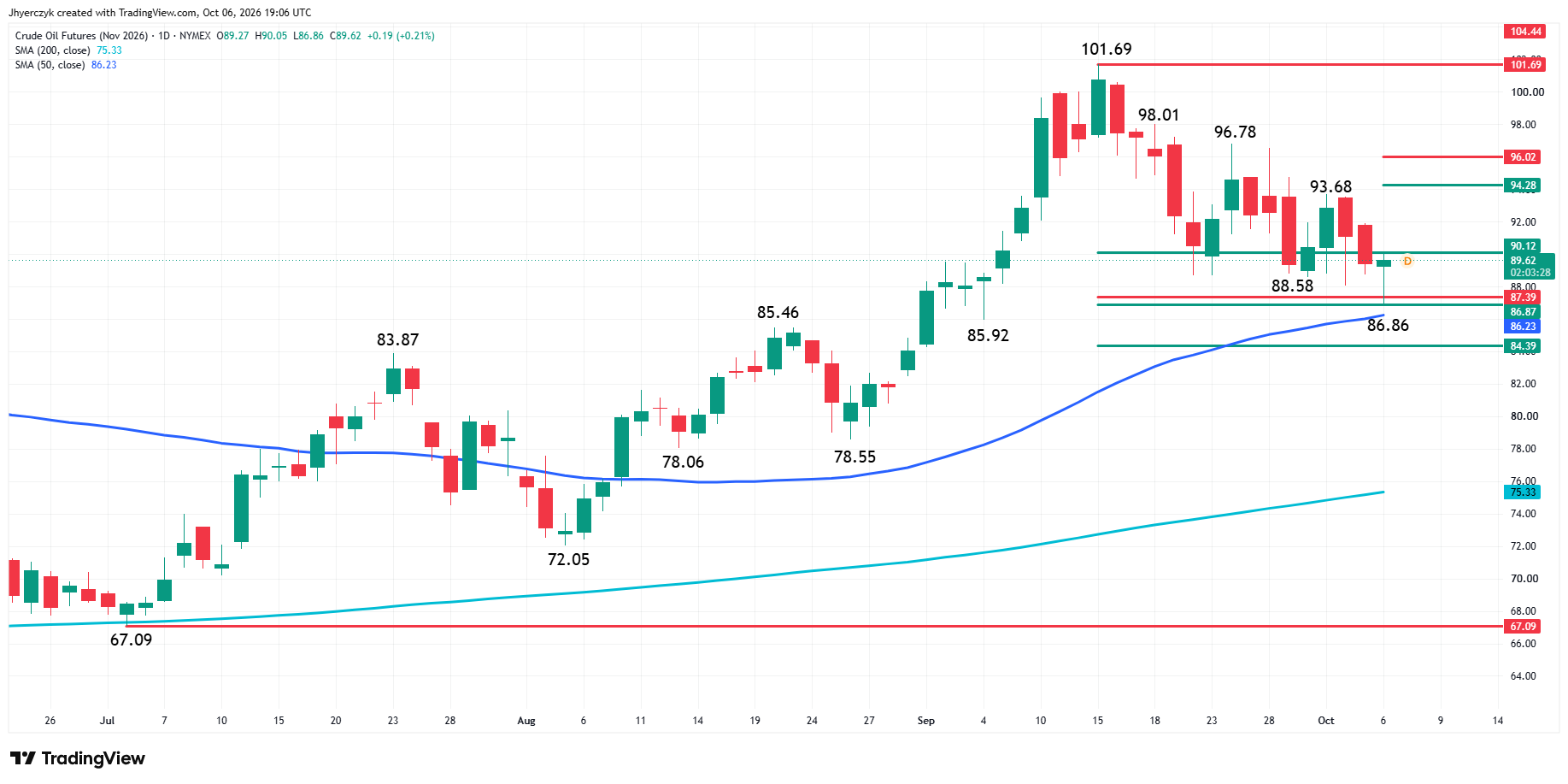
November WTI crude oil futures are trading higher late Tuesday after testing a major support cluster and reversing to the upside. The main trend is up according to the daily swing chart, but the minor trend remains down.
A trade through the main top at $101.69 will reaffirm the uptrend. A move through the main bottom at $78.55 will change the main trend to down.
Brent Oil Price Forecast
Every new Brent Oil analysis as it publishes, today's technical signal and key levels, live price — on one page.
See all Brent Oil forecastsThe minor trend will turn up on a trade through $93.68.
Buyers came in at the short-term retracement zone at $90.12 to $87.39. The selling extended to $86.86, where the market found additional support at the 50% level at $86.87. The 50-day moving average at $86.23 and the next 50% level at $84.39 create a deeper support cluster under the market.
The first upside target is the minor top at $93.68. Above it, resistance comes in at $94.28 to $96.02. A trade through this area could extend the rally into the minor tops at $96.78 and $98.01.
Tuesday’s reversal from $86.86 shifted the market off the low, but the minor trend remains down until $93.68 is taken out.
Daily December Brent Crude Oil Futures Technical Analysis
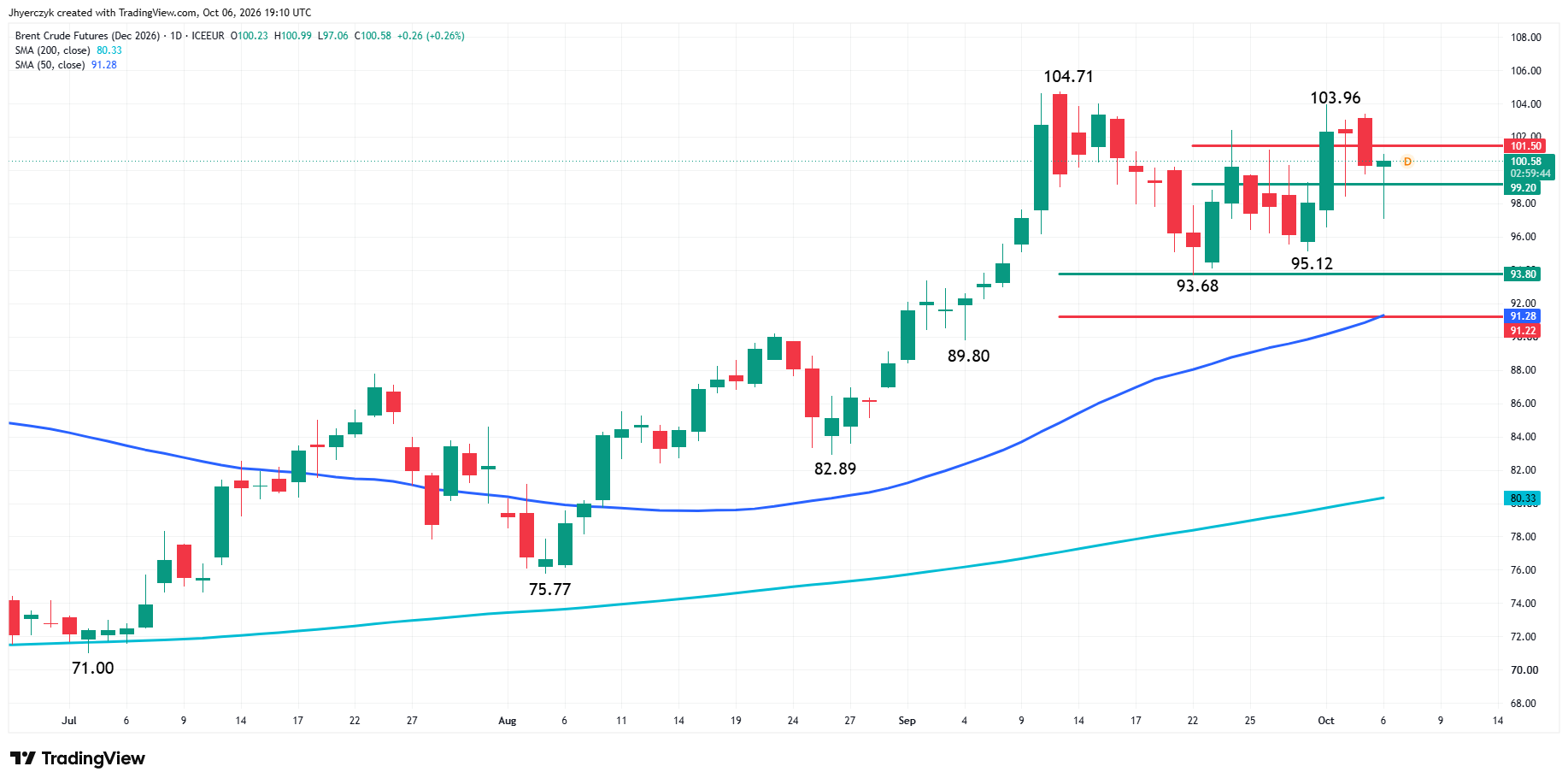
December Brent crude oil futures are trading slightly higher late Tuesday after buyers stepped in below the short-term retracement zone and pushed prices back inside it. The main and minor trends are up according to the daily swing chart.
A trade through $103.96 will signal a resumption of the uptrend. A move through $95.12 will change the minor trend to down, while a trade through $93.68 will change the main trend to down.
Tuesday’s low at $97.06 came in below the short-term retracement zone at $101.50 to $99.20. Buyers took the offer and pushed the market back into the zone, which is still the key area to watch. Holding above $99.20 would show the zone is becoming a support base. A break below it would weaken the near-term outlook.
The main support area is the retracement zone at $93.80 to $91.22. The rising 50-day moving average at $91.28 is sitting inside this area, making it an important support cluster.
The EIA Raised Its Forecast While Crude Was Selling Off
The EIA lifted its fourth-quarter Brent forecast to about $105 a barrel, $14 above its prior estimate. It now sees Brent averaging about $98 for 2026, an 8% increase from last month’s forecast. The agency also raised its 2027 forecast by $10 to $84 a barrel.
The reason is not difficult to find. Diesel remains tight, refiners are trying to maximize distillate output and global inventories have been drawn down during the Iran war. Saudi Arabia’s East-West Pipeline is running again, and producers have adapted with alternative routes and ship-to-ship transfers. Those workarounds are helping, but they are not adding a large spare supply cushion to the market.
The EIA expects Middle East production shut-ins to fall from 4.5 million barrels per day in the fourth quarter to 2.7 million barrels per day in the first quarter of 2027. That’s a meaningful recovery and it still leaves a lot of crude missing.
Gulf oil flows excluding Iran recovered to more than 81% of prewar levels in September, which gave sellers something to work with Tuesday. It doesn’t explain away the EIA’s quarterly forecast hike, though.
The Release Adds Barrels, but the Buffer Is Still Thin
The IEA is putting out 100 million barrels of crude and diesel. Sellers had been waiting weeks for something like that.
Aramco’s Amin Nasser says most of what’s left in storage can’t actually get to the market, and more than a billion barrels have already come out since the war started.
The difference between barrels in storage and barrels available for a supply shock is the trade.
Oil can be sitting in tank bottoms, pipelines, strategic reserves or locations where governments will not let it move. The release buys some diesel relief and that’s it.
The U.S. Strategic Petroleum Reserve is the lowest it’s been since 1982. Winter is riding on Middle East tankers.
Recovering Flows Put a Ceiling on the Panic Trade
Bulls can’t pretend the exports aren’t coming back. The Saudis have the East-West Pipeline shipping again after the Houthi attacks, and other exporters in the region are moving oil through dark transits and ship-to-ship transfers.
That’s why Brent isn’t priced like the Strait of Hormuz is shut. Oil is finding a way out, and the EIA thinks that keeps growing into next year.
U.S. output is another part of the medium-term supply story. The EIA sees U.S. crude production rising to a record 13.9 million barrels per day in 2026 and 14.3 million barrels per day in 2027.
That’s your ceiling. The floor is a stockpile buffer that keeps shrinking and the chance somebody hits more infrastructure before those new barrels show up.
Tuesday’s selloff tested the floor. Buyers came in before the session was over.
What to Watch
The International Energy Agency release and recovering Gulf flows gave sellers their opening Tuesday, and they used it. The EIA’s quarterly forecast hike and a stockpile buffer that keeps shrinking are why the selling ran into buyers at support. The physical market has more barrels moving than it did a month ago and less room for another disruption.
November WTI washed out to $86.86, found support at the 50% level and reversed higher by late afternoon in New York. The bias is bullish while the main trend remains up and the market holds above the 50-day moving average, with $93.68 overhead.
December Brent dipped to $97.06 under its retracement zone before buyers pushed it back inside. The bias remains to the upside while Brent holds above the $99.20 lower boundary and the main trend remains up, and $103.96 is the top buyers still have to clear.
If you’d like to know more about how to trade crude oil, please visit our educational area.