



The crude premium came out fast Tuesday when traders heard Saudi barrels were moving again, the East-West Pipeline had restarted and Iran might reopen the Strait of Hormuz. The market sold first. Thursday is asking where the deal is. There is no agreement to reopen Hormuz.
At 10:21 GMT, November Brent crude oil futures are trading $105.10, up $2.02 or 1.96%. The session high is $106.50 and the low is $101.83. November WTI crude oil futures are trading $93.53, up $1.37 or 1.49%. The session high is $94.69 and the low is $91.23.
Daily November WTI Crude Oil Technical Analysis
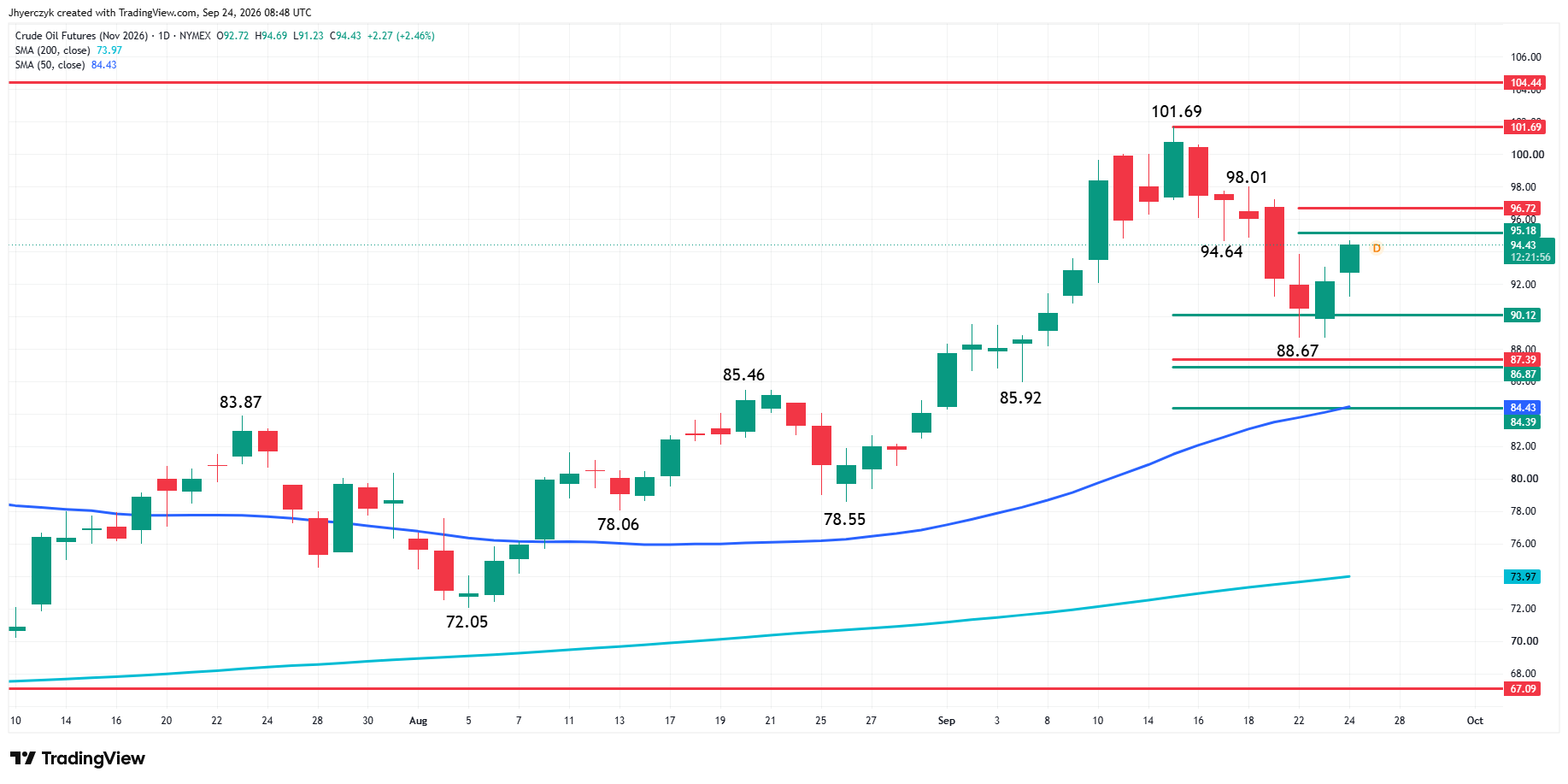
November WTI crude oil futures are edging higher on Thursday for a second session. The main trend is up according to the daily swing chart. A trade through $101.69 will signal a resumption of the uptrend. A move through $78.55 will change the main trend to down.
The minor trend is down. It is controlling the momentum. It turned down on September 21 when sellers took out the minor swing bottom at $94.64. A trade through $98.01 will change the minor trend to up and shift momentum to the upside. The new minor bottom is $88.67.
Retracement zone support at $90.12 to $87.39 stopped the selling at $88.67 on September 22. Additional support comes from the 50% level at $86.87 and the price cluster formed by the 50-day moving average at $84.43 and the 50% level at $84.39.
On the upside, a new minor range has formed between $101.69 to $88.67. Its retracement zone at $95.18 to $96.72 is the next upside target.
With the main trend up according to the daily swing chart, my bias is still to the long side. My outlook has weakened, however, with the minor trend change to down.
The key area to watch is $95.18 to $96.72. Trader reaction to this zone is likely to determine whether the buying is strengthening enough to make another run at $101.69, or if the selling is strong enough to produce a potentially bearish lower secondary top.
Brent Oil Price Forecast
Every new Brent Oil analysis as it publishes, today's technical signal and key levels, live price — on one page.
See all Brent Oil forecastsDaily November Brent Crude Oil Futures Technical Analysis
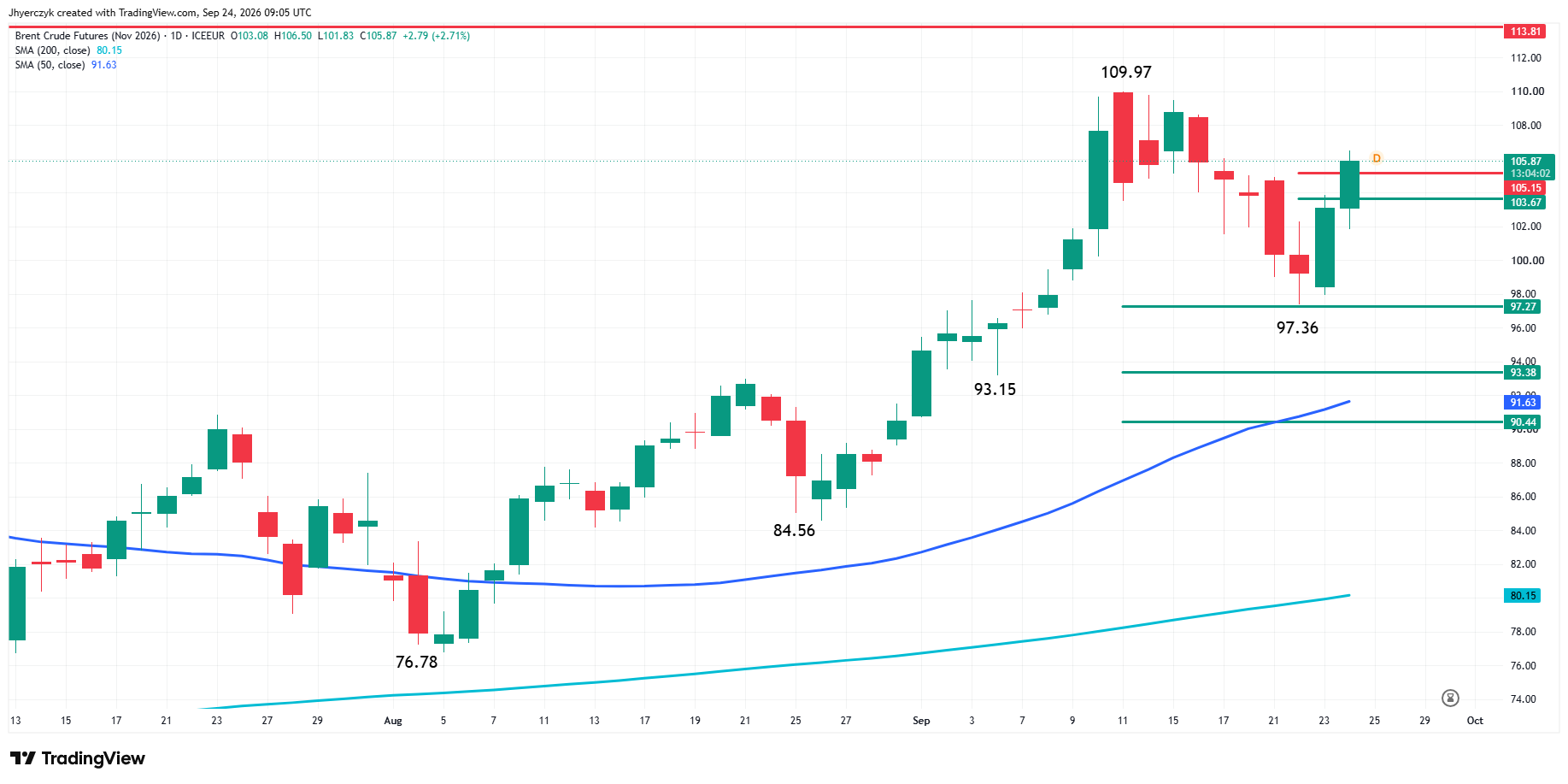
November Brent crude oil futures are making a strong move early Thursday. The technical pattern appears to be a little stronger than the WTI setup.
The main trend is up according to the daily swing chart. The new main bottom is $97.36. A trade through this level will change the main trend to down. Taking out $109.97 will signal a resumption of the uptrend.
The new main bottom at $97.36 was just above the 50% level at $97.27. This pivot price is the mid-point of the $84.56 to $109.97 range.
The new main range is $109.97 to $97.36. Its retracement zone is $103.67 to $105.15. In my opinion, trader reaction to this zone is likely to determine whether buyers make a run at $109.97, or if sellers take enough control to form a potentially bearish secondary lower top that will eventually lead to a breakdown under $97.36 and a change in the main trend.
With the main trend up, my bias is to the upside and for a resumption of the rally over the 61.8% level at $105.15. My bias will weaken on a sustained move under $103.67.
The Hormuz Story Is Still a Negotiation
The U.S. and Iran remain divided over the terms for ending the conflict. Iran wants the naval blockade on its ports lifted and the Strait reopened. U.S. officials are saying a deal will take time and have kept military options on the table.
Tuesday’s talk of Hormuz reopening inside seven days gave crude traders a reason to sell. The report came from a single unnamed official through Kyodo News. No ships went back through the Strait on it. Loading schedules did not change. The security risk for every tanker in the Gulf is the same Thursday as it was Monday.
Saudi Arabia has made the supply picture less tight than it was at the peak. The East-West Pipeline resumed partial operations according to three sources briefed on the matter. The restart gives the kingdom another route to the Red Sea. TankerTrackers showed Aramco loaded about 14 million barrels on seven VLCCs inside the Gulf Sunday. JPMorgan had Saudi flows through the Strait averaging 2.9 million barrels per day over the past six days. In August that was 700,000. Iraq’s oil minister said exports are running above 3 million barrels per day and could rise above 600,000 barrels per day through Turkey.
Those are real changes. November Brent crude oil futures fell to $97.36 Tuesday and November WTI crude oil futures reached $88.67 on that combination. Thursday took most of it back.
Extra routes are not normal routes. The pipeline is at partial capacity. Tankers are changing loading plans. Cargoes are moving through ship-to-ship transfers in Oman. None of that is how Saudi Arabia moved crude before the attacks. Brent is tied directly to waterborne crude and Middle East shipping lanes. WTI has U.S. production and inland supply behind it. Thursday’s rally is hitting Brent harder for that reason.
The Diesel Export Ban Was Denied but the Threat Did Its Work
Politico reported that the administration was preparing a 90-day ban on diesel exports. The report cited administration officials but the White House denied it later in the day. ULSD futures dropped about 5% Wednesday before the denial.
The policy has not been proposed formally. The denial removed the immediate shock. A ban would keep more barrels inside the United States. Retail diesel above $6 per gallon makes the politics obvious. Europe is leaning on U.S. distillate exports right now because Middle East product flows are still disrupted. A ban takes those barrels away from Europe.
A ban would not create a refinery barrel. It would move an existing barrel from one buyer to another. Europe would lose a major source of replacement diesel and pay a bigger premium for whatever is left. Refiners, distributors, and overseas buyers cannot ignore the possibility just because this version of the report was denied.
Crude Built While Distillate Stocks Fell
EIA data showed U.S. commercial crude inventories rose 3 million barrels to 426.4 million barrels for the week ended September 18. Analysts had expected a 641,000-barrel draw. A crude build during a session where November Brent crude oil futures are rallying $2.79 is one reason to think the product side is doing the work right now, not crude supply.
EIA distillate inventories, including diesel and heating oil, fell 428,000 barrels to 107.4 million barrels in the same week. One weekly draw is one data point. Distillate inventories at 107.4 million barrels with gasoil premiums at records and an export-ban threat still floating is where the product market stands heading into next week.
Diesel needs a barrel that has already been refined, delivered, and kept out of a market that is paying record premiums for it. Crude can get an extra cargo from Saudi Arabia or a commercial inventory build. Diesel cannot solve its problem the same way.
The Strategic Petroleum Reserve has fallen toward 285 million barrels according to EIA data, near its lowest level in decades. Commercial crude is building. The reserve behind it is at its thinnest level in decades. That is two charts pointing in different directions on the same page.
What to Watch
The Kyodo News report came from one unnamed official. No ships went through the Strait on it. Hormuz is not open until tankers are moving and insurance markets confirm it. One attack or one failed meeting in New York puts the premium back into November Brent crude oil futures Thursday morning.
The White House denied the Politico diesel export-ban report. Distillate inventories fell to 107.4 million barrels last week according to the EIA. Gasoil’s premium to Brent is at a record near $95 per barrel. The denial did not fix that. Another distillate draw or a refinery problem puts diesel back in front of the crude trade fast.
The premium came out on hope Tuesday. Thursday is showing how quickly it returns when hope is all the market has.
If you’d like to know more about how to trade crude oil, please visit our educational area.