



The oil market spent two days selling diplomacy and woke up Wednesday to missiles, retaliatory strikes and the collapse of the only proposal that had a chance of reopening the Strait of Hormuz. Iran rejected Oman’s plan. The military exchange resumed. The pause that traders were selling into did not survive 48 hours, and the shorts who pressed crude lower on the Oman headlines had to cover everything they put on.
September Brent crude futures rose $3.93, or 4.67%, to $88.02 a barrel at 10:45 GMT. September WTI crude futures gained $3.49, or 4.40%, to $82.75 a barrel.
The Truce Lasted Two Days
U.S. Central Command reported that Iranian forces launched multiple ballistic missiles at U.S. bases in what Centcom called an attempted surprise attack. The missiles were intercepted and no U.S. positions were hit but the oil market was done waiting for context. Iran then rejected Oman’s proposal for joint regional management of Hormuz, the one plan that was actually on the table and the assumption behind Tuesday’s entire selloff. The shorts who pressed crude lower on the diplomatic headlines had to cover everything they put on.
Hormuz Traffic Is Still the Only Number That Matters
Only a few commodity vessels have transited Hormuz so far this week. Bab el-Mandeb showed some improvement Tuesday with 39 vessels passing through, the highest count since July 19, and five had transited Wednesday at the time of the latest data. Saudi Arabia has the East-West Pipeline to Yanbu as a partial workaround but the Houthis have already hit that infrastructure and the route is still running under military risk. Two exits from the Gulf are impaired and a handful of successful transits through one of them does not change the math when the main route is effectively closed.
Inventory Data Lines Up Behind the Geopolitical Bid
The American Petroleum Institute reported U.S. crude inventories fell about 3.3 million barrels in the week ended July 24 with Cushing stocks down 273,000 barrels. Gasoline built roughly 918,000 barrels but the crude draw is the number that matters when the geopolitical premium is already driving the trade. The EIA report due later Wednesday is the confirmation.
The Strategic Petroleum Reserve dropped by another reported 3.7 million barrels to its lowest level since March 1983. OPEC+ is reportedly preparing to halt output increases for three months starting in October after completing the return of barrels tied to voluntary cuts. Saudi Arabia has spare capacity but the problem is not at the wellhead. The barrels sitting behind disrupted shipping lanes do not reach refiners by adding more production at the source.
Brent Oil Price Forecast
Every new Brent Oil analysis as it publishes, today's technical signal and key levels, live price — on one page.
See all Brent Oil forecastsDaily September WTI Crude Oil Futures Technical Analysis
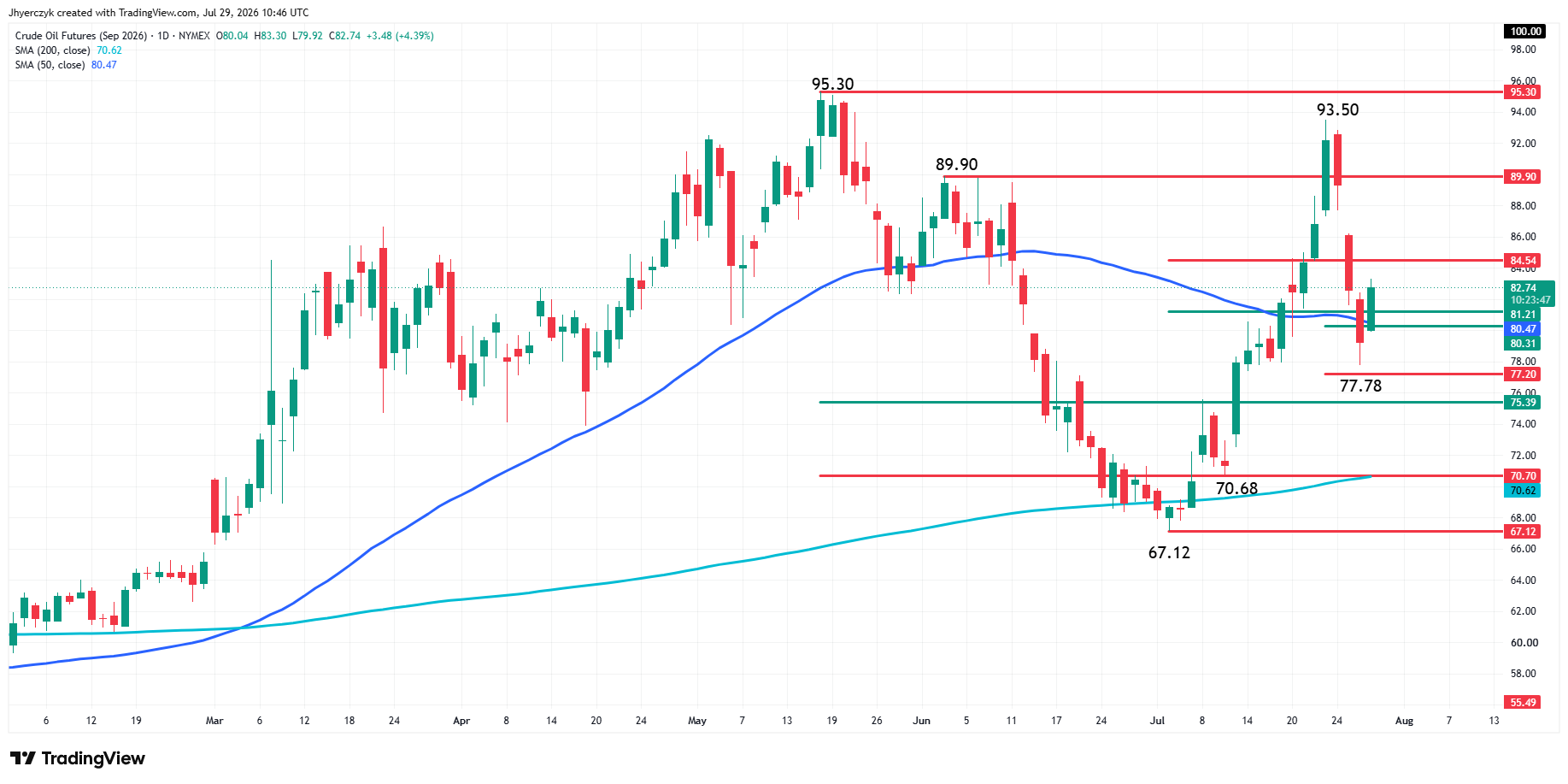
September WTI crude oil futures jumped overnight on a bullish headline. After finding support at $77.78 on Tuesday, the market surged through a pair of 50% levels at $80.31 and $81.21. The 50-day moving average at $80.48, however, is the key to the next major move.
A sustained move over $80.48 will indicate the presence of buyers. If this creates enough upside momentum then look for a quick extension into $84.54. Overcoming this level will indicate the buying is getting stronger. This could create the upside momentum needed to challenge the gap at $86.20 to $87.68.
At this time, the current rally is being fueled by short-covering, in my opinion. But if bullish traders can build a support base at $81.21 to $80.31. Then there is the possibility that new buyers will re-enter the market.
Daily September Brent Crude Oil Futures Technical Analysis
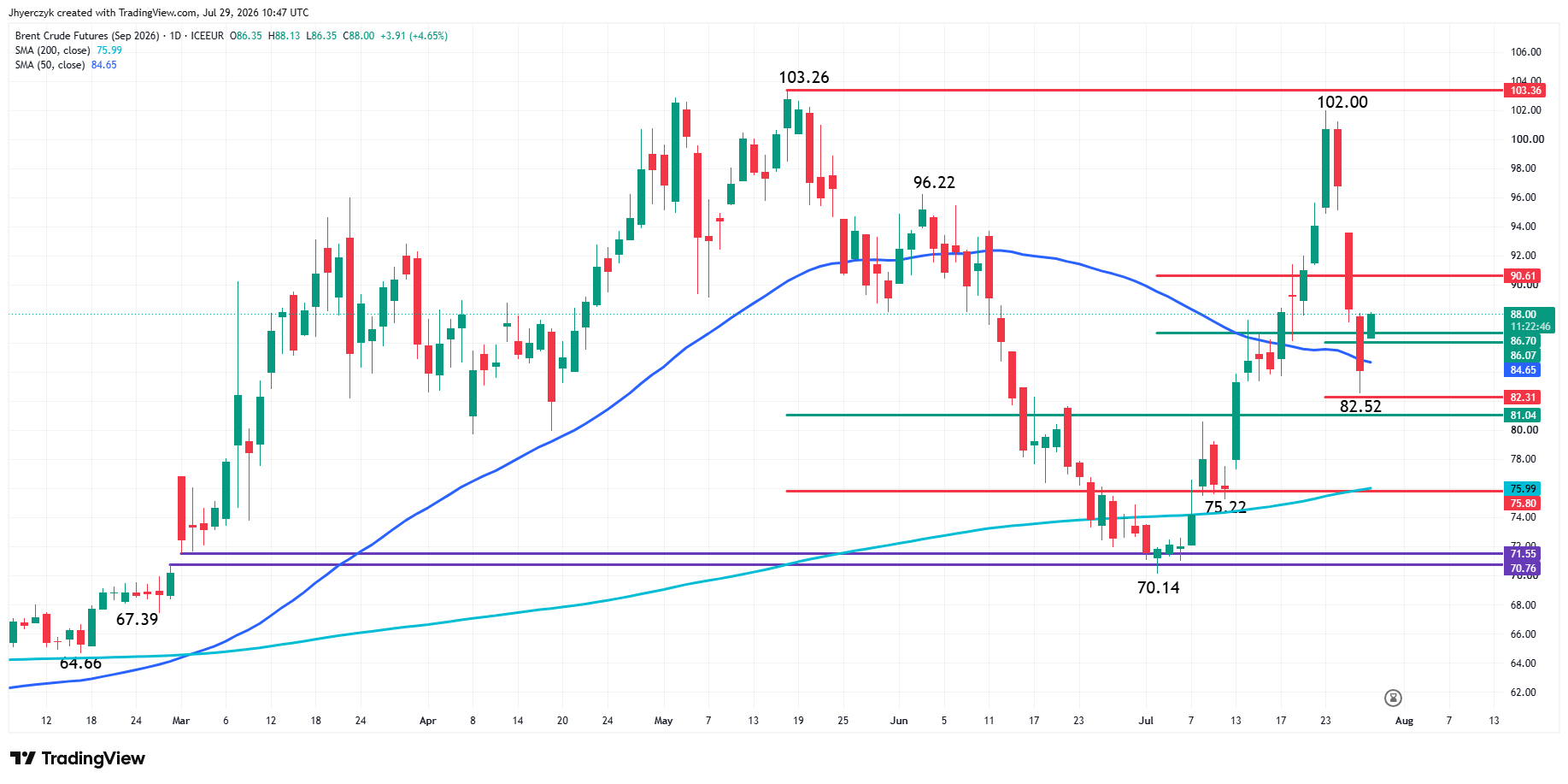
September Brent crude oil futures are edging higher on Wednesday, one day after hitting their lowest level since July 13 at $82.52 yesterday. The market also crossed to the strong side of the 50-day moving average at $84.66 after closing on the weak side of it on Tuesday.
Today’s early strength also put the market on the bullish side of a pair of 50% levels at $86.70 and $86.07.
Under the 50-day MA is the weekly low at $82.52, a Fibonacci level at $82.31 and a long-term 50% zone at $81.04.
On the upside, the nearest potential resistance is the Fibonacci level at $90.61. Overcoming this level will indicate the presence of buyers. If the move gains traction then look for traders to try to fill Monday’s gap at $93.60 to $95.13.
The overnight price action demonstrates the importance of the 50-day. This is the key level to watch today for direction. Traders may try to form a support base at $86.70 to $84.66 before launching the next rally. If they don’t then any rally is likely to look like short-covering rather than new buying.
What to Watch
The EIA report later Wednesday either confirms the API crude draw or undercuts it and the market is leaning toward confirmation after a 3.3 million barrel pull. That number landing on the same morning Iran rejected the Oman plan and launched missiles at U.S. bases gives buyers the geopolitical bid and the domestic data pointing in the same direction. The shorts who sold Tuesday’s diplomacy are the ones buying Wednesday’s escalation and the covering is not finished if ship counts through Hormuz stay depressed while both sides keep striking.
WTI and Brent both cleared their 50-day averages overnight and what happens at those levels over the next two sessions determines whether this is the start of the next leg higher or another headline spike that fades. A sustained hold above the 50-day and buyers have a base to work from heading into Thursday’s GDP and PCE data. A failure to hold and the market goes right back to trading the range between diplomatic hope and military reality that has been defining crude for three weeks.
Brent whipsawed from above $102 on July 23 to below $84 Tuesday and back above $88 Wednesday morning. DBS sees the contract trading that $80 to $100 band near term and the range makes sense while the conflict keeps cycling between diplomacy that fails and retaliation that follows. Tuesday’s sellers found out how fast the lower end gets bought when the next round of strikes hits.
If you’d like to know more about how to September WTI crude oil futures, please visit our educational area.