



I went back through all 15 Bank of Canada hikes since 2017, and the loonie was stronger over the following week in 11, with the edge gone by the third week. The Bank of Canada decides on 28 October, and swaps priced about an 80% chance of a quarter point hike to 2.50% as of 19 October. I expect USD/CAD to ease toward 1.3982 after the decision and take no view beyond two weeks. Below, I date every hike on the Bank’s own series, rank the hedge funds’ Canadian dollar short against its history, test the pair against the two year gap, and set the levels where I’d be wrong.
Two common readings say the hike fuels a bigger loonie rally, or that a priced hike moves nothing. The record supports neither.
News
The Bank of Canada announces at 09:45 ET on Wednesday 28 October with a new Monetary Policy Report, according to its 2026 schedule. The Fed decides the same afternoon, at the end of its 27 to 28 October meeting, and September PCE inflation follows at 08:30 ET on 29 October in the BEA’s release schedule.
Governor Tiff Macklem started the repricing. On 19 October The Globe and Mail reported his view that if oil stays around US$100, “we expect inflation to gradually drift up” from 3%, a line The Hub also carried, and it put swap odds at about 80% on Bloomberg data, up from roughly 35% on 16 October.
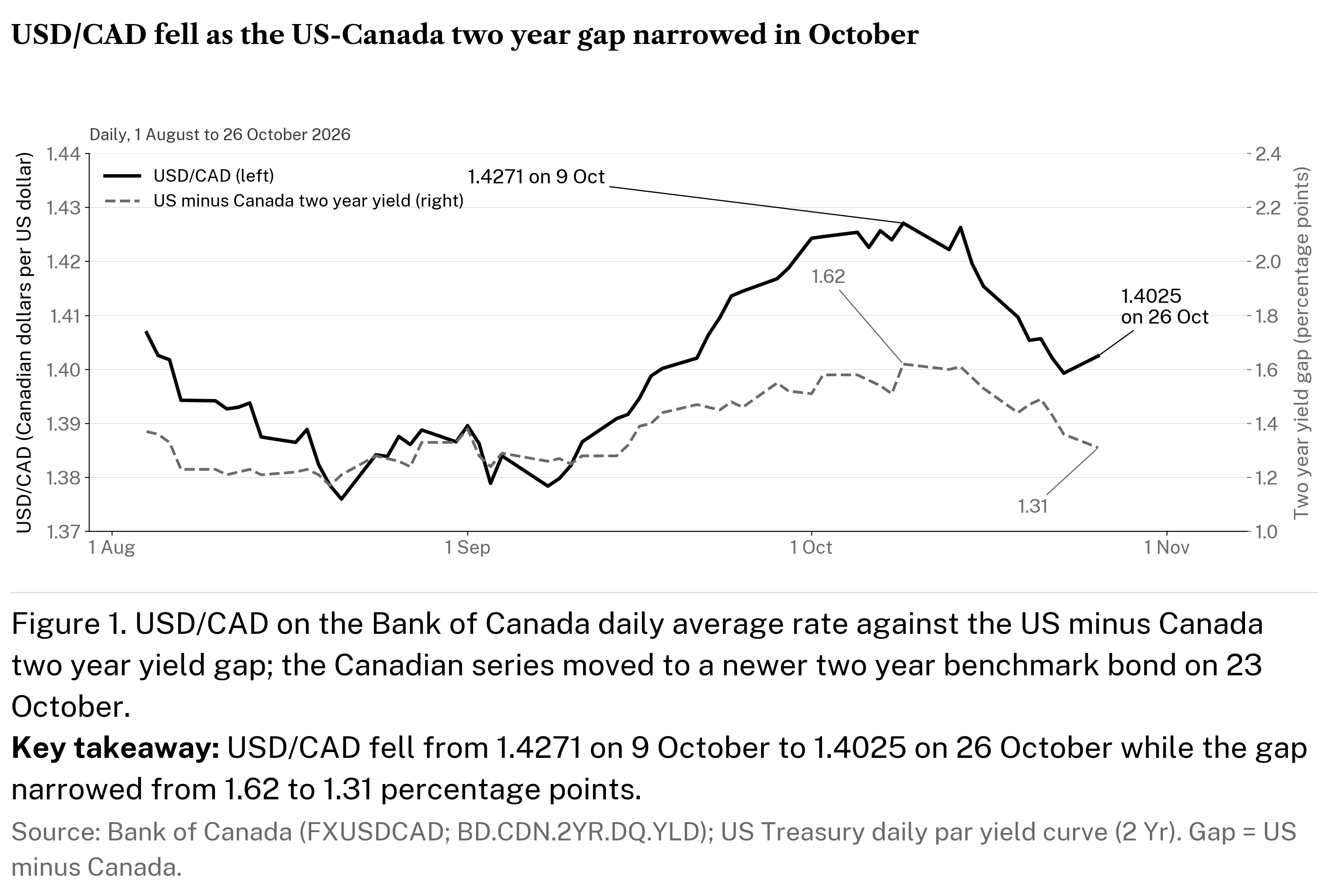
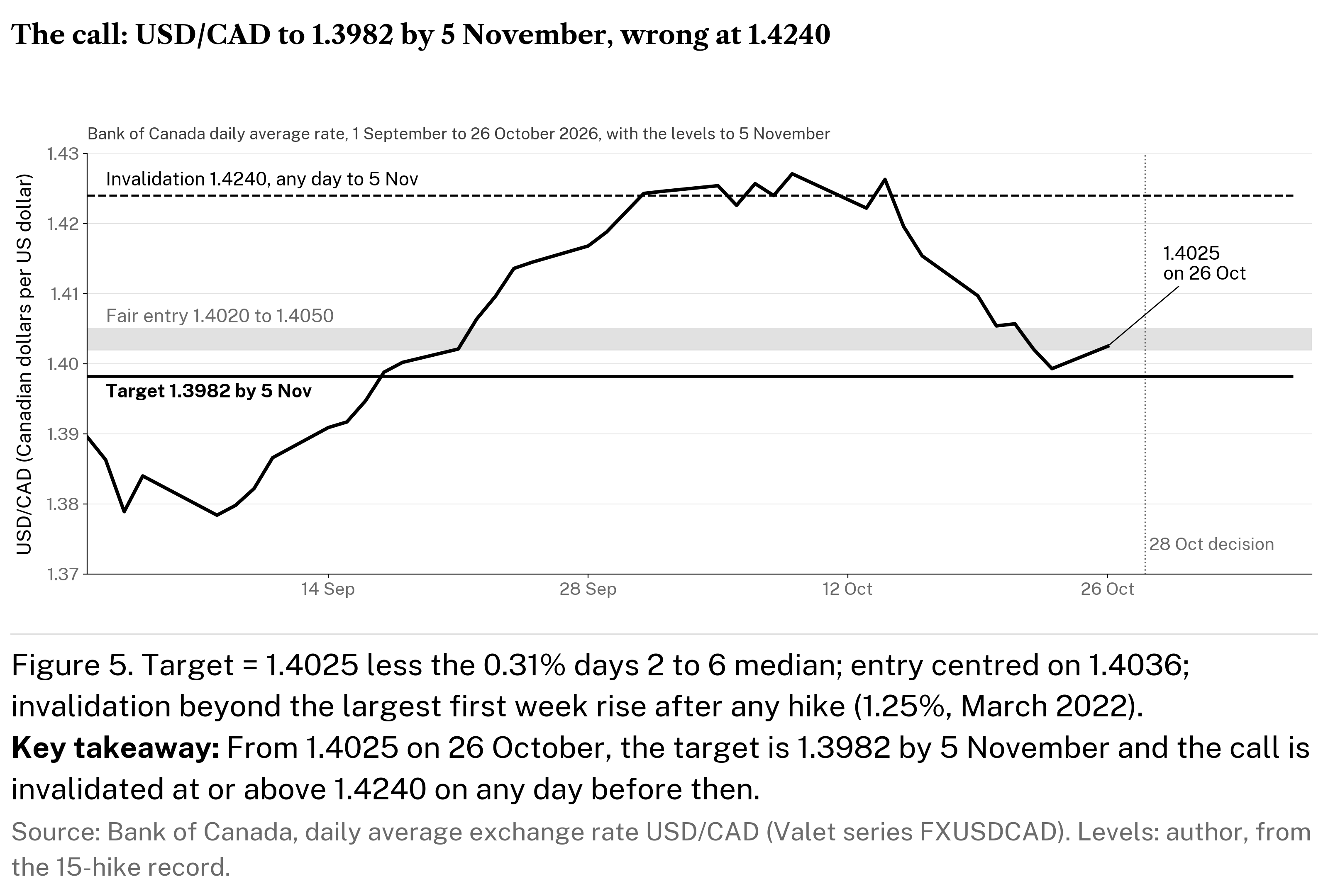
On the Bank of Canada’s daily average rate, USD/CAD set its 2026 high at 1.4271 on 9 October, fell to 1.3993 by 23 October and stood at 1.4025 on Monday 26 October, 1.72% below the high. I read that fall as a hike largely paid for in advance.
Context
Statistics Canada put September consumer prices 3.1% higher than a year earlier, up from 3.0% in August. Gasoline rose 27.8%. Excluding gasoline, inflation slowed to 2.2%, and the Bank’s preferred core measures, CPI-median and CPI-trim, eased to 1.9% and 1.8%. The September Labour Force Survey showed 68,000 jobs lost, the second monthly fall, with unemployment at 6.5%. My read: a Bank hiking for oil while its core gauges cool.
USD/CAD Price Forecast
Every new USD/CAD analysis as it publishes, today's technical signal and key levels, live price — on one page.
See all USD/CAD forecastsSince the cut announced on 29 October 2025, the policy rate has been 2.25%. A hike would be the Bank’s first since July 2023. Canada’s two year benchmark yield rose from 3.18% on 9 October to 3.37% on 26 October, while the US Treasury yield at the same maturity eased from 4.80% to 4.68%. Part of the Canadian rise is a switch: the series jumped from 3.22% to 3.33% on 23 October, when the Bank moved its two year benchmark to a newer bond.
Stepping back helps to show how this exchange rate usually works. Canada’s dollar is the currency of a large energy exporter that sells most of its goods to one neighbour, the United States. For decades that made the loonie a rough proxy for oil, rising when crude rose and falling when it fell. That link’s never been fixed, and it tends to loosen when oil jumps for reasons of war or supply, since such shocks also move the other forces that act on a currency.
The other steady driver is the gap between interest rates in the two countries. Money tends to move toward the currency that pays more, so when Canadian rates rise relative to American ones, the Canadian dollar usually firms. Yields on short government bonds capture that gap well, since they move with expectations for the next few central bank decisions. When both central banks are raising rates at the same time, the currency tends to follow whichever side moves further than traders expected.
By the time a governor raises rates, futures and swaps have usually priced most of the move, and the currency has already done much of its adjusting. What follows the decision then depends on fresh information, such as the bank’s new forecasts, the next data releases and what the other central bank does.
Futures positioning adds a further layer, showing how hedge funds and asset managers are leaning, and a very lopsided position can unwind quickly if the news turns. A crowded position on its own doesn’t decide timing, though, because traders can stay crowded for months while the trend continues. Futures also cover only one slice of currency trading, most of which runs through banks and spot markets around the world.
Financial Analysis
Fifteen hikes, and the first week does the work
I matched every increase in the Bank’s overnight rate target since 2017 to its daily USD/CAD rate. There were 15, from July 2017 to July 2023. I dated each on its announcement day, which for the five 2017 and 2018 hikes is also the day the new rate took effect. My base is the rate on the day before each announcement.
On the decision day, the median move was a 0.30% fall in USD/CAD. The loonie was stronger 11 times out of 15.
I expected one trading day to carry the move. It did not, since single trading days in the following week gave medians anywhere between a 0.08% and a 0.64% fall. I then averaged each hike’s rate over the second to sixth trading days. The median of those averages is a 0.31% fall, and the loonie was stronger in 11 of 15. On a one sided test, a split of 11 against 4 would arise by chance about 6% of the time, which makes it a small edge. Two weeks out, the median fall was 0.28%. The loonie was stronger in 10.
At three and four weeks the outcomes split roughly evenly. Four weeks out, USD/CAD was higher in eight of the 15 cases, with a median rise of 0.87%. Restarting the clock on any of the five days from the decision gave four week medians between +0.49% and +1.19%.
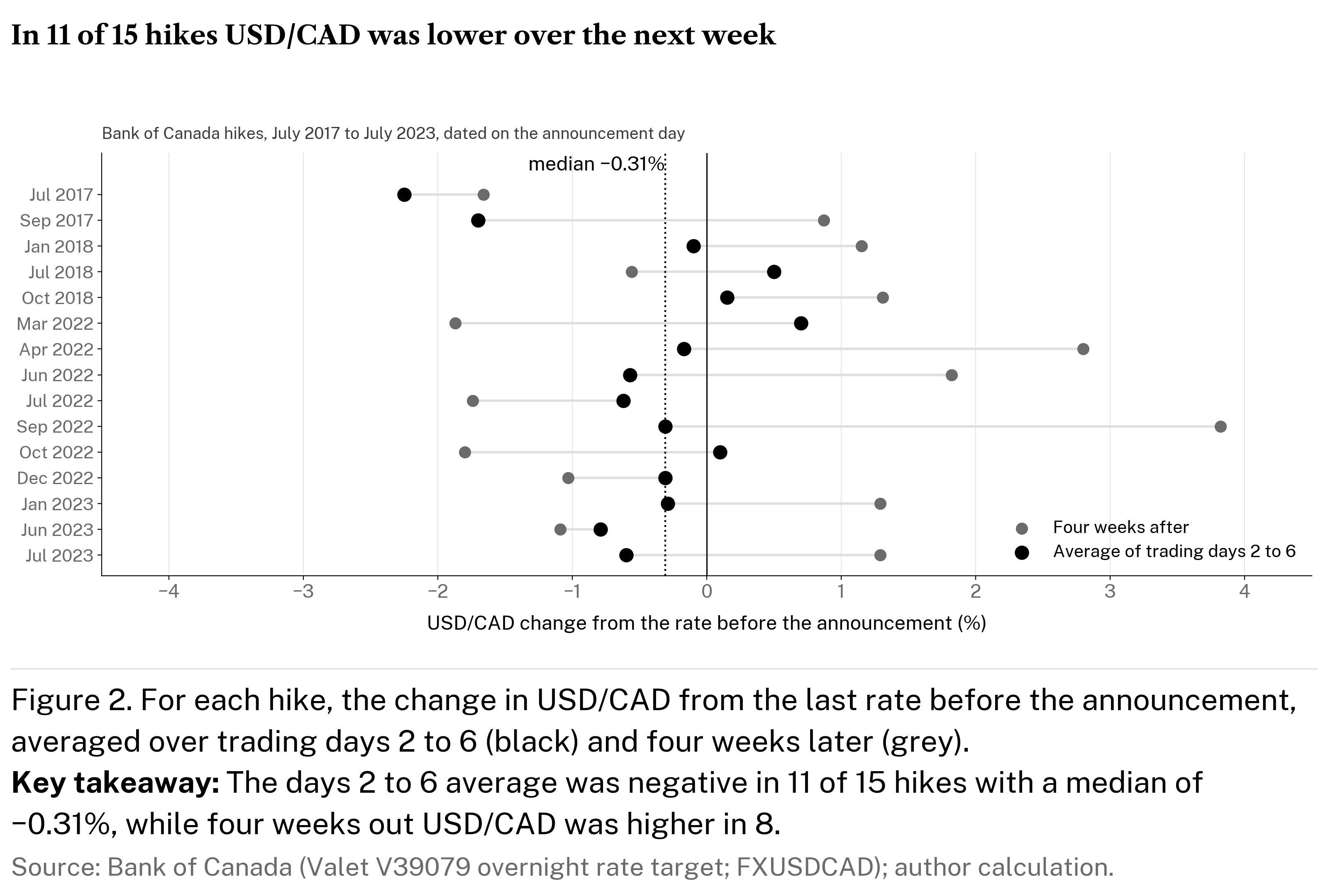
Nine hikes followed a loonie rally in the two weeks before the meeting, as now, and they looked much the same. On the fifth trading day their median USD/CAD fall was 0.63%, and the loonie was stronger in seven. The two hikes that opened a cycle split at that horizon: July 2017 brought a 2.52% fall and March 2022 a 0.89% rise, which runs counter to my call. Some of those hikes were not fully priced, and I could not rebuild the swap pricing before each one.
The short that hasn’t squeezed
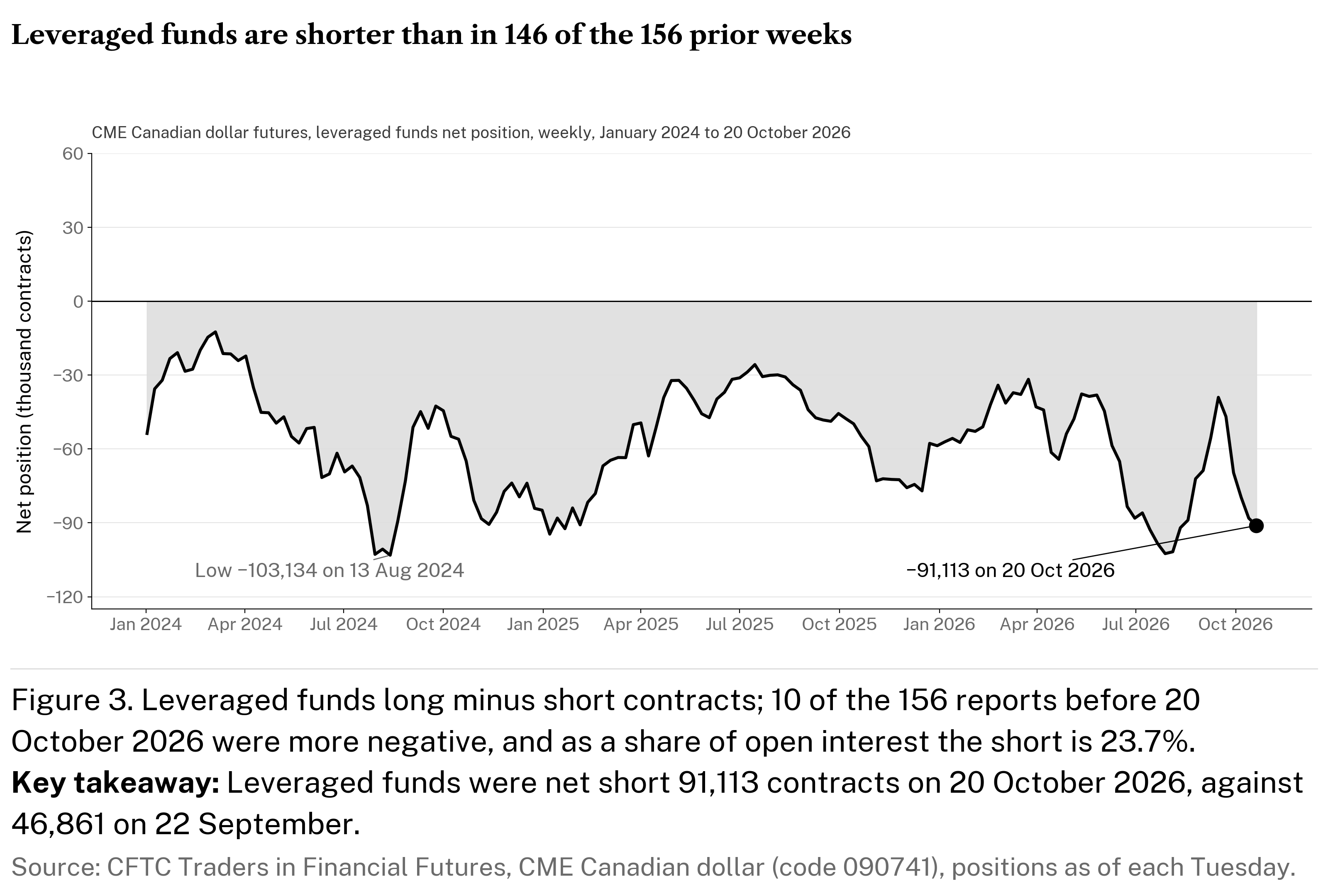
Leveraged funds’ positions come from the CFTC’s Traders in Financial Futures report for 20 October, released on 23 October, which shows 28,341 long and 119,454 short Canadian dollar contracts on the CME. That’s a net short of 91,113, almost double the 46,861 of 22 September. When I ranked it against the previous 156 weekly readings, only 10 were more negative, but as a share of open interest it is 23.7%, and 52 of those 156 readings were deeper on that measure, so the short looks extreme in contracts and ordinary against the size of the market.
I wanted to know whether shorts this deep have squeezed before, so I ranked each weekly reading since June 2009 against its previous three years and flagged the bottom tenth. From 2017 on, 89 weeks qualified and 87 have a full eight weeks after them, and USD/CAD had fallen after 44, risen after 42 and was unchanged after one, which gives me no squeeze edge. Counting only the first week of each run inside the bottom tenth leaves 10 runs, and USD/CAD was higher eight weeks later in seven of the nine with a full window.
The two year gap moves the pair
I regressed weekly changes in USD/CAD on weekly changes in the US-Canada two year yield gap over the 52 weeks to 26 October. I ran it for each weekday, with and without filling holiday weeks from the day before. Slopes ran from about 4.5% to 6.9% per percentage point. Their t-statistics ran from 4.6 to 6.6, with an R-squared of 0.30 to 0.47. From January 2025 the slopes are smaller, 3.5% to 4.4%, with an R-squared of 0.17 to 0.23. WTI spot from the EIA, over the same weeks through its last print on 20 October, never produced a t-statistic beyond 1.8 in size.
October was less tidy. Between 9 and 20 October, WTI rose from $98.73 to $107.89. USD/CAD fell 1.52%. Over the same dates the yield gap narrowed from 1.62 to 1.47 percentage points, which the slopes put at a fall of only 0.7% to 1.0%. Macklem tied his warning to oil near US$100, so crude reached the pair through the Bank’s expected path. On 19 October, about three in four Albertans backed staying in Canada in early returns reported by CTV News. That removed a political risk in the same week, so I can’t credit October’s rally to rates alone.
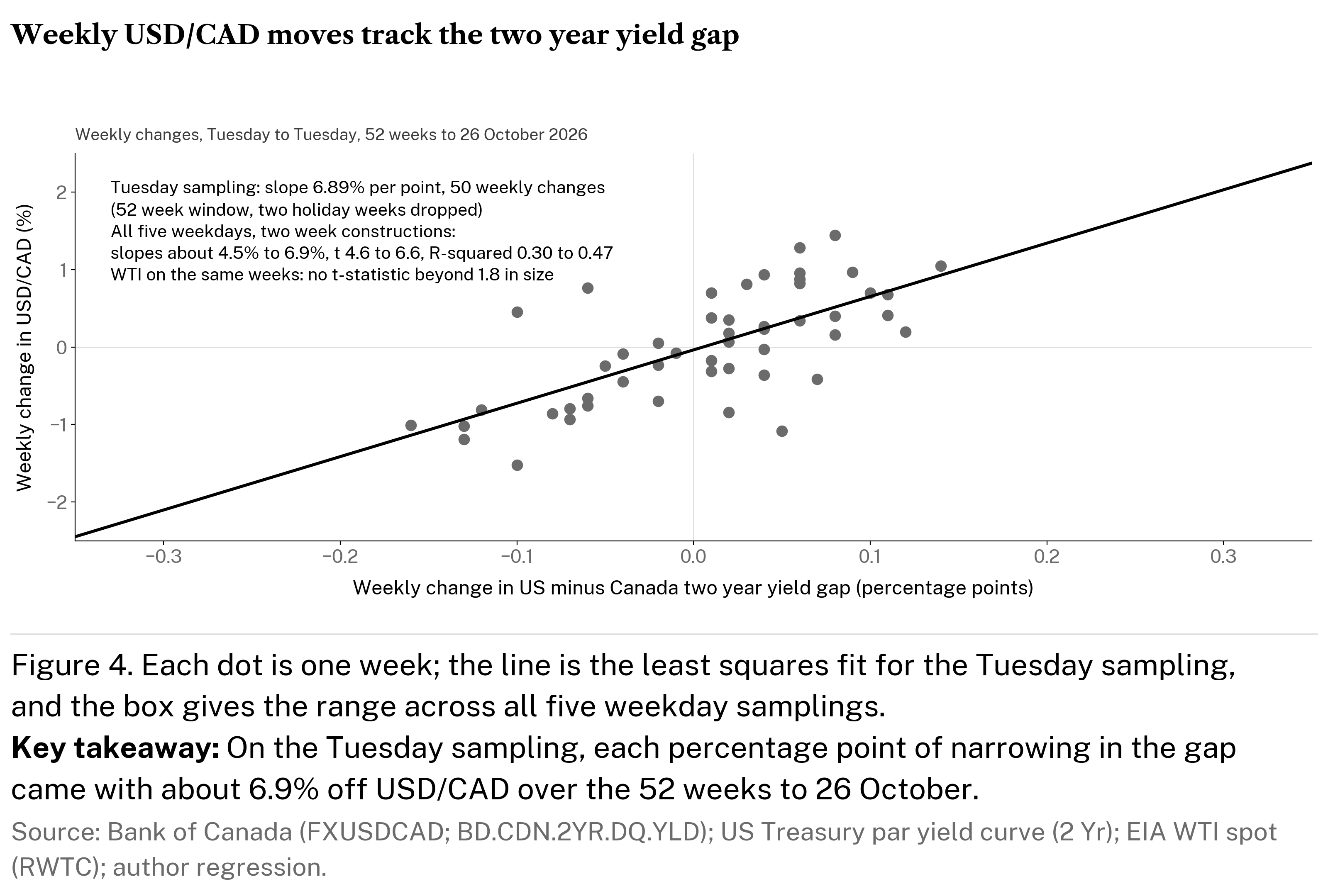
With swaps near 80% on 19 October, a delivered quarter point hike is a surprise of about 5 basis points. A hold is a surprise of 20 basis points the other way. If the two year gap moved one for one with that surprise, the slopes would put a hike at about 0.2% to 0.3% off USD/CAD and a hold at about 0.9% to 1.4% on it. Weighted by those odds, the rate model expects almost no move from the decision itself, so my lean rests on the hike record alone and stays small.
Position and Risk
In my view, the week after a hike favours the loonie, and the record gives no direction after two weeks. My asset is USD/CAD, measured on the Bank of Canada’s daily average rate, and my direction is lower over the week after the decision.
My target is 1.3982 by 5 November. I took the 1.4025 rate of 26 October and applied the 0.31% median from the second to sixth trading days. Because the record starts from the rate before each decision, the entry sits before 28 October, and after the decision much of the measured move has already printed. I’d treat 1.4020 to 1.4050 as a fair entry zone, about 15 pips either side of 1.4036. That centre is 1.4025 plus 0.08%, the median of each past hike’s highest rate in its first five trading days.
The call is invalidated by a Bank of Canada rate at or above 1.4240 on any day through 5 November, beyond the largest first week rise after any of the 15 hikes, 1.25% in March 2022. Applied to 1.4025, that rise tops out at 1.4200, and I leave 40 pips above it. A print there would mean I’ve misread the hike week. It’ll also lapse if the Bank holds on 28 October, because I measured hikes and nothing else.
The risk I watch most inside the call is a hike delivered with a cautious Monetary Policy Report, and a hold ends the call. A hawkish Fed the same afternoon or the September PCE report on 29 October could widen the US side of the two year yield gap, and the US midterm elections on 3 November fall inside the window.
Conclusion
My base case has USD/CAD at 1.3982 by 5 November. In 11 of 15 hikes the loonie ended the following week stronger, a small and only borderline significant edge. The deep short hasn’t been a reliable squeeze signal in my tests, and over the past year the two year yield gap has explained the pair’s weekly moves far better than oil.
Over six to twelve months I’d watch the US-Canada rate gap ahead of oil, and the 9 December decisions at both central banks will show whether it keeps narrowing. I tested a priced hike the same way in my AUD/USD analysis, and I’ll follow the releases on the economic calendar and check the Bank of Canada rate against 1.3982 and 1.4240 through 5 November.