


Gold has a couple of different things to think about this morning, the first one being a modestly supportive retreat in U.S. real yields and a mixed signal from industrial activity. Treasury data showed the 5-year real yield at 2.64% on Friday, down from 2.76% the prior session, while the 10-year real yield declined from 2.88% to 2.77%. A lower real yield can help improve the appeal of precious metals, including silver, but it does not necessarily guarantee that the price will rise. Silver is more exposed to manufacturing demand than gold is, so the move in yields is only part of the situation here.
Manufacturing Improving Slightly
Most recent U.S. production data offers evidence of a small manufacturing improvement rather than broad acceleration. In its G.17 release published on November 17, the Federal Reserve reported that manufacturing output rose 0.3% in October, matching the previous month’s increase. The manufacturing production index moved from 98.1 in May to 98.7 in September on a 2017=100 basis. Total industrial production declined 0.4% in October, however, after rising 0.7% in September. Mining output fell 0.8%, and utilities output dropped 4.3%.
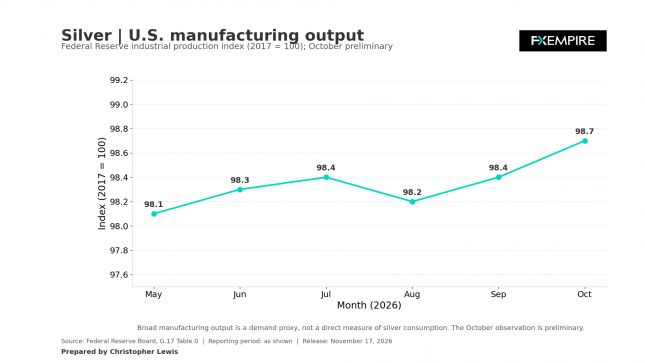
This contrast can matter for silver because a better manufacturing component is constructive for industrial use, while broader monthly falls caution against describing the entire industrial economy as strong. Keep in mind that October’s figure is preliminary and could be revised.
Federal Reserve Cannot Determine Whether Manufacturers Bought More Silver
The Federal Reserve release does not explicitly say that manufacturers bought more silver, and it cannot establish the same change in solar panel demand, electronics, electrical contact, or brazing uses as well. Silver’s industrial end uses can benefit from activity in electronic and electrical equipment, but the link from a broad manufacturing index to the physical silver balance is simply inference, not something that can be guaranteed.
CFTC CoT Report
Positioning remains positive but has eased slightly. CFTC futures-only data dated November 17 showed non-commercial traders with 35,995 long and 17,704 short COMEX silver contracts, a net long of 18,291. The prior week’s net long was 19,364, meaning the speculative net position shrank by 1,073 contracts. This is a modest reduction, not a wholesale exit. The data are measured on Tuesday and released late in the week, so they describe positioning before the weekend and do not capture today’s trading.
Silver Price Forecast
Every new Silver analysis as it publishes, today's technical signal and key levels, live price — on one page.
See all Silver forecastsGold remains relevant because silver often responds to the same real-rate and currency focuses while carrying the larger industrial-demand component. The decline in real yields is therefore supportive for both metals in principle, but silver can underperform if growth-sensitive demand expectations deteriorate. Conversely, stable to improving manufacturing alongside lower yields would create a more balanced tailwind than a monetary catalyst alone. Correlations do, of course, vary over time, and the official data currently does not establish a fixed relationship.
A data revision is also due this week. The Federal Reserve says it plans to publish an annual revision to industrial production indices at noon EST on November 24, using a new 2022 base year and incorporating additional benchmark information. That revision may alter historical levels and comparisons, so readers should distinguish the November 17 preliminary October estimate from the revised historical series that follows.
Slight Macro Tailwind
The near-term view is balanced with a slight macro tailwind. Real yields fell. Manufacturing grew for a second month, but total industrial output contracted, and futures positioning remains net long after a small weekly reduction. The bullish case will improve if lower real yields persist and subsequent industrial data confirm wider-based growth. If real yields rebound and output softens again, it could weaken the case for silver.
Charts Look Weak Still
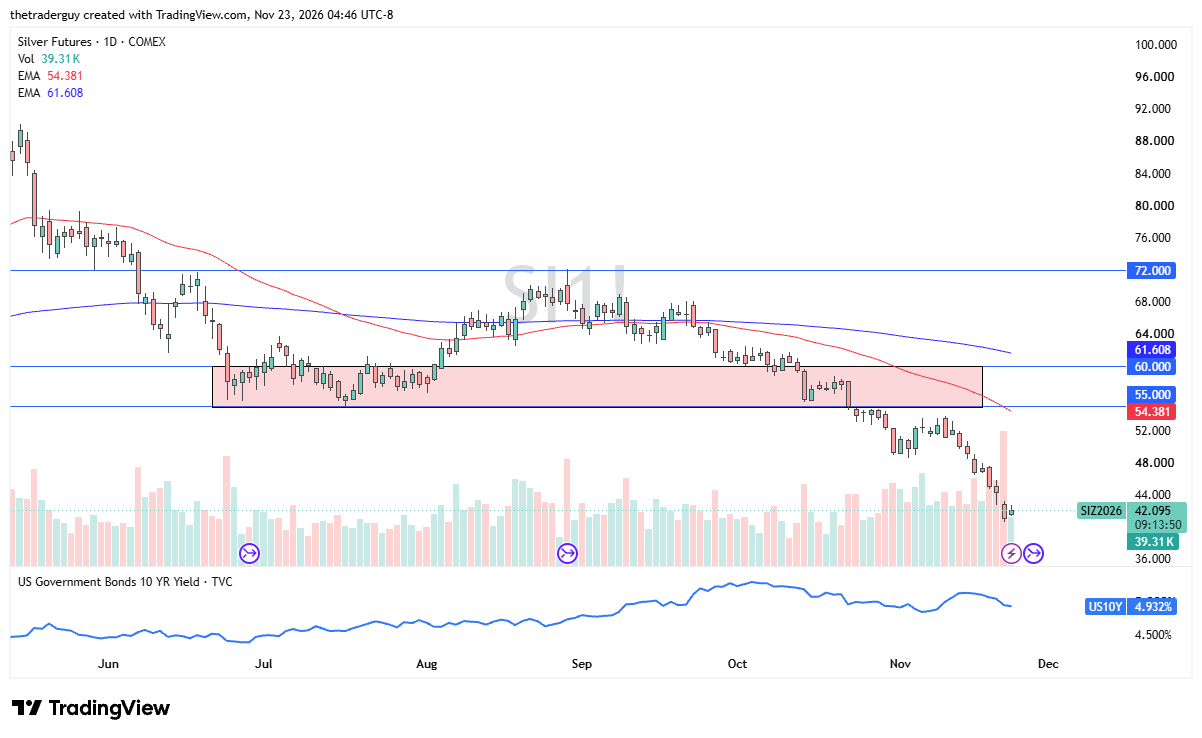
Looking at the charts, the silver market has bounced slightly, but it still seems very negative, and at this point in time, I still look at rallies as opportunities to sell into at the first signs of exhaustion. Quite frankly, despite the fact that real yields have dropped a bit, there is still a significant tailwind coming out of the Treasury market.
If you’d like to know more about how to trade gold and silver, please visit our educational area.