


Silver has fallen precipitously during the early part of the Thursday session as traders react to reports that the United States is pulling diplomats from Saudi Arabia ahead of fresh attacks against the Iranians, believed to be after the midterm election.
Modest Industrial Improvement
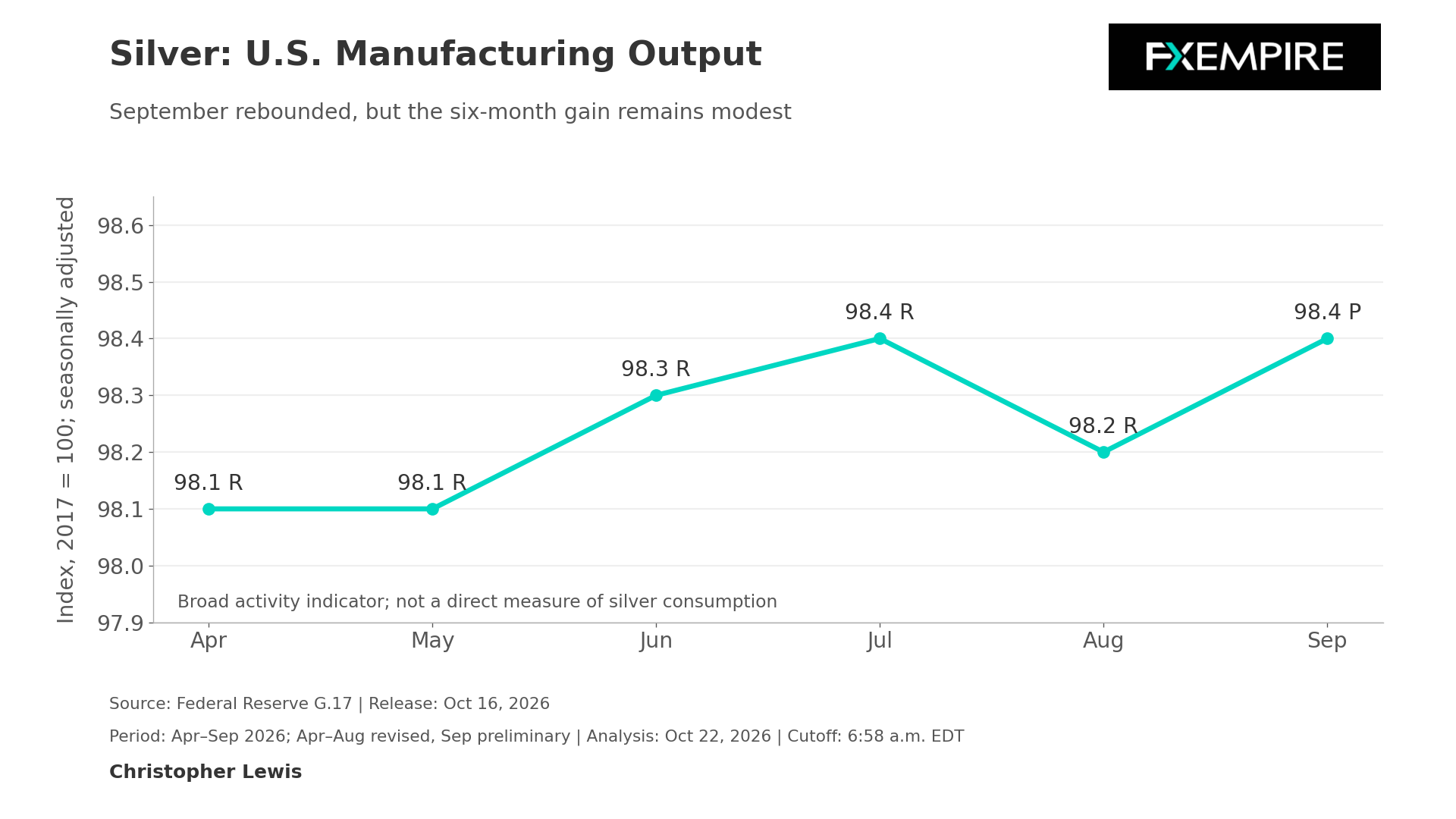
The fundamental picture beyond that combines modest industrial improvement with a still-demanding financing environment. The Federal Reserve’s October 16 industrial production release showed manufacturing output increasing 0.3% in September after a revised 0.2% decline in August. Manufacturing was reported to be 1.1% above the previous year, and while these are preliminary September activity estimates, the gains in manufacturing do suggest that demand for silver could be picking up.
The historical context matters in this case, though. The seasonally adjusted manufacturing index stood at 98.4 in September compared with 98.1 in April, with the 100 level being calculated via the 2017 readings. The rebound, therefore, shows modest progress across that period rather than a dramatic industrial revival.
Broad Manufacturing Cannot Tell the Whole Story
Silver is used across several industrial applications, which is why the broad manufacturing index alone doesn’t measure direct silver consumption. Stronger factory output does not establish how much metal was purchased, which technologies accounted for demand, or whether inventories were accumulated. It’s a bit premature to turn an improvement in aggregate activity into an estimate of additional silver demand.
At This Point, the Monetary Side Is Probably the Main Driver
The Treasury’s 10-year real par yield eased to 2.76% yesterday from 2.77% the day before. The 2-year nominal par yield instead increased to 4.81% from 4.79% the previous session. A small reduction in longer-term inflation-adjusted opportunity costs alongside firmer short-maturity nominal financing conditions offers a bit of a mixed signal.
Silver Price Forecast
Every new Silver analysis as it publishes, today's technical signal and key levels, live price — on one page.
See all Silver forecastsThis contrast can produce a less straightforward response than an inflation-hedge narrative might suggest. Lower real yields could support precious-metal demand, but high borrowing costs can restrain working capital, capital spending, and inventory financing. Silver can consequently be influenced by both monetary expectations, especially coming out of the Federal Reserve, and changes in manufacturing confidence.
PPI Report Last Week
The BLS reported September final-demand PPI last week, rising 1.3% monthly and 6.3% annually. The measure excluding food, energy, and trade services increased 0.5% monthly and 5% annually. Separately, the CPI release last week put September headline consumer inflation at 3.7% annually. These measures cover different stages of economic pricing and are not interchangeable, though.
Silver sees elevated producer costs having conflicting implications. It can strengthen interest in monetary protection, but at the same time, it can also squeeze manufacturers’ margins and reduce the appeal of holding costly materials such as silver or gold. The effect depends on whether businesses can pass through costs and whether final demand remains resilient.
Federal Reserve
The Federal Reserve’s September 16 decision raised the federal funds target range to 3.75% to 4%. Its next meeting is scheduled on October 27 and 28, but at this point in time, most traders expect the Federal Reserve to hold rates. That being said, a less restrictive path could improve financing conditions, which in turn could lift silver.
The stronger silver scenario would be sustained manufacturing improvement with easing real yields. The weaker scenario would combine industrial disappointment with renewed strength in real financing costs. Watching both will offer the framework more than relying on the direction of gold alone.
Current official buying, supply, exchange inventory, and positioning figures are a bit mixed at the moment and therefore considered to be noisy more than anything else. The silver market will, of course, remain very sensitive to war headlines, which are currently the biggest problem the market faces.
The Setup
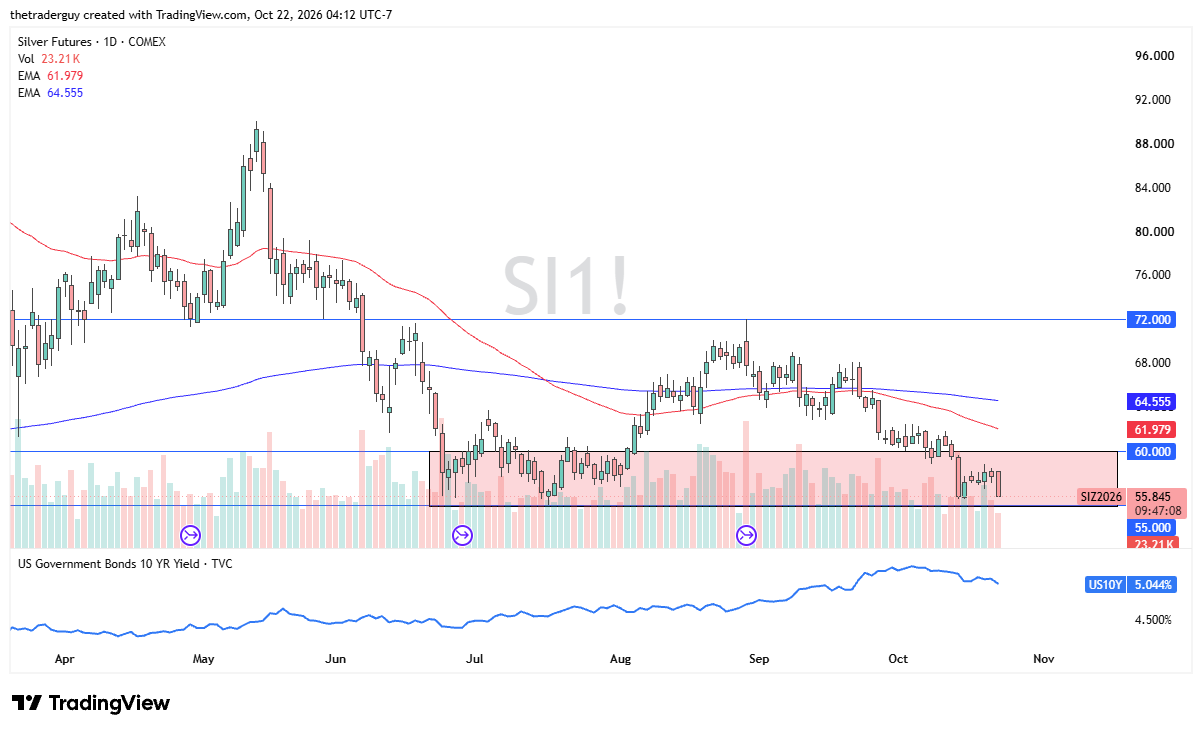
As things stand right now, it looks as if the silver market is getting ready to threaten the $55 level, and from a technical-analysis standpoint, this is a major floor in the market. Breaking below the $55 level could be thought of as very negative. Currently, we are in a range between $55 and $60, so a bounce from here would just re-solidify the idea of support being just below.