


Silver currently has a bit of a mixed fundamental backdrop. The latest U.S. industrial figures provide some evidence of continued expansion, but the improvement is not broad or powerful enough to justify an unqualified industrial-demand-boom type of narrative.
At the same time, positive real yields keep opportunity costs attached to holding a precious metal that pays no income. The Federal Reserve’s October 16 industrial production release showed manufacturing output increasing 0.3% in September after a 0.2% decline in August. Manufacturing was 1.1% above its year-earlier level.
Overall industrial production rose 0.7% in September, with utilities increasing 3.5% and mining rising 0.2%. The distinction between headline and manufacturing matters for silver. A strong utility reading can lift total industrial output without implying an increase in metal-intensive factory activity.
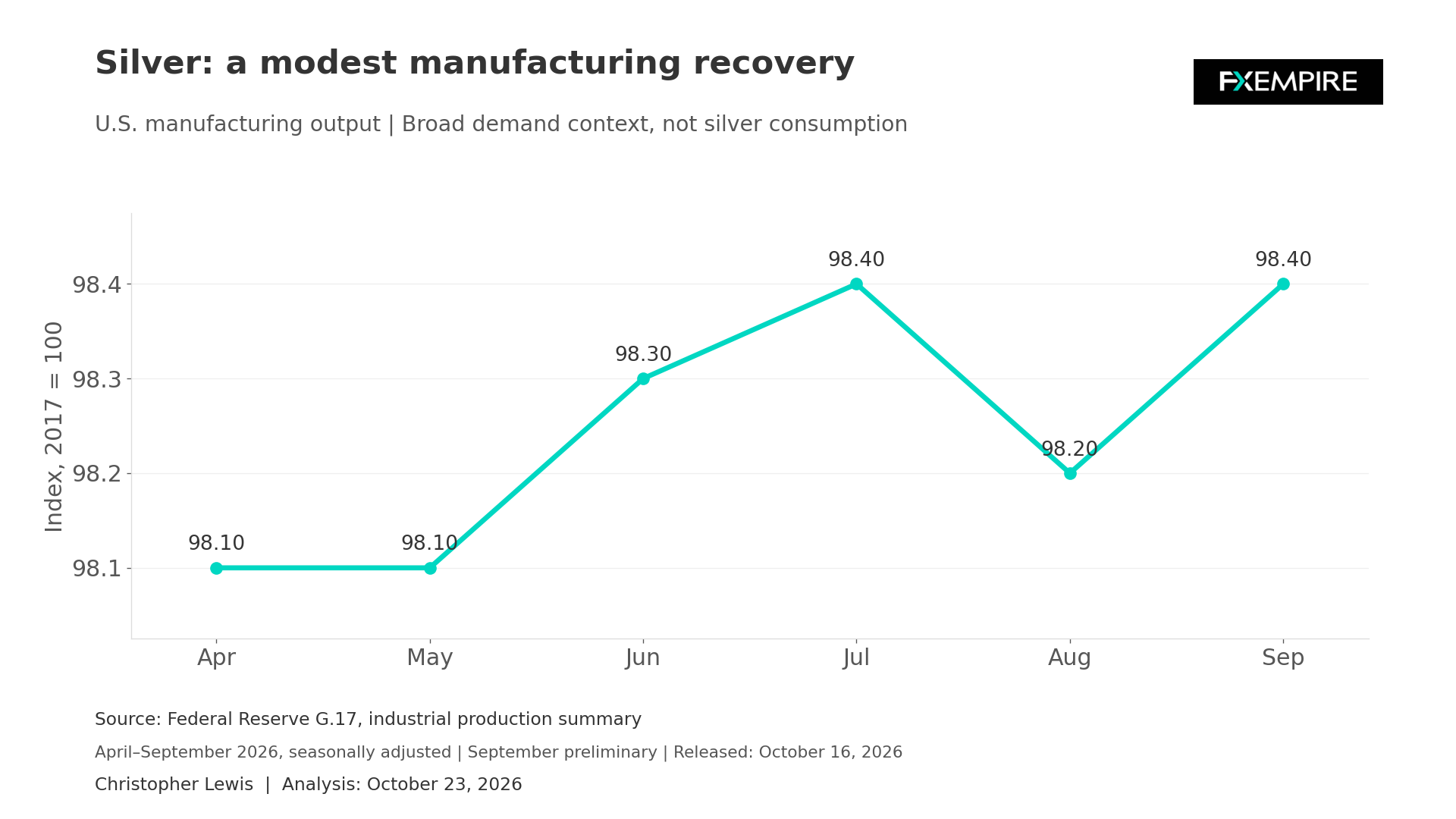
Manufacturing’s improvement is encouraging, but a modest rebound after a decline is much different than accelerating expansion. The manufacturing index reached 98.4 in September on a 2017=100 basis. This matches July’s reported level. April and May were both 98.1. September is still preliminary, while earlier observations incorporate all revisions.
The chart below illustrates gradual, uneven progress in broad U.S. factory output. The industrial evidence offers some support while limiting the strength of the bullish claim. Better factory activity could improve the environment for industrial metals, but the amount of silver used depends on the mix of goods produced. A broad production index doesn’t give us all of the answers.
This also explains why longer-term stories about electrical applications or solar power should be handled carefully in a daily report. A structural use case does not establish that orders increase this week. Without fresh official in-use figures, most of this is conjecture at the moment.
The Monetary Side Is Important as Usual
The Federal Reserve’s October 22 H.15 release put the 10-year inflation-indexed Treasury yield at 2.76% on October 21. The September 16 policy decision that raised the federal funds rate to 3.75% to 4% is still fresh in the minds of traders as well.
For silver, tight financing conditions can operate through both investor demand and industrial activity. Higher returns on interest-bearing assets such as bonds make holding metal less attractive. More expensive credit can also affect how manufacturers behave and their willingness to expand capacity or carry inventories.
Silver also tends to respond differently to different types of economic weakness. Softer data that reduce expected policy restraint might help its monetary appeal if it seems as if the Federal Reserve is likely to cut rates. If the same data implies a substantial deterioration in industrial demand, that could be a bit of an offset.
The next FOMC meeting is October 27 and 28 and could be a catalyst. The useful question will be not so much what they do, but what they say. There is no expected interest-rate hike for the meeting, although traders still believe that December is very much live.
A cautiously constructive industrial reading doesn’t seem to be helping the silver market, though, as we have in fact dropped below the crucial $55 level. The $55 level has a lot of market memory attached to it and was, in fact, the bottom of the recent consolidation area.
Silver Price Forecast
Every new Silver analysis as it publishes, today's technical signal and key levels, live price — on one page.
See all Silver forecastsThe Setup
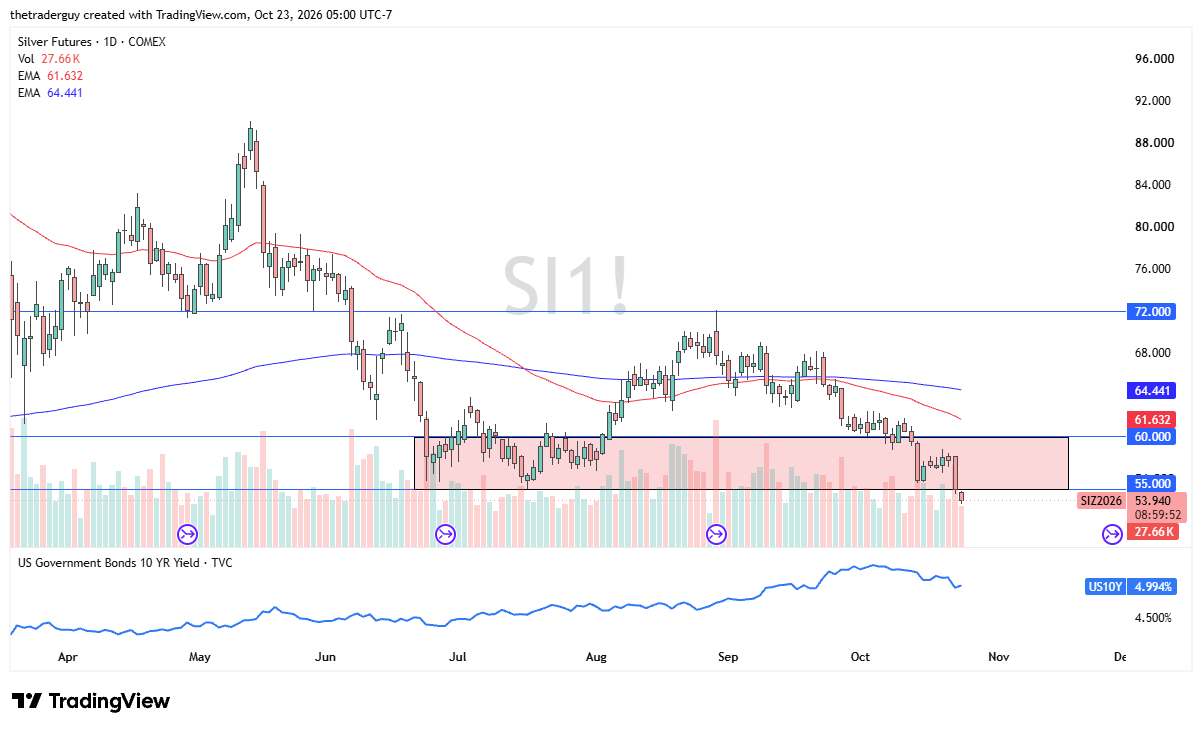
At this point, it looks like the selling pressure in silver is accelerating, and short-term rallies will certainly be appealing to those looking to fade all of those positive moves. The next major support level is closer to the $50 level, just as the $55 level, based on market memory, could very well end up being resistance.