


Silver’s weekly fundamental picture combines evidence of continued industrial activity with an uneven manufacturing expansion and a persistent interest-rate hurdle to overcome.
Manufacturing Hires
The most useful development is not just that U.S. hiring continued; it’s that the week’s official release showed meaningful differences between sectors, making a broad claim of booming industrial demand difficult to support. Friday’s October report showed manufacturing added 19,000 jobs. Computer and electronic product manufacturing contributed 7,000, while machinery and primary metals each added 4,000.
These figures describe employment, not necessarily silver purchases. Nonetheless, they provide a fresh indication that several industrial categories continued hiring rather than a uniform slowing retreat across the factory sector. The combination of the two provides a careful connection to silver markets. More workers can accompany increased production, but procurement also depends on inventories, technology, product mix, and the amount of metal used per manufactured unit. Hiring in electronics, therefore, is relevant background without establishing how many ounces were consumed.
Productivity Report
Thursday’s preliminary productivity report makes the unevenness clearer. BLS estimated third-quarter manufacturing output growth of 1.3% at a seasonally adjusted annual rate. Durable manufacturing output increased 3.8%, while non-durable output declined by 1.6%. The accompanying chart compares those official growth rates and shows stronger activity in one broad segment alongside contraction in another rather than uniform manufacturing acceleration.
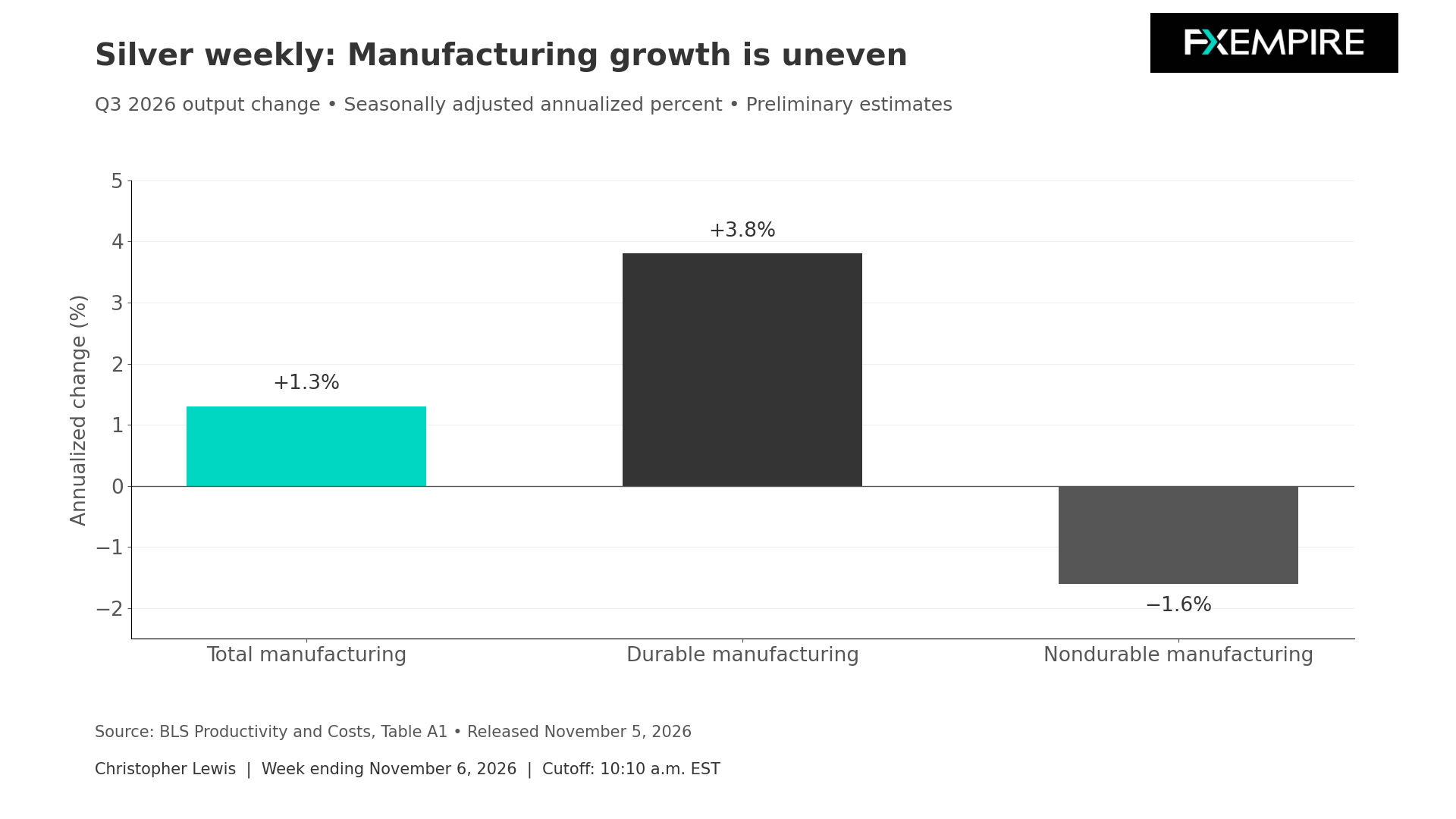
These are annualized quarterly changes, not year-over-year rates. They also describe the third quarter rather than activity occurring during the first week of November. The distinction matters for a weekly review. The new information arrived this week, but the economic behavior it suggests took place earlier.
Silver Price Forecast
Every new Silver analysis as it publishes, today's technical signal and key levels, live price — on one page.
See all Silver forecastsManufacturing Costs Complicate Things
Costs complicate the picture. Manufacturing unit labor costs increased 2.7% at an annualized rate in the third quarter and 4.0% from a year earlier. Firms facing higher costs may attempt to raise selling prices, improve efficiency, and protect margins through tighter purchasing. None of these responses guarantees weaker silver consumption, but they do explain why positive output growth does not necessarily translate.
The older production data remains consistent with a measured expansion. The Federal Reserve’s October 16 release showed September manufacturing output up 0.3% on the month and 1.1% over the year. Manufacturing capacity utilization was 75.9%, below its 78.2% long-run average. This supplies background evidence of growth with spare capacity rather than proof that industrial users are competing for an exhausted production base.
Financial Conditions Work Against Silver at the Moment
Financial conditions are the other side of the silver investment case. The Federal Reserve left its policy range at 3.75% to 4% on October 28. The November 5 H.15 release reported a 10-year inflation-indexed Treasury yield of 2.64% for November 4. It establishes a positive real-return alternative to holding metal, which of course is a bit of a problem for silver.
Silver can benefit with industrial expectations increasing and investment demand improving at the same time. It can also face conflicting forces when resilient growth supports fabrication demand but encourages restrictive policy. Compared with a purely monetary argument, the industrial channel creates another way for the outlook to improve, although it also induces sensitivity to slowing production and cautious corporate purchasing.
Consumer Spending
Consumer spending provides another reason to distinguish nominal growth from physical activity. BEA’s September report showed spending rising 0.5% in current dollars but less than 0.1% after inflation. Real disposable income fell 0.3%. Released on October 29, these figures are background information.
Next week’s October CPI and PPI releases, scheduled for November 10 and November 13 at 8:30 a.m. EST, will give us more of a read into the inflation side of the equation. Softer price pressure could improve financial conditions. Renewed pressure could offset some benefit from the resilient activity in industrial sectors.
Technical Setup
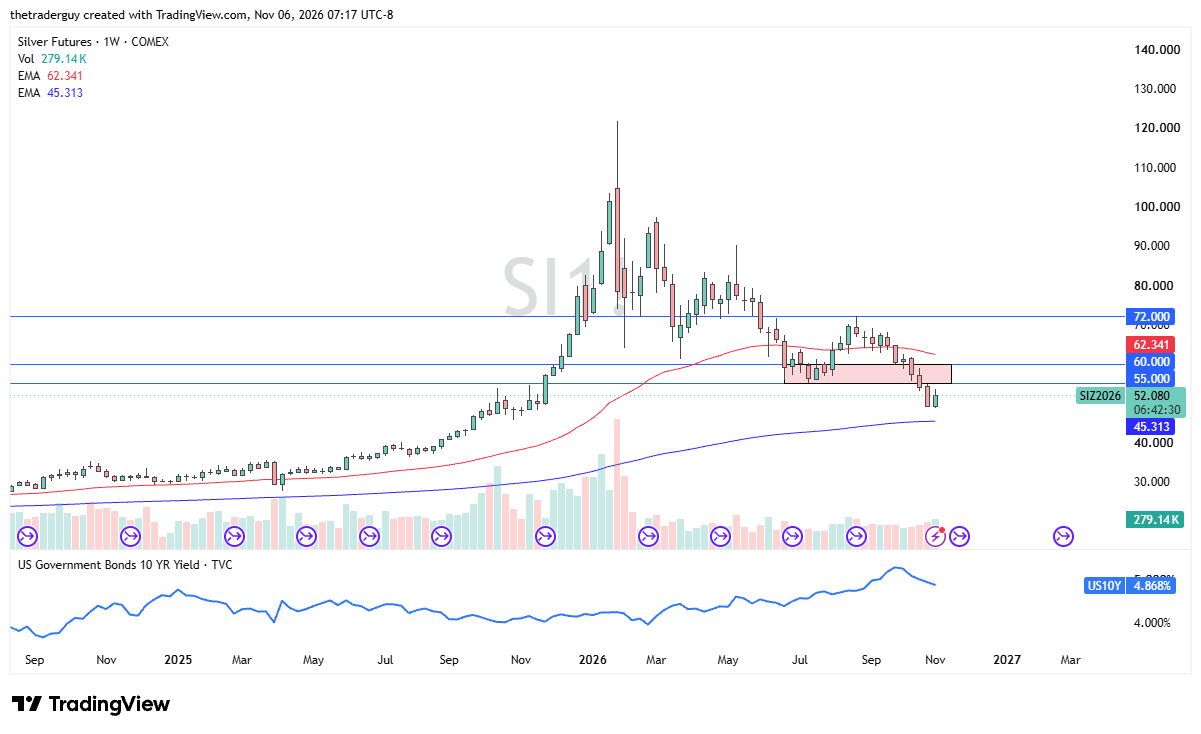
From the technical analysis standpoint, it looks like the $55 level could remain a serious barrier. We did give back some of the gains rather quickly after the jobs number on Friday, and it looks as if a move above $55 would be needed to get bullish in the slightest.
As things stand right now, it still looks like a market that could break down, but longer term I like silver once we get rates under control. There is a lot of demand out there just waiting to be had, but as things stand right now, the inflation and interest-rate side of the equation continues to push silver lower.