Spot Silver Consolidates as Momentum Shifts Following Reversal Top
Spot Silver (XAGUSD) is nearly flat on Friday in a lackluster trade. The trend is up, but momentum has shifted to the downside, following the confirmation of Monday’s dramatic closing price reversal top.
At 19:02 GMT, XAGUSD is trading $72.00, up $0.36 or +0.50%.
Long-Term Silver Outlook Supported by Industrial Demand and Supply Shortage
The long-term trend is being supported by demand and a shortage of silver, and to some extent, two or more rate cuts by the Fed. The industrial demand and the supply shortage are real and documented. The rate cuts are speculation since the Fed has only projected one in 2026 and is on record as being data dependent. Furthermore, there were dissenters at the last meeting in December and a split on whether the focus should be on the labor market or on pushing inflation down.
CME Margin Hikes Trigger Short-Term Volatility in Silver Futures
The short-term is a little bearish due to the shake-up fueled by the CME. The futures exchange raised margins twice in a week to deal with what they called extraordinary volatility. Nearly overnight, this made trading silver and gold futures very expensive, forcing weaker capitalized traders to liquidate positions and driving unprecedented volatility that is more than likely to continue over the near future until the weakest long is driven out.
Extreme Silver Volatility Expected as Speculators Exit Positions
So for a few weeks, we could see extreme volatility in silver as speculators bail out. Furthermore, the focus isn’t going to be on the Fed, Treasury yields or the direction of the U.S. Dollar. When the dust clears, those factors will matter. Longer-term, the market will still be supported by industrial demand and supply shortages, which is good news for “buy the dip” investors, because we believe a big dip is coming.
Technical Analysis: Silver Tests Critical $72.41 Pivot Level
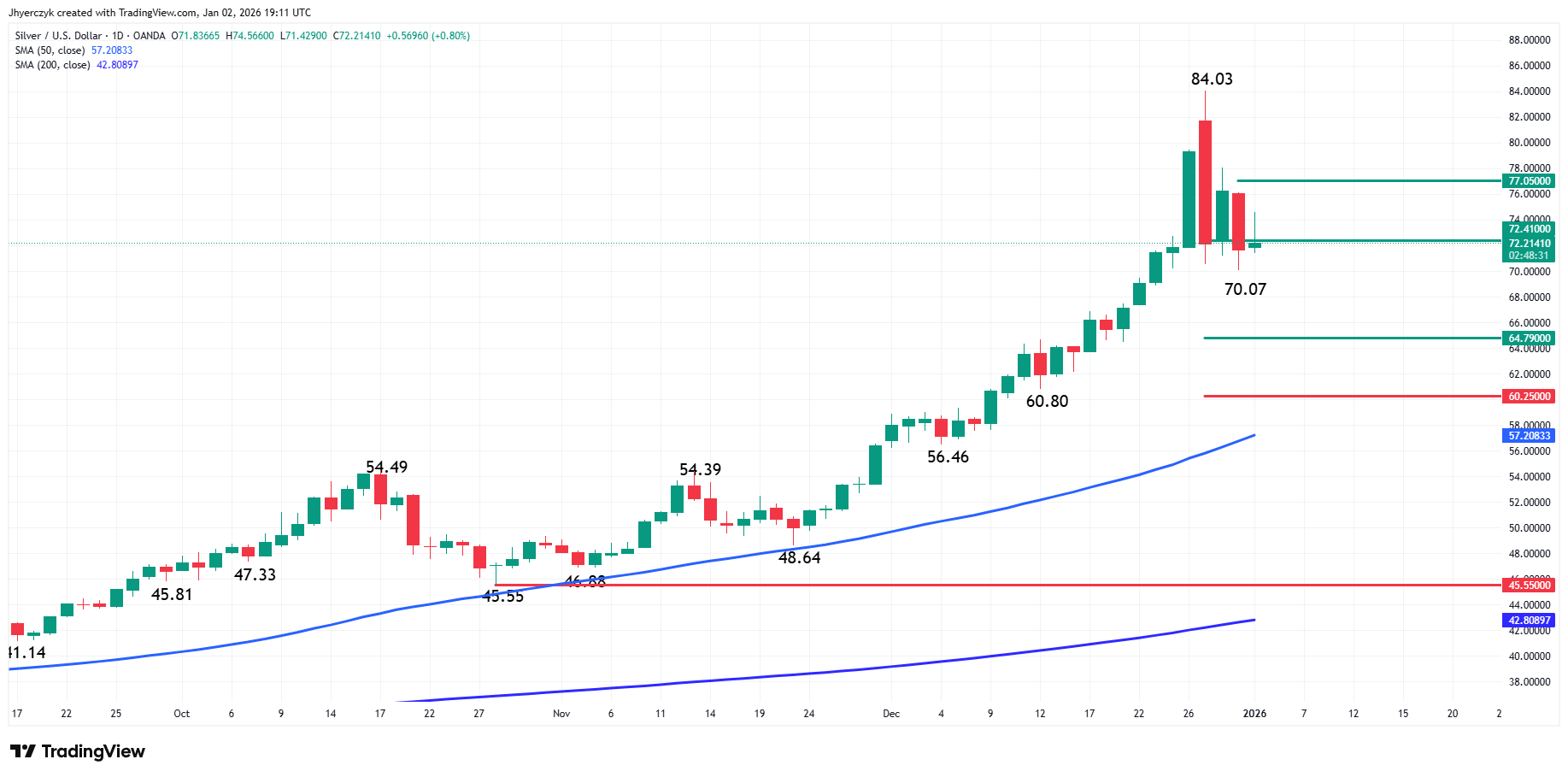
Technically, now that Monday’s closing price reversal top has been confirmed, let’s focus on the downside.
Silver Price Forecast
Every new Silver analysis as it publishes, today's technical signal and key levels, live price — on one page.
See all Silver forecastsThe short-term range is $60.80 to $84.03. The market is currently straddling its 50% level at $72.41. It is going to act like a pivot.
Key Retracement Zone at $64.79-$60.25 Targets Silver Correction
The longer-term range was formed by the October 28 main bottom at $45.55 and the December 29 main top at $84.03. This has created a retracement zone target at $64.79 to $60.25. Under this area is the 50-day moving average at $57.20.
The new minor range is $84.03 to $70.07. Its mid-point at $77.05 is resistance.
Silver Price Pattern Suggests Potential Rally to $77.05 Before Further Decline
As you can see on the chart, a market doesn’t go straight down. In this case, we could see a surge into $77.05 before new shorts come in to drive prices through $70.07 and into our target zone.
Closing Price Reversal Signals 50-61.8% Correction Ahead
The closing price reversal top is not a change in the trend. Often, it is created to alleviate some of the upside momentum in a runaway market. It also often leads to a 50% to 61.8% correction of the last major range. This reaffirms our commitment to the $64.79 to $60.25 target zone.
More Information in our Economic Calendar.