



Stocks Recover at Midday as Trump Rules Out Military Action on Greenland
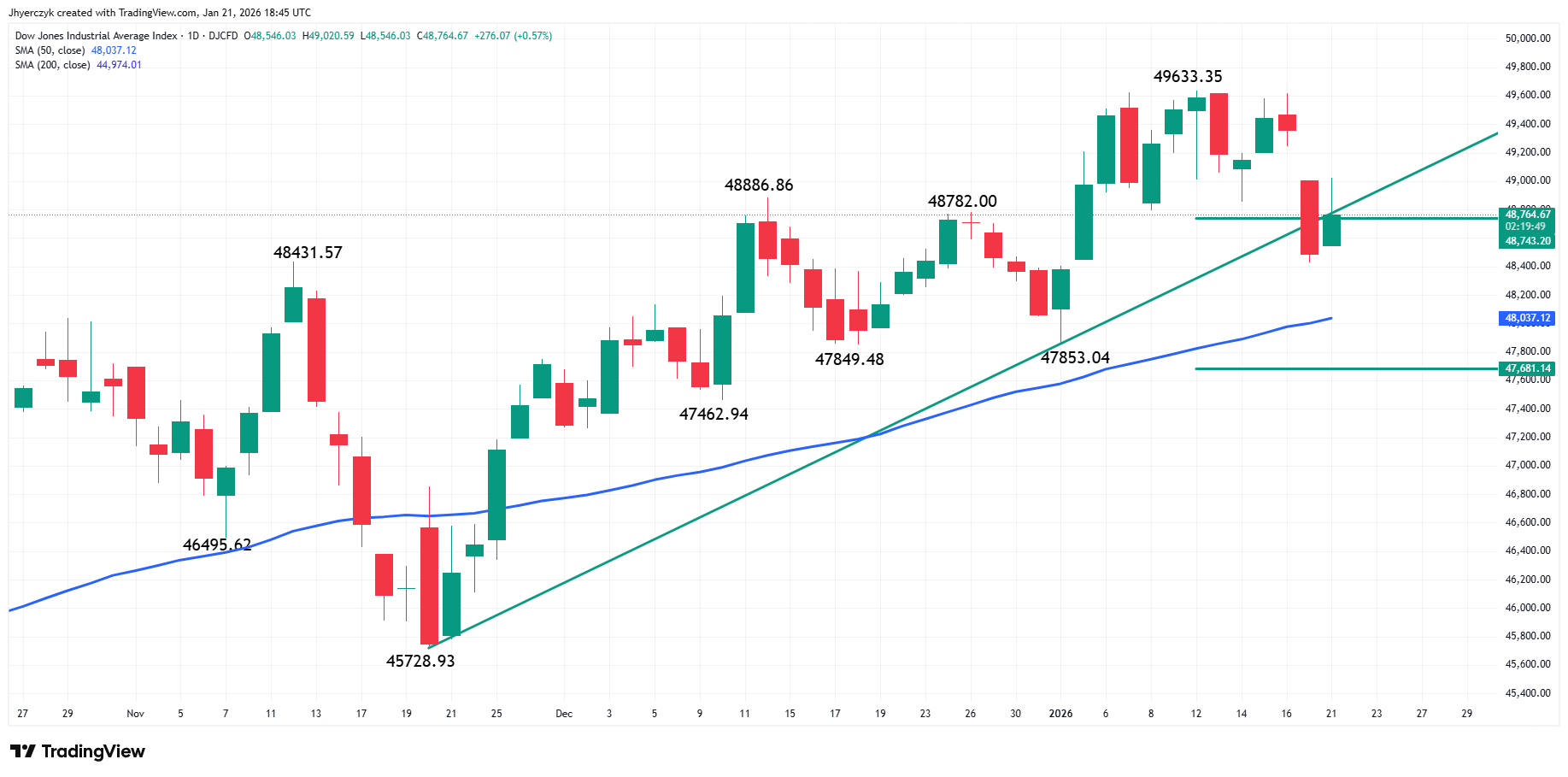
The U.S. stock market is trading higher at the mid-session on Wednesday as bargain hunters attempted to recover from a two-day setback that included their worst performance since October during the previous session. The major indexes were under pressure during most of the pre-market session but turned positive on today’s opening after President Trump, speaking in Davos, Switzerland, told world leaders that he was ruling out military action in his attempt to obtain Greenland, but that negotiations for a U.S. takeover should begin now. His main argument centered around the United States being the only country that can guarantee security for the Danish territory.
At 18:42 GMT, the Dow is trading 48778.61, up 290.02 or +0.60%. The S&P 500 Index is at 6826.70, up 29.84 or +0.44% and the Nasdaq Composite is trading 22997.071, up 42.748 or +0.19%.

Diplomatic Resolution Expected, But Long Road Ahead
The price action may suggest that investors are happy there will be no military force used to take Greenland, but it doesn’t suggest investors believe there will be a quick solution either. There may be a diplomatic resolution at the end of the game, but there is nothing to suggest it will be a short game. Until then, Trump is standing by his threat to implement another 25% tariff on the European countries who oppose his plan, while European Union (EU) members plot their retaliation.
Uncertainty and “Sell America” Trade Drive Market Volatility
This type of scenario often creates uncertainty and investors don’t like uncertainty because sometimes it takes time to figure out how to offset the risk. In this case, they choose to sell, which was one of their easiest options. However, not only have we seen liquidation selling this week, but we’ve also experienced the “sell America” trade. This is a form of protest by the Europeans, who are expressing their opposition to Trump by selling American assets like stocks, Treasuries and the Dollar. When combined with the uncertainty liquidation, this is what produced Monday and Tuesday’s exaggerated sell-off.
Best and Worst Case Scenarios for Market Direction
Since the issue is not likely to be resolved quickly, the best scenario will be a rangebound trade, with investors selling rallies and accumulating value. The worst case scenario is an escalation of the selling in a move similar to the one in April 2025 when Trump first announced his Liberation Day tariffs. Within two days of the announcement, the S&P 500 lost about 10%, the Dow over 9%, and the Nasdaq around 11%, representing the largest two-day loss in history at that time before Trump started to walk back some of his tariffs.
Davos Remarks, Supreme Court Case, and Earnings in Focus
In addition to Trump’s speech in Davos, investors have also been eyeing other remarks from business leaders in Davos, the Supreme Court as it hears arguments over Trump’s push to remove Fed Governor Lisa Cook, and another round of earnings results.
Dow Jones Price Forecast
Every new Dow Jones analysis as it publishes, today's technical signal and key levels, live price — on one page.
See all Dow Jones forecastsOf the 33 companies in the S&P 500 that reported quarterly earnings through last Friday, 84.8% beat analysts’ estimates for profit, according to LSEG I/B/E/S data, compared to the long-term average of 67.3%.
Technical Outlook: Key Moving Averages Test Market Strength
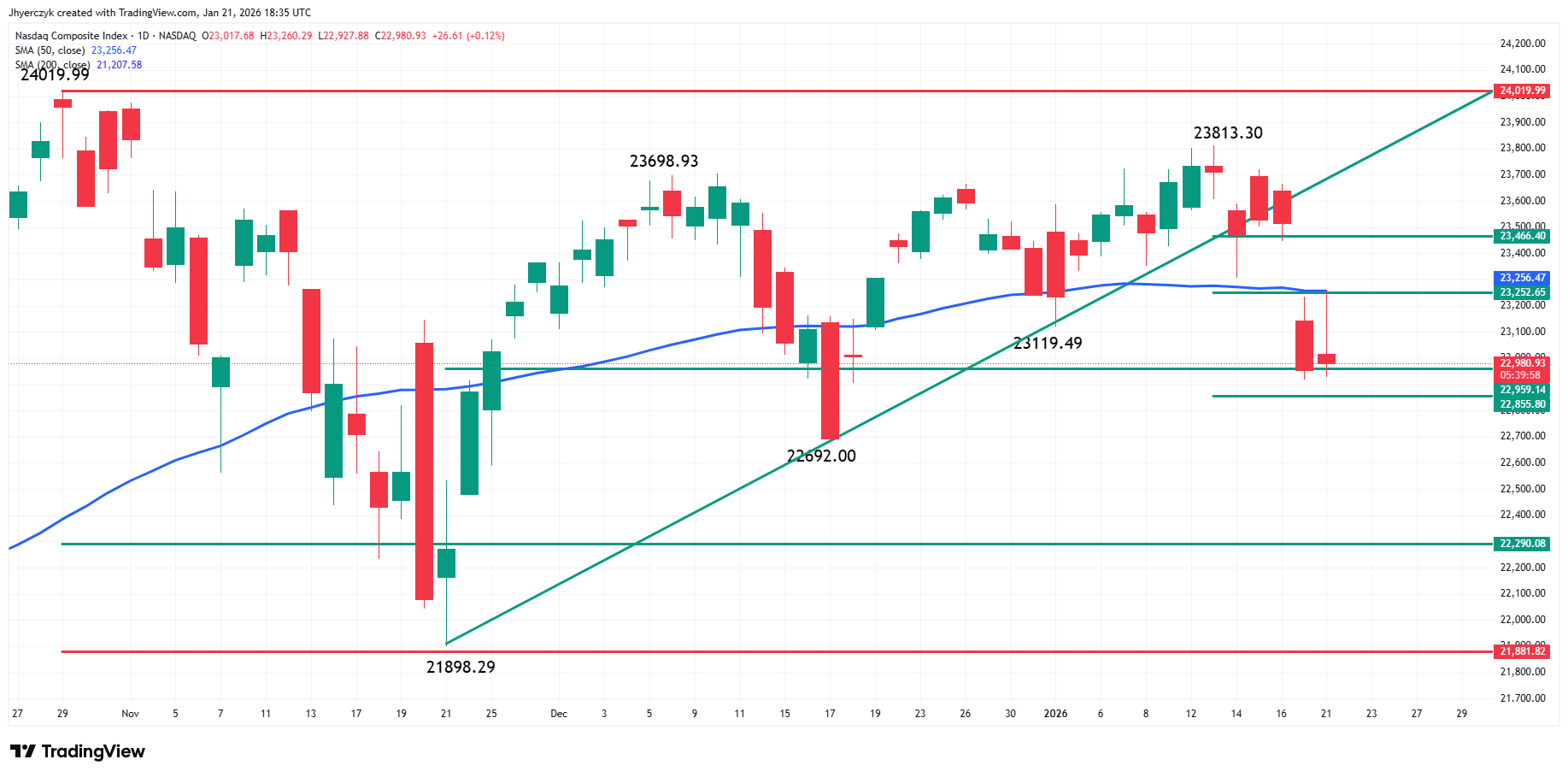
Going into the close, we’ll be watching to see if the major indexes can hold on to their gains. The Nasdaq Composite is trying to establish support on a long-term 50% level at 22959.14, while trading on the weak side of its 50-day moving average at 22256.59.
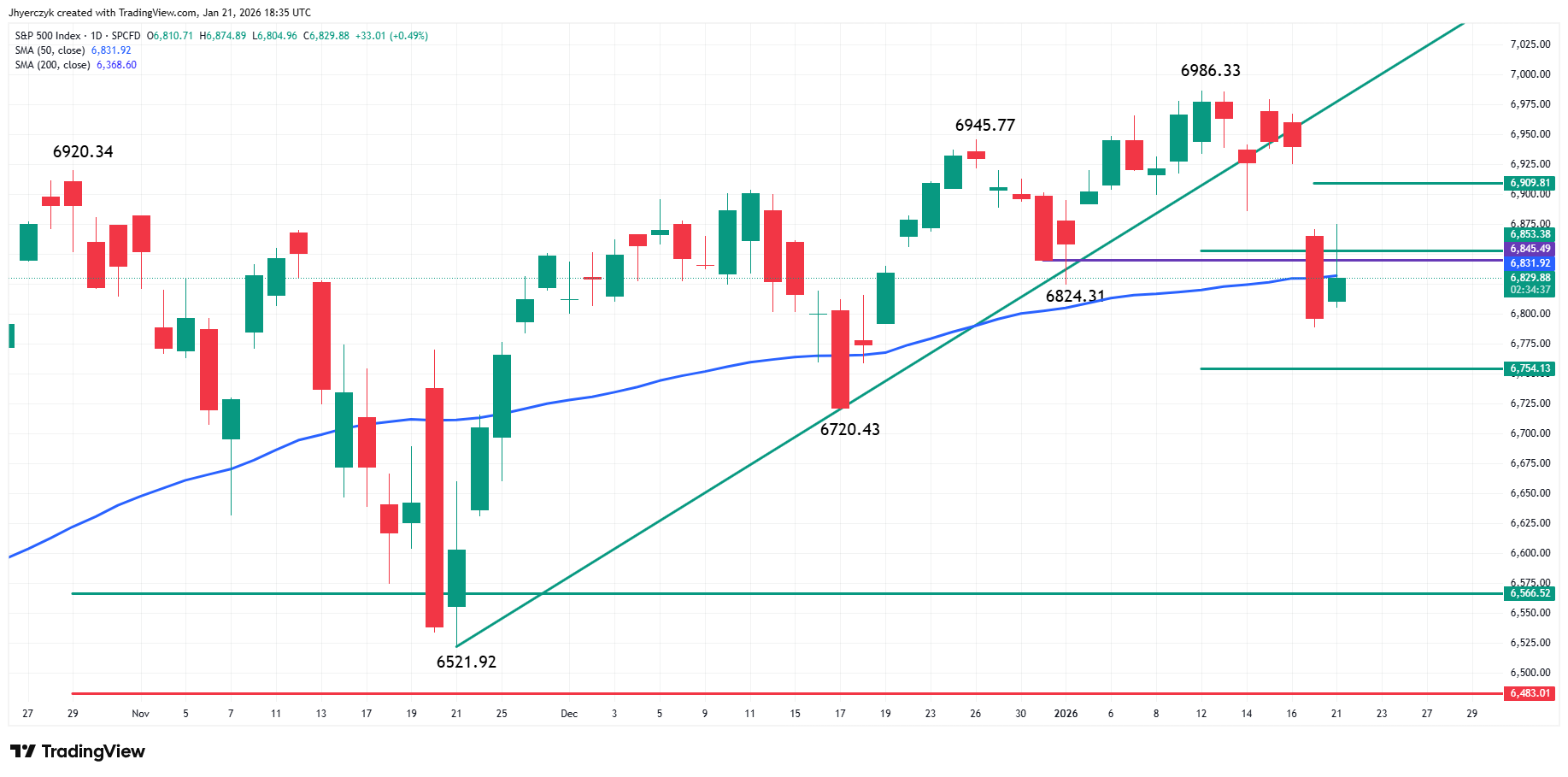
The S&P 500 Index has been straddling its 50-day moving average at 6831.89, but is currently trading on its weak side. A failure to re-establish support above this indicator could send the benchmark index to 6754.13, its long-term 50% level.
More Information in our Economic Calendar.


