Companies aren’t hiring. Friday’s jobs report showed only 50,000 new jobs in December across the entire country. But unemployment dropped from 4.5% to 4.4%, and wages grew 3.8% annually.

Why Companies Stopped Hiring
Business owners are hesitant to hire for three reasons:
Tariffs create uncertainty. Businesses that import products don’t know what their costs will be in six months. A manufacturing company might pay $100,000 for materials today, but if tariffs change, those same materials could cost $120,000 or $80,000 next quarter. When you can’t predict costs, you can’t expand your workforce. This affects car manufacturers, electronics retailers, and furniture stores.
Worker shortages persist. Restaurants, construction sites, farms, and hospitals previously relied on immigrant workers who are now harder to find. A construction company might have projects lined up but can’t find enough workers. Even businesses wanting to hire can’t always find qualified people, leaving job openings unfilled for months.
Wages remain high. Despite the slowing economy, businesses must pay competitive wages. A restaurant that paid cooks $15 an hour in 2019 might now need to pay $20 or more. These higher labor costs make every hiring decision more expensive and risky.
Job openings are down compared to a year ago. When openings exist, companies conduct more interview rounds, check more references, and sometimes just leave positions empty.
Jaime Martinez Medina, Global Market Strategist at PU Prime commented:
Gold Price Forecast
Every new Gold analysis as it publishes, today's technical signal and key levels, live price — on one page.
See all Gold forecastsThe latest U.S. jobs report highlights a labor market entering an unusual and fragile phase. December saw only 50,000 new jobs created, a clear sign that hiring momentum has slowed sharply. Yet unemployment fell from 4.5% to 4.4%, while wage growth remained firm at 3.8% year-on-year. This apparent contradiction reflects what can best be described as a low-hire, low-fire economy.
Companies are increasingly reluctant to expand payrolls. Uncertainty around tariffs makes cost planning difficult, worker shortages persist in sectors such as construction, healthcare, and hospitality, and wages remain elevated compared to pre-pandemic levels. At the same time, businesses are avoiding layoffs, scarred by the post-COVID hiring chaos and unwilling to risk losing workers they may struggle to replace later. As a result, employment is weakening not through mass job cuts, but through fewer hires, longer job searches, and some workers leaving the labor force altogether.
This dynamic places the Federal Reserve in a difficult position. Rate cuts traditionally stimulate hiring, but lower interest rates cannot solve labor shortages. With wages still rising and inflation not fully defeated, the Fed has little incentive to move aggressively. Policymakers have signaled caution, suggesting that one rate cut in 2026 is more likely than the multiple cuts markets are currently pricing.
This disconnect matters for financial markets. Equities, bonds, and precious metals are all trading near record highs on the assumption of significant Fed easing. However, the latest labor data does not justify that optimism. If hiring remains weak but unemployment and wages stay stable, the Fed can afford to wait.
Should markets be forced to reprice toward a more cautious policy path, bond yields could rise, equity volatility could increase, and recent weakness in the U.S. dollar could reverse. Until labor conditions deteriorate decisively, the risk is not recession, but disappointment; and that adjustment could come quickly.
Why Companies Aren’t Firing Either
During COVID recovery, companies were desperate for workers, paying signing bonuses and still struggling to fill positions. Some fast-food restaurants offered $500 just to show up for an interview. Business owners remember that chaos and don’t want to repeat it.
So even with slow business, they’re keeping workers rather than risk being unable to rehire when demand returns. A retail store might have employees with little to do, but the owner keeps them on payroll rather than face the nightmare of trying to staff up later.
This explains why unemployment crept up slowly through 2025 — from 4.0% at the start to 4.5% by November — without the mass layoffs you’d normally see in a slowdown. The increase came from new job seekers who can’t find work and the unemployed staying jobless for longer periods.
December’s drop to 4.4% happened partly because some people gave up looking and officially left the labor force. When you stop actively searching for work, you’re no longer counted as unemployed.
The Worker Shortage Problem
Normally when the economy slows, the Federal Reserve (the Fed) cuts interest rates. Lower rates make borrowing cheaper for businesses. Cheaper borrowing means more spending, expansion, and hiring.
But what if businesses can’t find workers even when they want to hire?
That’s the current situation in construction, farming, restaurants, and healthcare. There aren’t enough available workers due to immigration restrictions. When workers are scarce, wages stay elevated — that 3.8% annual increase proves it.
The Fed can lower interest rates, but that won’t create more construction workers or nurses. It might just increase prices without helping employment. This is why the Fed is moving cautiously on rate cuts.
What Interest Rate Cuts Mean for You
When the Fed cuts interest rates, borrowing becomes cheaper — mortgages, car loans, business loans. This usually helps the economy grow and helps people find jobs.
Right now, the Fed says they might cut rates once in 2026. They’re being cautious because inflation remains elevated, rate cuts can’t fix worker shortages, and they’re avoiding the 2021-2022 mistake when they kept rates too low too long and inflation exploded.
Fed Chair Powell says the job market is “cooler but still balanced” — hiring is weak but not disastrous, with mixed signals that mean no rush to cut rates.
Why Wall Street Sees It Differently
Traders are betting the Fed will cut rates at least twice in 2026 because they expect hiring freezes will eventually cause layoffs, they price in worst-case scenarios, and the Fed often cuts more than initially indicated.
If the Fed doesn’t deliver those expected cuts, bond yields will rise and stock markets will get volatile.
What Friday’s Report Showed
Friday’s numbers told a mixed story
- Only 50,000 jobs added (very weak)
- Unemployment fell from 4.5% to 4.4% (but partly because people stopped looking)
- Wages up 0.3% monthly, 3.8% annually (steady growth)
This perfectly captures the “low-hire, low-fire” economy. Businesses won’t hire, but they won’t fire either. Job hunting is difficult, but current employees are relatively secure.
What to Expect in 2026
Unless unemployment spikes or wages fall sharply, the Fed will stay cautious. The most likely scenario: one rate cut, a long wait-and-see period, and no rush to ease borrowing.
Wall Street may hope for more cuts, but the data doesn’t support it. If companies start mass layoffs or hiring stops completely, the Fed will respond. Until then, we’re in this uncertain middle ground.
What This Means for Financial Markets
The Current Disconnect
Stocks, gold, and silver are all trading at or near all-time highs because markets are pricing in two or more Fed rate cuts in 2026. But Friday’s jobs report doesn’t support that optimistic view. This creates a dangerous setup.
Bonds and Yields
Treasury yields remain relatively low as traders bet on multiple rate cuts. If the Fed sticks to its one-cut stance and the jobs data doesn’t deteriorate further, yields will need to rise to reflect reality. That repricing could be sharp and painful for bond holders.
Stock Market
Equities are rallying on rate cut expectations that may not materialize. The disconnect between the Fed’s cautious one-cut message and the market’s two-cut pricing leaves stocks vulnerable. When reality catches up — either through Fed communications or continued mixed jobs data — expect volatility. The low-hire environment also means corporate earnings growth will stay sluggish, which doesn’t justify current valuations.
Gold and Silver
Precious metals are at record highs, benefiting from rate cut expectations and safe-haven demand. But if the Fed doesn’t deliver multiple cuts, higher-for-longer rates typically pressure gold and silver. The current rally assumes Fed dovishness that Friday’s report doesn’t confirm.
U.S. Dollar
The dollar has been weaker than fundamentals suggest, partly because traders expect aggressive Fed easing. If rate cut expectations get trimmed back toward the Fed’s actual one-cut stance, dollar strength should return.
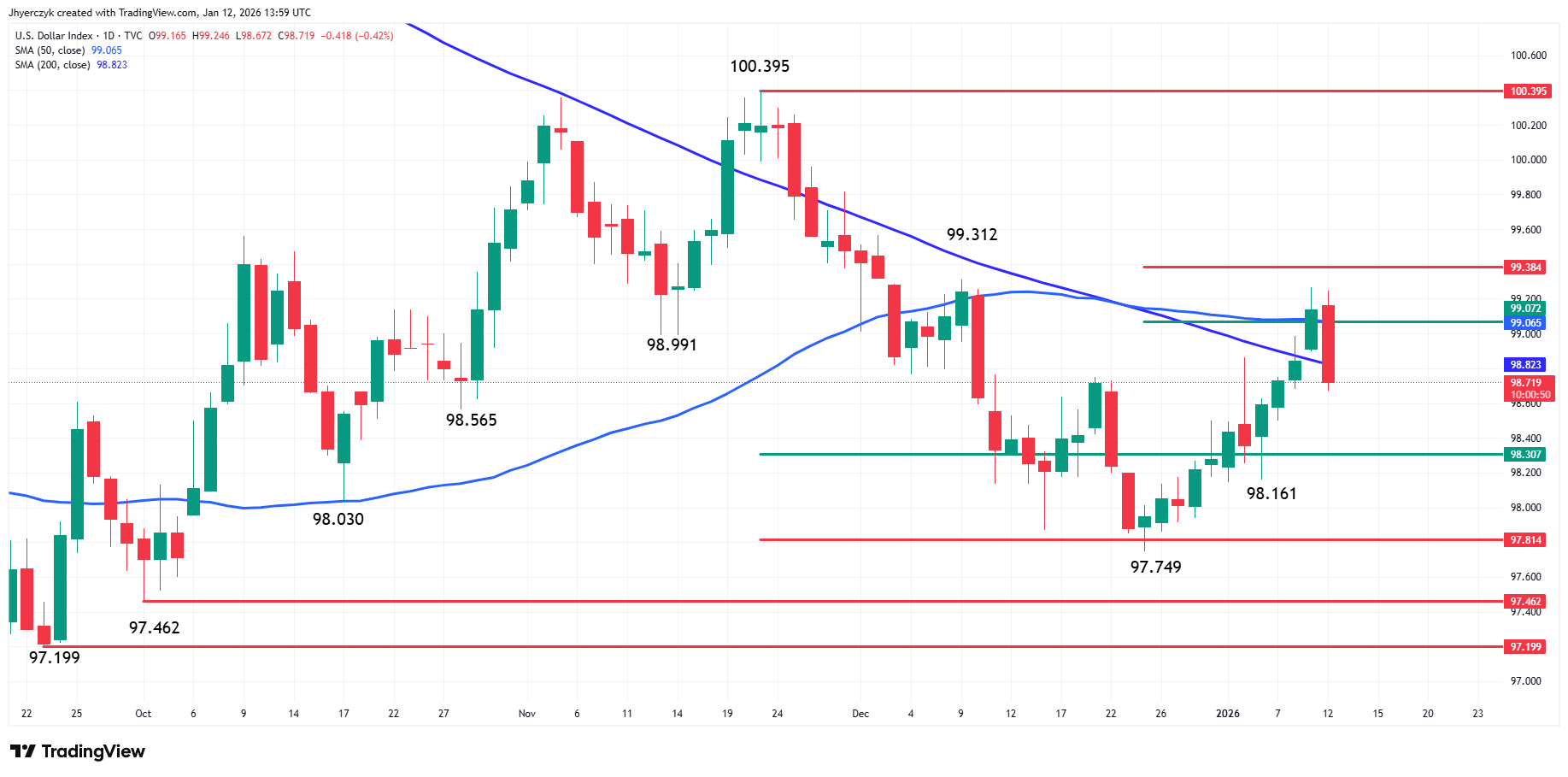
US Dollar Index (DXY) chart – Source: TradingView
The risk is clear: markets are priced for a Fed that doesn’t exist yet. Friday’s mixed jobs report — terrible hiring but falling unemployment and steady wages — gives the Fed cover to stay cautious. When markets realize the second and third rate cuts aren’t coming, the repricing across assets could be swift.