
Market Overview
During early European trading on Tuesday, the US Dollar Index (DXY), which measures the dollar against six major currencies, extended its decline and briefly touched an intraday low near 97.70. The move reflects growing expectations that the Federal Reserve may continue easing policy after recent rate cuts.

Fed Officials Signal Caution, Not Consensus
Federal Reserve officials remain split on the path ahead. Cleveland Fed President Beth Hammack said on Sunday that policy is well positioned to pause, allowing time to assess the impact of the 75-basis-point cuts delivered earlier this year. While markets anticipate further easing, Hammack emphasized the need to monitor incoming economic data before adjusting rates again.
Separately, Fed Governor Stephen Miran noted on Monday that recent indicators do not point to an imminent recession. He warned, however, that keeping rates unchanged for too long could eventually raise downside risks. Miran also suggested there is less justification for aggressive moves now that rates are already trending lower.
Safe-Haven Flows Add Pressure
The dollar has also come under pressure as investors rotate toward safe-haven assets. Heightened geopolitical tensions have boosted demand for precious metals, reducing appetite for the greenback. Recent uncertainty surrounding energy supply routes and infrastructure has added to risk aversion across markets.
Ongoing disruptions linked to the conflict in Eastern Europe continue to weigh on global sentiment, reinforcing defensive positioning. As demand for assets such as gold increases, the US dollar has struggled to regain momentum, leaving it vulnerable to further downside in the near term.
GBP/USD Price Forecast
Every new GBP/USD analysis as it publishes, today's technical signal and key levels, live price — on one page.
See all GBP/USD forecastsUS Dollar Index (DXY) – Technical Analysis
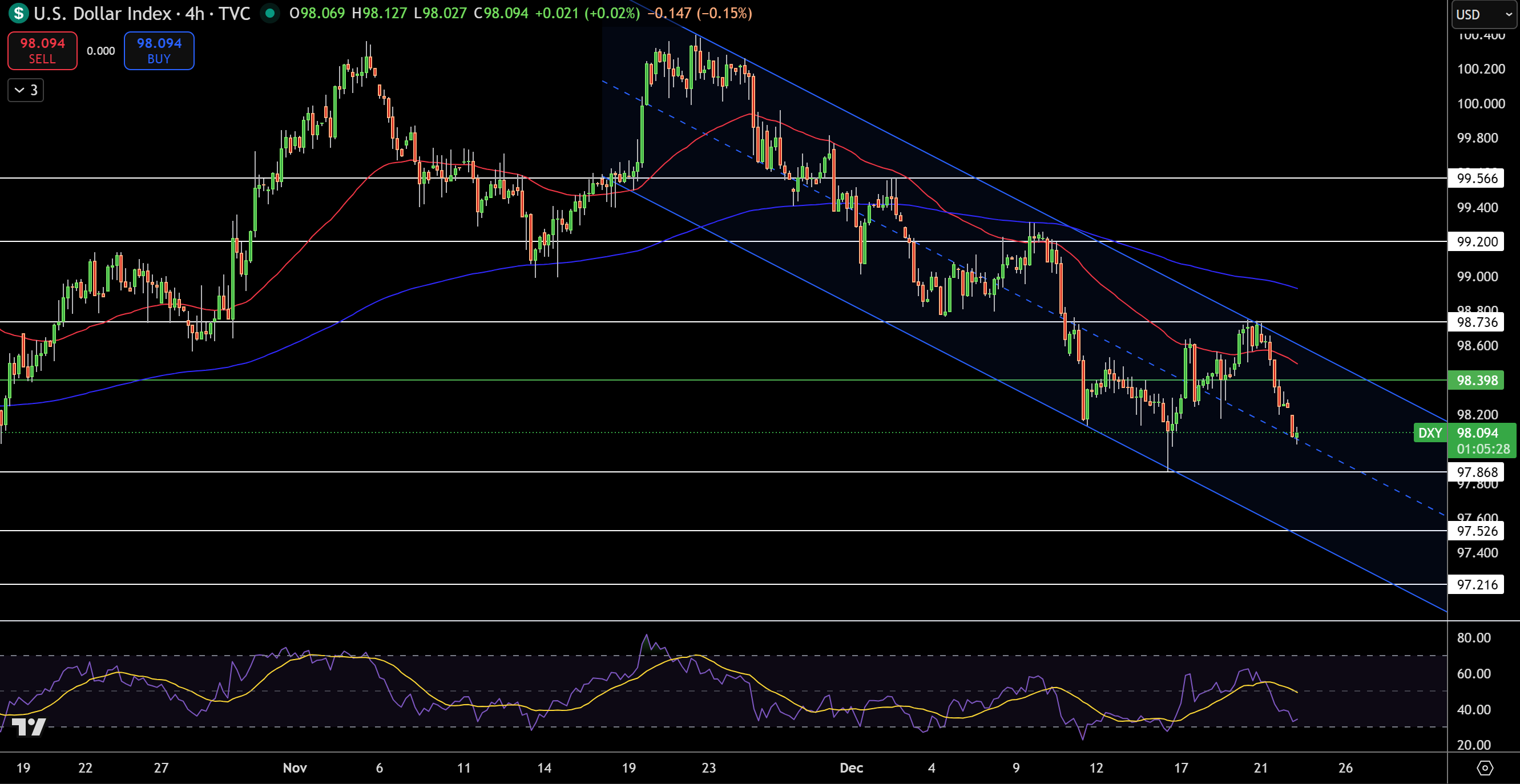
The US Dollar Index is trading near 98.10 on the 4H chart, extending losses within a well-defined descending channel. Price continues to post lower highs and lower lows, keeping the short-term trend firmly bearish. Recent candles show limited rebound attempts near 98.70, where the falling trendline and the 50-EMA converge, acting as dynamic resistance.
The 200-EMA sits higher near 99.20, reinforcing the broader downside bias. Support is holding around 97.85, with a deeper level near 97.50 if selling accelerates. RSI remains below 45, reflecting weak momentum and lack of bullish conviction. The failure to reclaim the channel midpoint suggests sellers remain in control unless a clear breakout occurs. The trade idea is to sell on rallies below 98.60, target 97.50, stop above 99.10.
GBP/USD Technical Analysis
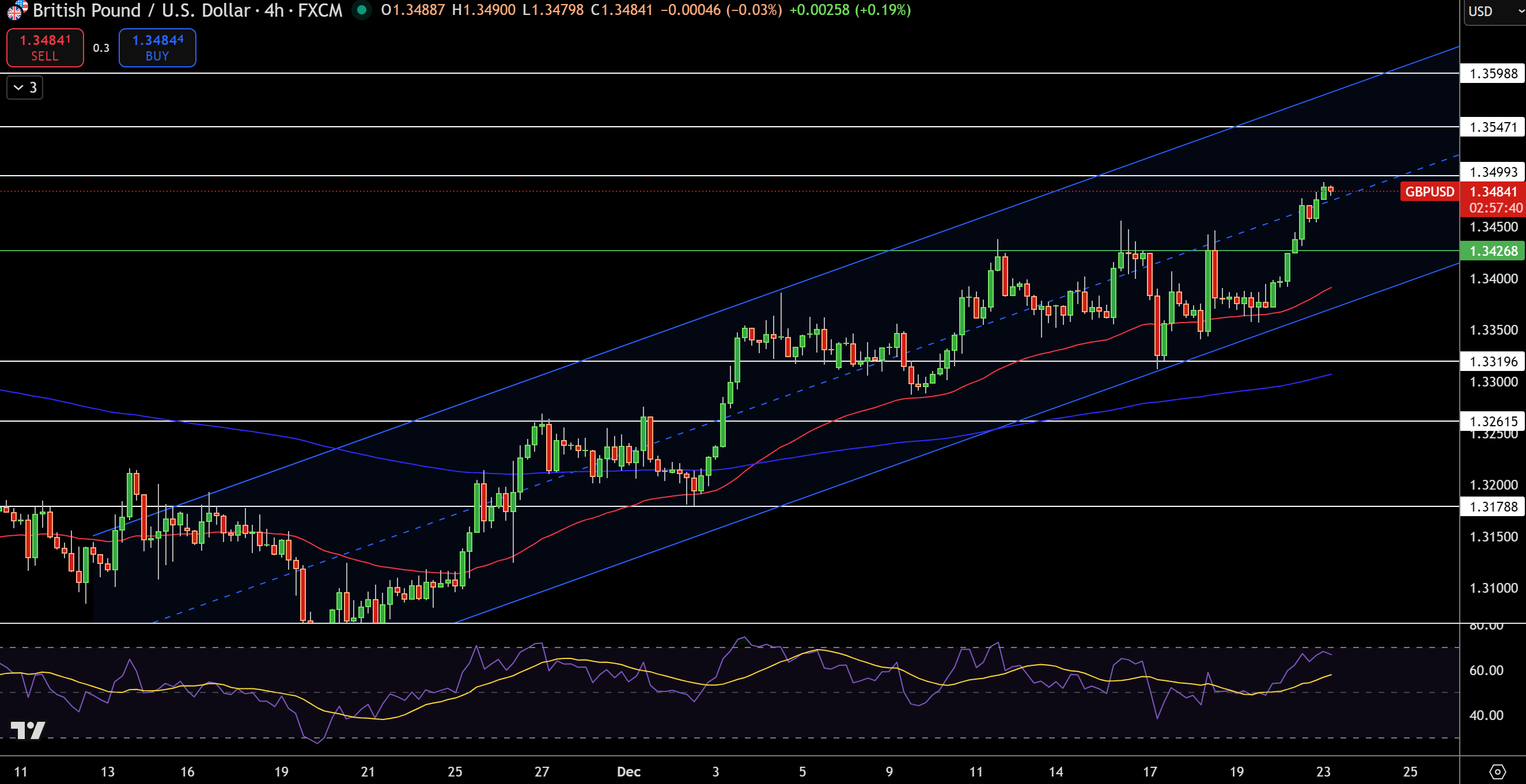
GBP/USD is trading near $1.3480 on the 4H chart, extending gains within a well-defined ascending channel that has guided price since late November. The structure remains constructive, with higher highs and higher lows intact. Recent candles show consolidation just below $1.3500, a psychological resistance zone where momentum has briefly slowed.
The 50-EMA is rising near $1.3425, providing dynamic support, while the 200-EMA around $1.3310 underpins the broader bullish bias. RSI is holding near 60, suggesting steady momentum without overbought conditions.
Pullbacks toward the mid-channel have consistently attracted buyers, indicating demand remains firm as long as price holds above $1.3420. The trade idea is to buy on dips near $1.3430, target $1.3580, stop below $1.3355.
EUR/USD Technical Forecast
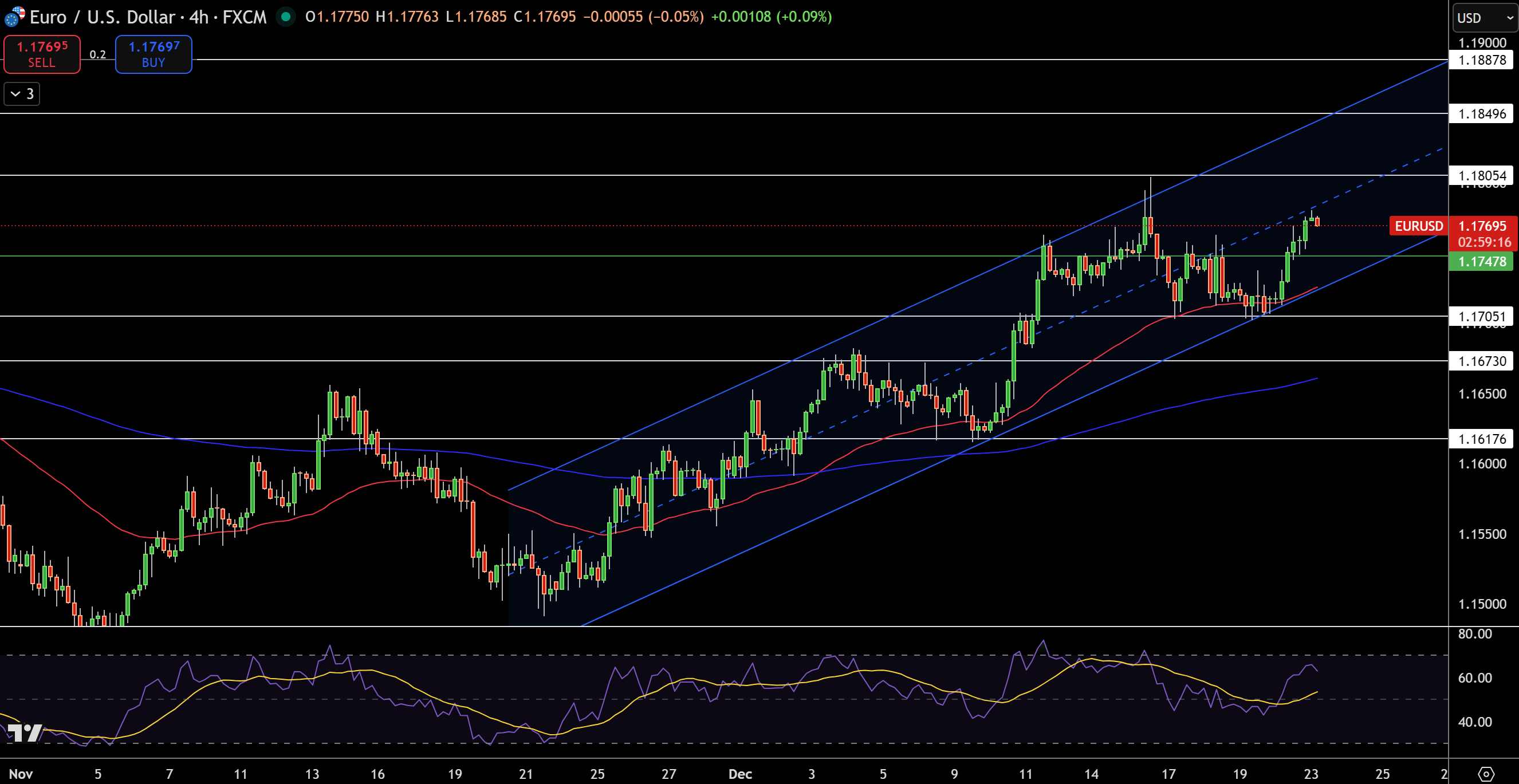
EUR/USD is trading near $1.1770 on the 4H chart, holding within a well-defined ascending channel that has guided price action since late November. Higher highs and higher lows remain intact, signaling a constructive short-term trend. Recent candles show consolidation just below $1.1805, a resistance zone that has capped upside attempts.
The 50-EMA is rising near $1.1735, offering dynamic support, while the 200-EMA around $1.1650 reinforces the broader bullish structure. RSI is hovering near 60, reflecting steady momentum without overbought conditions. A pullback toward the mid-channel area has been met with buying interest, suggesting demand remains active as long as price holds above $1.1705. The trade idea is to buy on dips near $1.1710, target $1.1850, stop below $1.1655.