


Market Overview
The US Dollar Index is hovering around 98.30, but it won’t hold for long. The Fed’s rate-cut expectations for 2026, and all that policy uncertainty, are really capping its upside potential.

Fed Minutes Show a Wide-Ranging Policy Debate
Minutes from the Fed’s December meeting just laid bare deep divisions among the Federal Reserve’s policymakers. Most officials are arguing that they should slow down and wait for clearer signs of inflation progress before cutting rates again. But then you’ve got others saying hold off on cutting rates altogether after 3 cuts already this year – we don’t want to make the labor market even worse.
Last month, the Fed cut interest rates by 25 basis points, taking their policy range to 3.50%–3.75% that’s a total cut of 75 basis points for the year, and it just goes to show how worried they are about the economy slowing down and inflation still being sticky.
Are Dollar Gains Probably Going to be Short-lived?
Even with the Dollar having recently gained, it’s still really under pressure in the bigger picture. It’s down nearly 9.5% this year due to low US yields and the lingering trade deal hang-up. Markets expect the Fed to cut rates at least two more times next year. If that happens, US yields could fall even further, effectively killing the dollar’s appeal relative to other major currencies.
Safe-haven Demand Is Still Here
Despite all of this, the Dollar is still attracting buyers when people get a bit nervous. Investors still think the US economy is a bit more solid than most other countries, which is probably helping keep a lid on downside pressures.
GBP/USD Price Forecast
Every new GBP/USD analysis as it publishes, today's technical signal and key levels, live price — on one page.
See all GBP/USD forecastsIn the short term, though all eyes are on US Initial Jobless Claims with forecasts calling for a slight rise to 220,000 from 214,000 last month, and with all the holiday things going on in the markets, you wouldn’t expect much of a reaction in the price until the new year.
US Dollar Index (DXY) – Technical Analysis
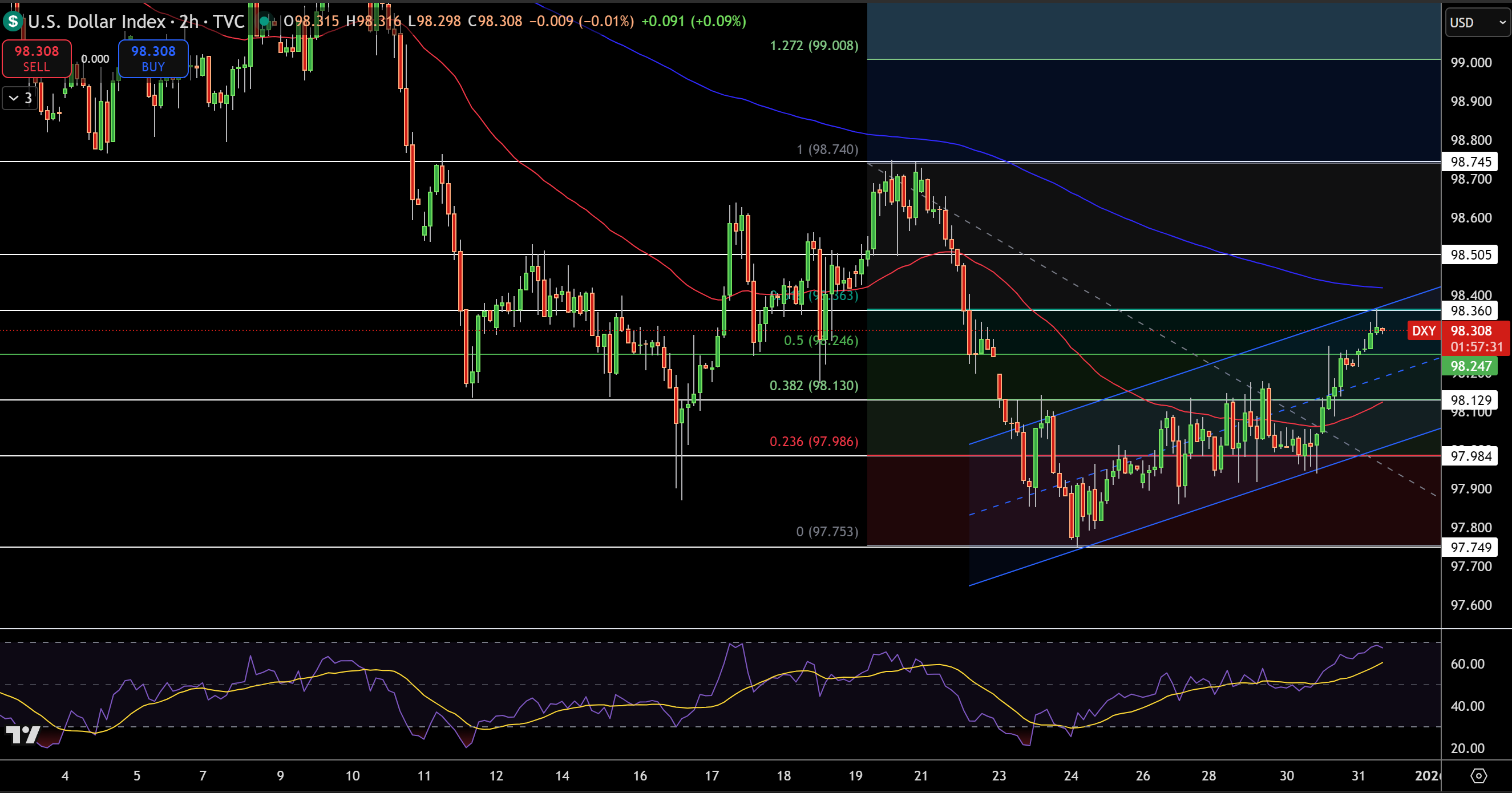
The U.S. Dollar Index (DXY) is trading near 98.30, extending its recovery within a short-term rising channel on the 2-hour chart. Price has reclaimed the 98.13–98.25 Fibonacci zone and is holding above the 50-EMA, signaling improving near-term momentum. Candlestick structure shows higher lows with smaller bearish bodies, suggesting sellers are losing control rather than pressing aggressively.
The index is now pressing toward 98.50–98.75 resistance, where prior supply and the descending trendline converge. RSI has pushed above 55, reflecting strengthening bullish momentum without reaching overbought levels.
A sustained hold above 98.25 keeps the recovery intact, while rejection here would signal consolidation rather than reversal.
GBP/USD Technical Analysis
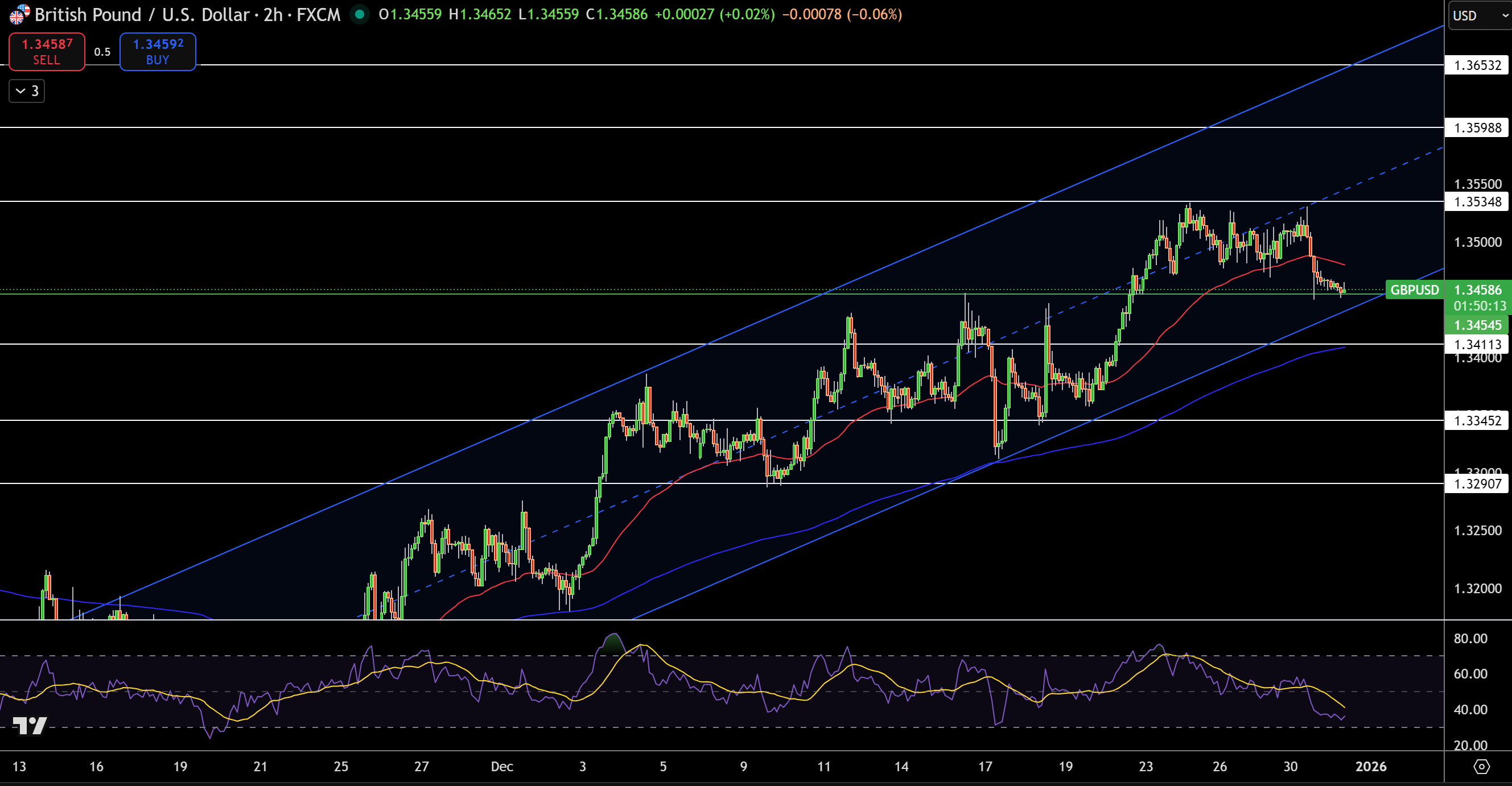
GBP/USD is trading near $1.3463, easing from recent highs but still holding within a clearly defined rising channel on the 2-hour chart. Price has slipped below the short-term 50-EMA, signaling near-term cooling, yet it remains above the rising channel base and the 200-EMA near $1.3410, which keeps the broader bullish structure intact.
Candlestick action shows smaller bodies and upper wicks, pointing to profit-taking rather than strong selling pressure.
Resistance remains capped around $1.3535, while immediate support sits near $1.3450, followed by $1.3410. RSI has dipped toward 40, suggesting softer momentum but not oversold conditions.
EUR/USD Technical Forecast
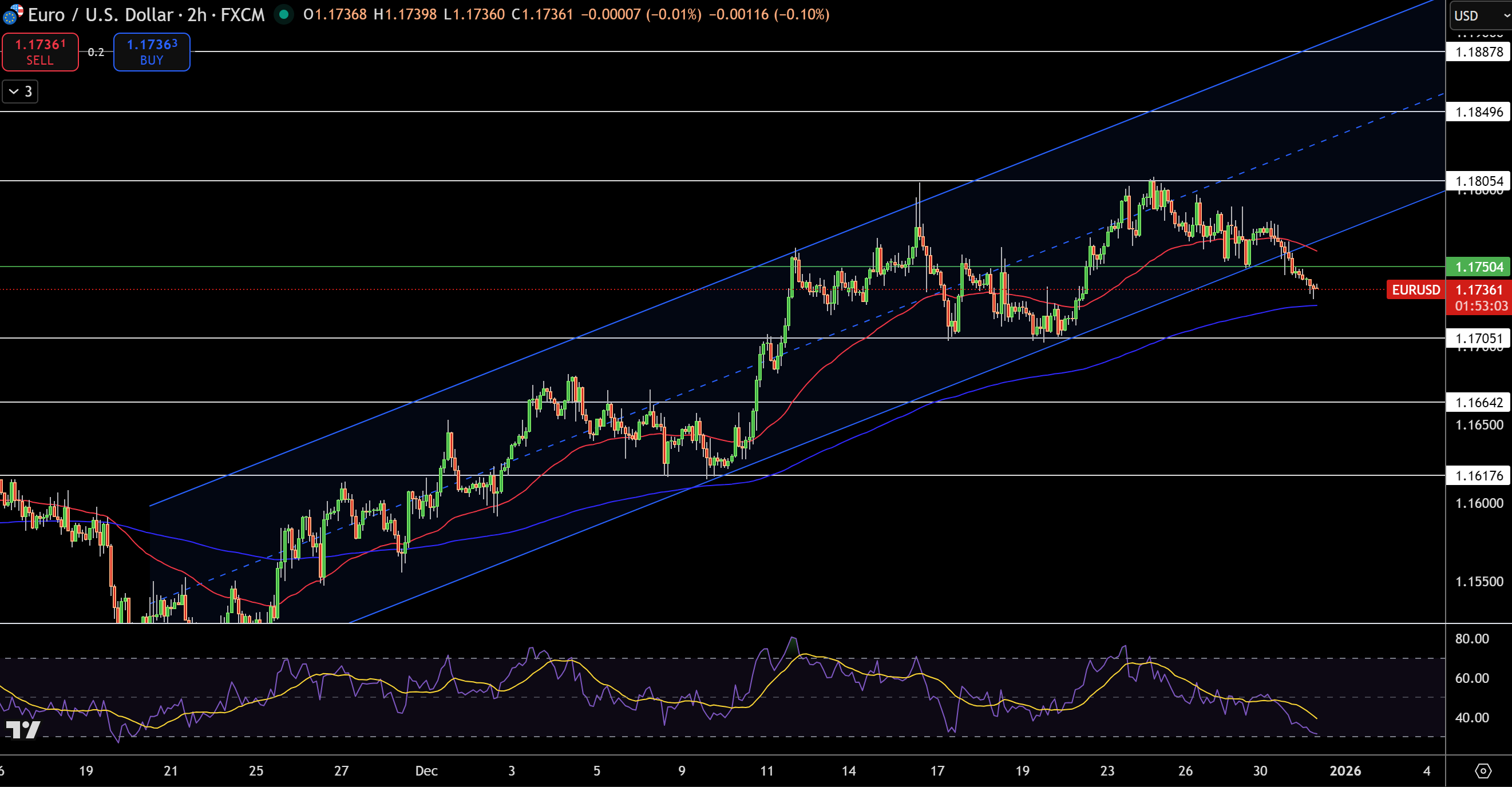
EUR/USD is trading near $1.1736, pulling back within a well-defined rising channel on the 2-hour chart. Price has slipped below the short-term 50-EMA but remains above the channel base and the rising 200-EMA near $1.1705, keeping the broader structure constructive.
Recent candlesticks show smaller bodies with longer wicks, signaling fading upside momentum rather than aggressive selling. The pair failed to sustain gains above $1.1805, confirming that zone as near-term resistance.
RSI has drifted toward 40, reflecting cooling momentum but not oversold conditions. As long as $1.1700 holds, the pullback looks corrective, with scope for stabilization before the next directional move.


