


Market Overview
The US dollar managed to keep up a bearish trend during European trading hours, continuing to slip lower to around 99.14 – but then things changed. US President Donald Trump announced that he was introducing new tariffs on a bunch of European countries, and as a result the Greenback took a hit as investors reacted to the escalating trade tensions. Traders are also on edge because the US markets were closed on Monday for Martin Luther King Jr. Day.
Trump’s Tariff Threats Drag the Dollar Lower
So as we mentioned earlier, President Trump announced a 10% tariff on goods from Denmark, Norway, Sweden, France, Germany, the Netherlands, Finland and the UK. He warned that this could go up to 25% in June if a deal to buy Greenland in full isn’t done.
This move has spooked everyone about the possibility of a trade war, putting the US dollar under pressure as investors worry about its impact on global trade and US exports.
Labor Market Data Limits Dollar Losses
But across the water, the US dollar got some support from some better-than-expected labor market data last week. The strong employment figures have pushed back expectations that the Federal Reserve might cut interest rates again until June and as a result financial markets are now giving a 95% chance that things will stay the same at the FOMC meeting on January 27-28 2026, according to the CME FedWatch tool.
US Dollar Index (DXY) – Technical Analysis
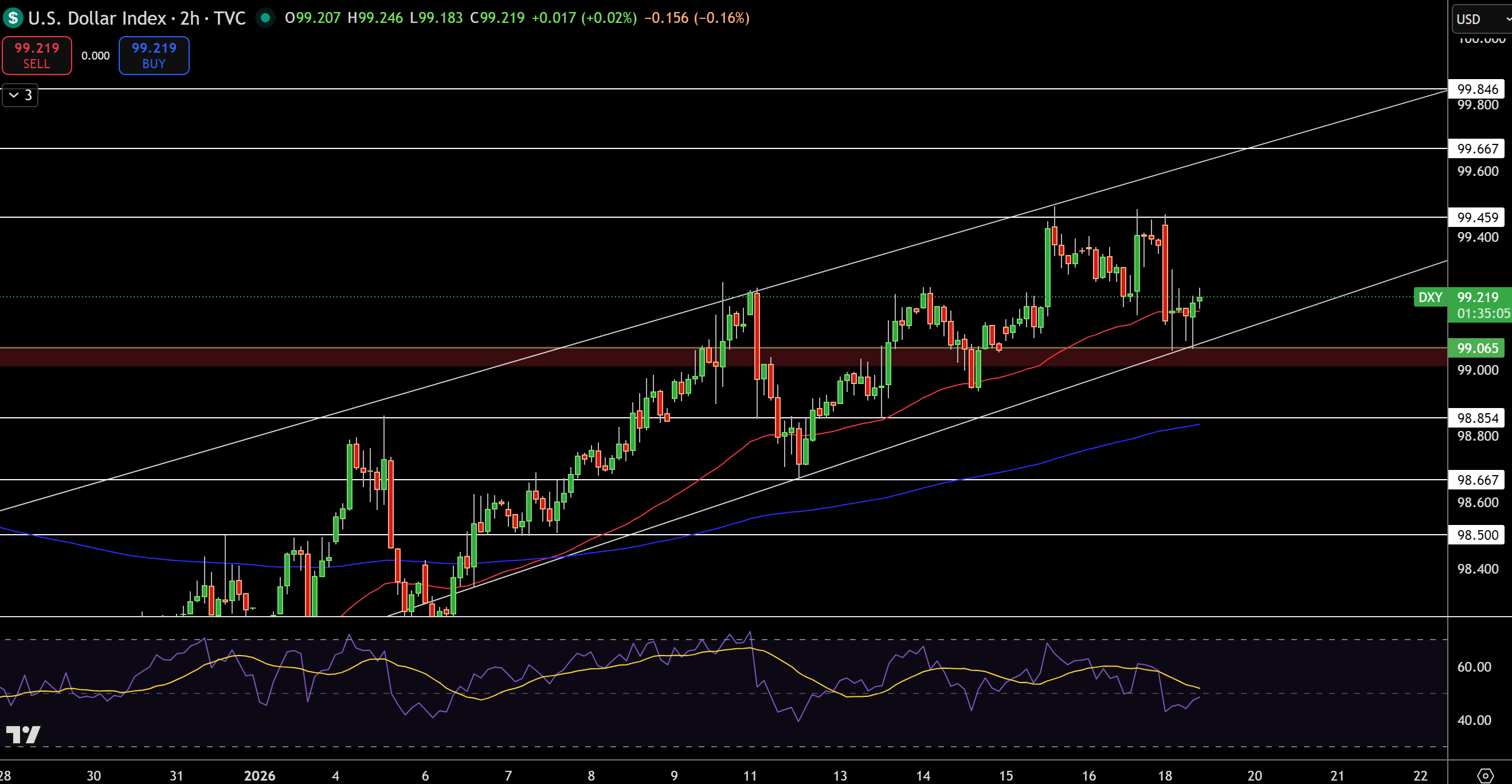
The US Dollar Index (DXY) remains constructive but is entering a short-term decision zone. Price is holding near 99.20, consolidating above the 99.00–99.05 support band, which aligns with prior resistance turned support and the rising 50-period Exponential Moving Average. As long as this zone holds, the broader structure favors continuation within the ascending channel.
EUR/USD Price Forecast
Every new EUR/USD analysis as it publishes, today's technical signal and key levels, live price — on one page.
See all EUR/USD forecastsMomentum has cooled. The Relative Strength Index is hovering near the mid-50s, signaling consolidation rather than trend exhaustion. Upside resistance is layered at 99.46, followed by 99.67 and 99.85, where the upper channel boundary caps recent advances.
A clean break above 99.46 would likely re-open upside toward the 99.80–100.00 area. Failure below 99.00 would expose 98.85, shifting the bias toward deeper consolidation rather than reversal.
GBP/USD Technical Analysis
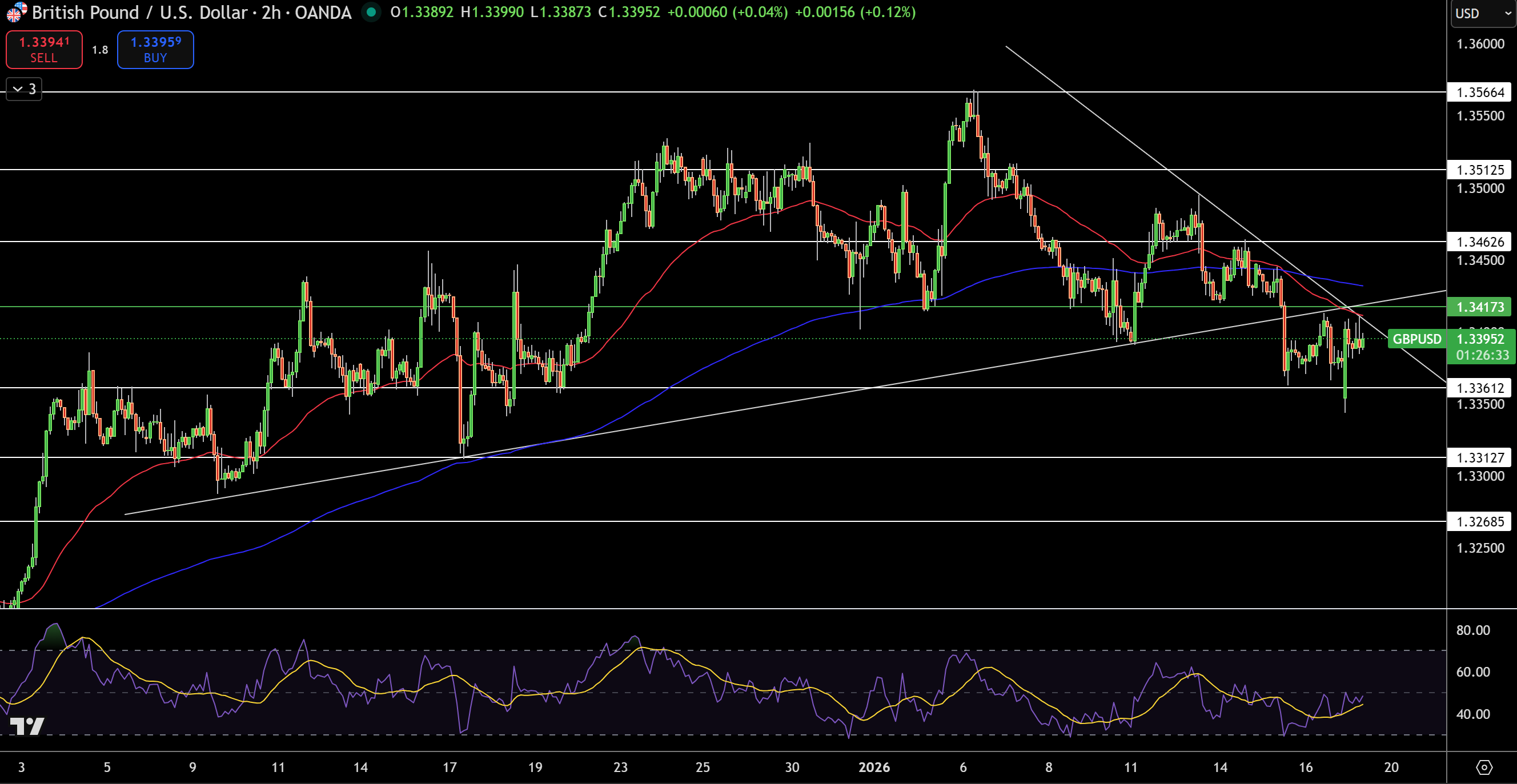
GBP/USD has stabilized after a sharp rejection at $1.3560, and it’s now trading around $1.3400 on the 2-hour chart. The pair is trying to base itself above the $1.3360-$1.3380 support area.
But despite the base, the upside momentum is still being held back by the 50-period and 200-period EMA’s clustered between $1.3450 and $1.3475. That’s also where the descending trendline resistance is.
A confirmed break above $1.3475 would be a big deal and open up some room toward the $1.3510 and $1.3560 zone. Holding above $1.3360 keeps the recovery option open; but if it breaks lower then you’re looking at a deeper pullback toward $1.3310.
EUR/USD Technical Forecast
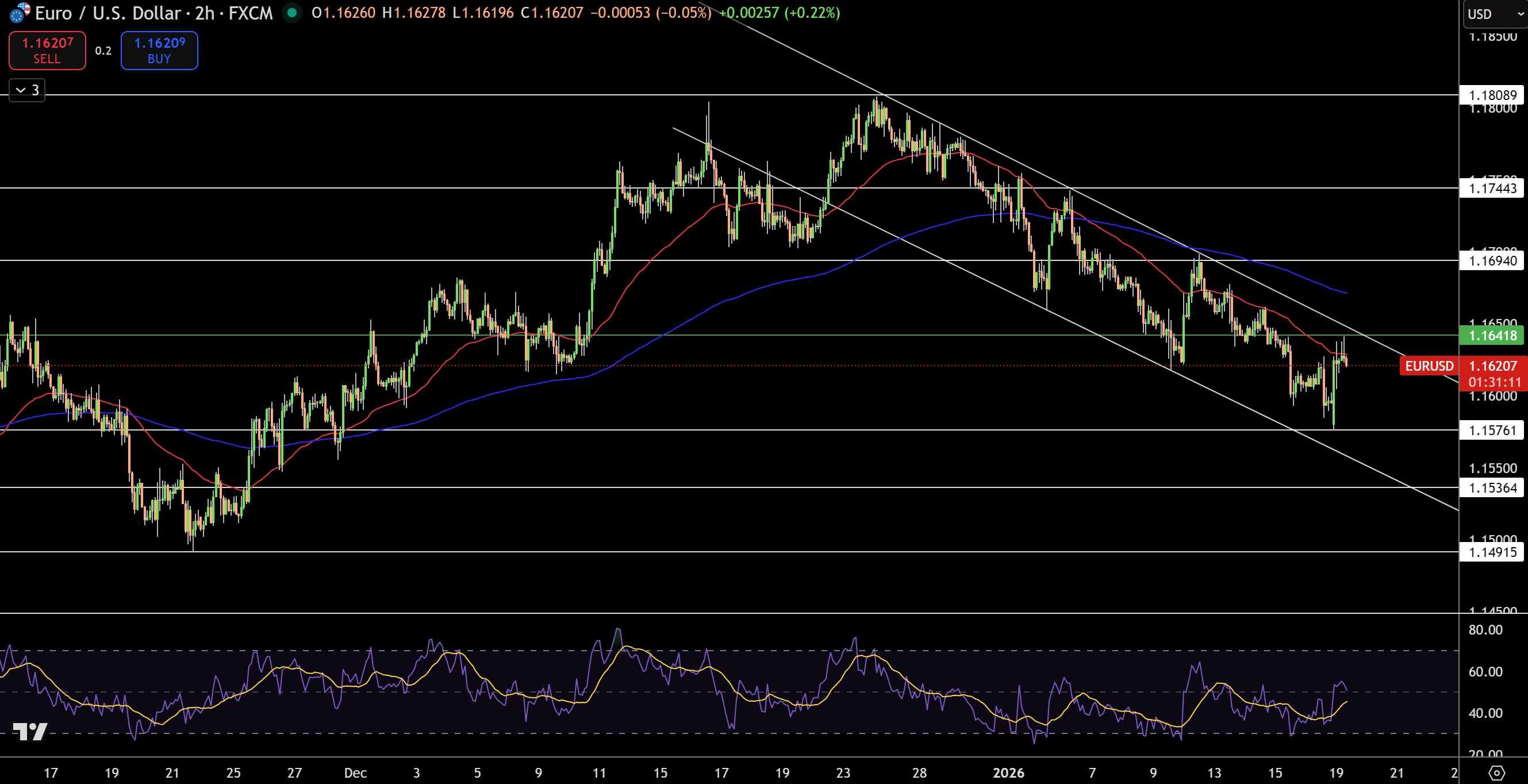
EUR/USD is trying to find a base after a long fall from the $1.1800 highs. On the 2-hour chart, price is rebounding from the $1.1575-$1.1600 support area. The price is still below the 50- and 200-period Exponential Moving Averages, indicating rallies remain capped.
The next level of resistance is at $1.1640, followed by $1.1695, where the descending channel top and the 200-period EMA converge. If it can break above this zone, then that would be a sign of a stronger trend shift toward $1.1745.
Holding above $1.1575 keeps a corrective recovery in play, but if it fails, then you’re looking at a downside move toward $1.1535.