



Dollar, Euro and Sterling: Inflation Risks Shape Policy Debate Ahead of US Jobs Data
Today’s US employment report will test whether resilient hiring supports further Federal Reserve rate increases. Europe faces a different problem: higher energy costs are raising inflation while threatening growth, leaving central banks to weigh the cost of tighter policy.
Dollar: Haven Flows Compete With Lower Treasury Yields
The technology-stock selloff has driven investors toward bonds and currencies sought for safety, including the yen and Swiss franc, Reuters reported Friday. The dollar faces competing pressures because lower Treasury yields, the returns available on US government bonds, have reduced its interest-rate support. Concerns over AI investment have therefore encouraged defensive positioning without giving the dollar an unqualified boost.
Thursday’s unemployment claims report offered evidence of labour-market resilience, with new claims lower than economists expected. Today’s payrolls report is the next test. Strong hiring could reinforce the case for further Fed increases; weaker employment and wage growth would complicate it.
Euro: Higher Inflation Leaves December Policy Open
Eurostat’s October flash estimate put annual inflation at 4.0%, up from 3.8% in September. Core inflation, which excludes energy, food, alcohol and tobacco, held at 2.5%. The preliminary figures leave the European Central Bank facing persistent inflation pressure even as energy disruption threatens economic activity.
Christine Lagarde said Thursday that incoming indicators would help determine whether a December rate increase is necessary, according to Reuters’ account. No December decision has been made. Higher rates could limit the spread of inflation into wages and other prices, but would also risk weakening demand. That trade-off keeps the euro sensitive to both inflation and growth data.
EUR/USD Price Forecast
Every new EUR/USD analysis as it publishes, today's technical signal and key levels, live price — on one page.
See all EUR/USD forecastsSterling: BoE Raises Rates but Keeps Further Moves Conditional
The Bank of England’s Thursday policy statement confirmed a 0.25-percentage-point increase in Bank Rate to 4%, following an 8-1 vote. The dissenter preferred a larger increase. The Bank expects inflation to reach around 5% by mid-2027, although evidence that higher energy costs are spreading into wages and other prices remains limited.
Further tightening depends on the evidence. For sterling, the question is whether persistent inflation requires higher rates despite pressure on household spending and business demand. The increase establishes a firmer policy stance, but the statement does not commit the Bank to a fixed sequence of further hikes.
US Dollar Index Technical Analysis: 101.535 Reclaim Supports Recovery
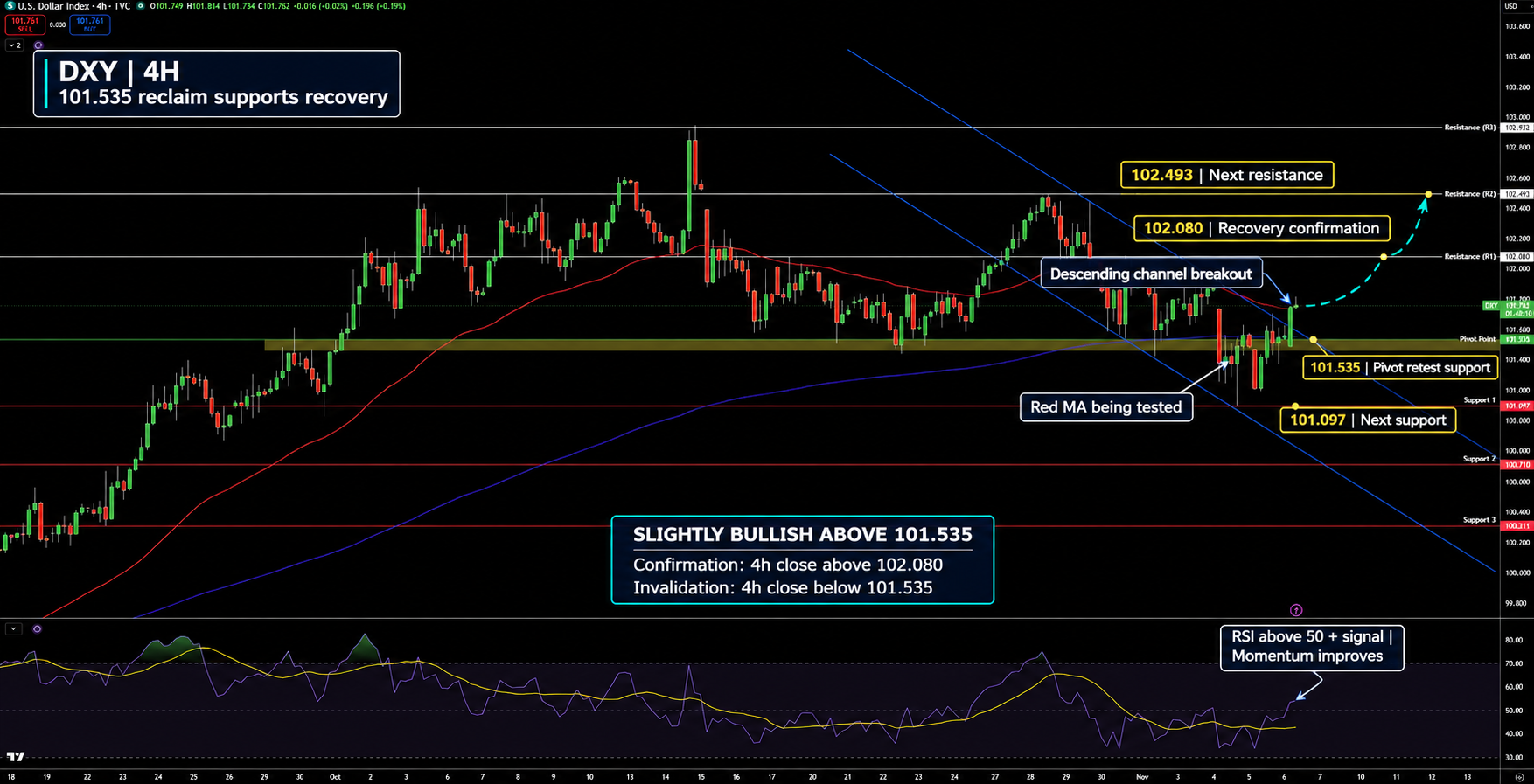
The US Dollar Index trades near 101.762 on the four-hour chart after reclaiming the 101.535 pivot, a marked reference level for the setup, and breaking above its descending channel. The channel’s parallel lines had guided prices lower. Price is now testing the red moving average, which tracks average prices over time, so the recovery still needs to hold its breakout.
Resistance, where sellers may return, stands at 102.080, followed by 102.493. Support, where buyers may step in, is 101.535, then 101.097. RSI, a 0 to 100 gauge of buying and selling strength, has risen above 50 and its signal line, a slower average of RSI. I lean slightly bullish, favoring a successful retest of 101.535. A four-hour close above 102.080 would strengthen the recovery; a close below 101.535 would invalidate the immediate breakout setup.
EUR/USD Technical Analysis: 1.12196 Pivot Break Exposes 1.11755
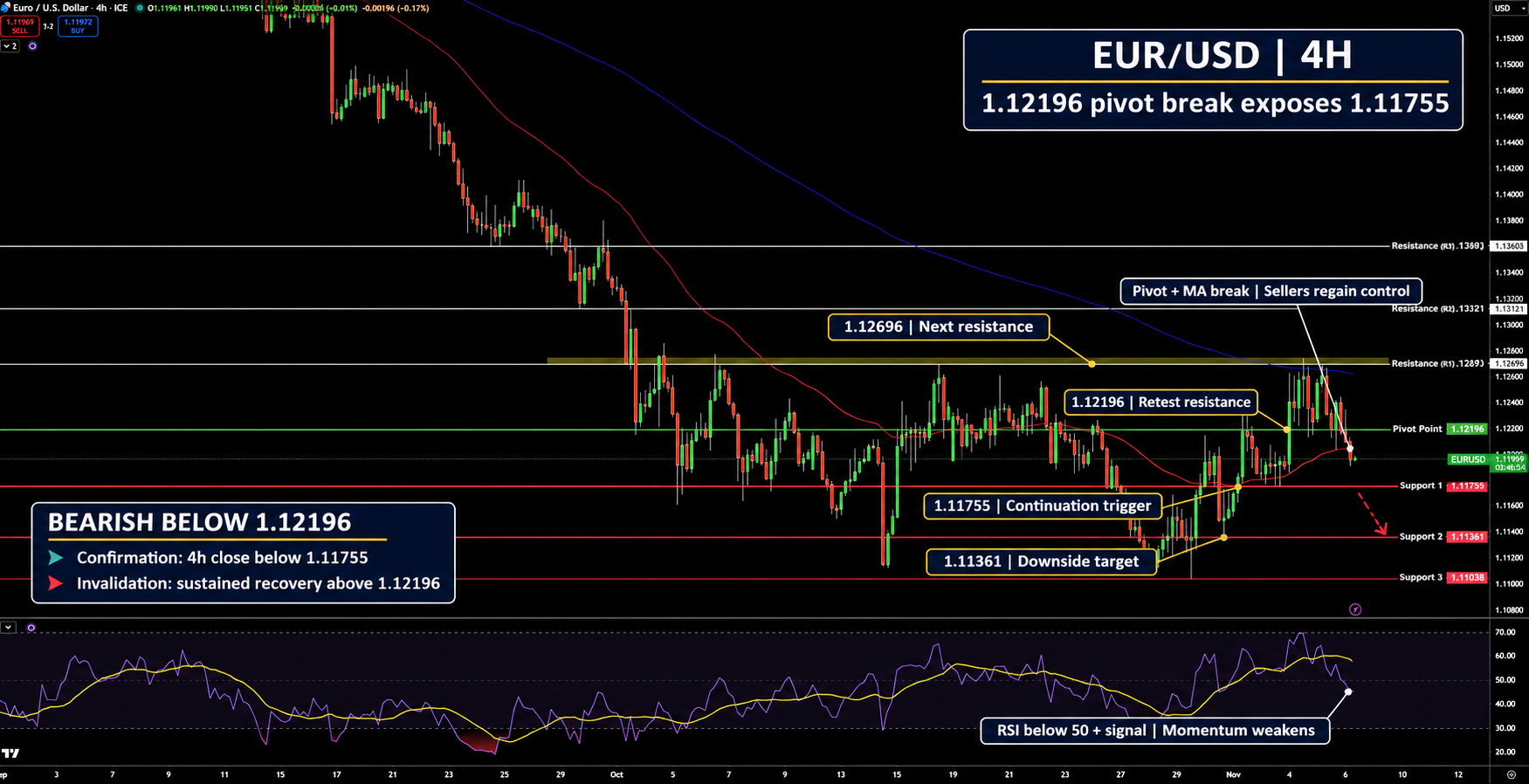
EUR/USD trades near 1.11969 on the four-hour chart after rejecting 1.12696 resistance and the falling blue moving average. The retreat below the 1.12196 pivot and red moving average shows that sellers have regained the immediate advantage. The latest decline leaves the pivot as the first level buyers need to recover.
Support stands at 1.11755, followed by 1.11361. Resistance begins at 1.12196, with 1.12696 the next hurdle. RSI has slipped below 50 and its signal line, confirming weaker momentum. My bias is bearish below 1.12196, favoring a failed retest of that level. A four-hour close below 1.11755 would confirm further weakness toward 1.11361. A sustained recovery above 1.12196 would invalidate the immediate bearish setup.
GBP/USD Technical Analysis: Pullback Puts 1.3406 Pivot in Focus
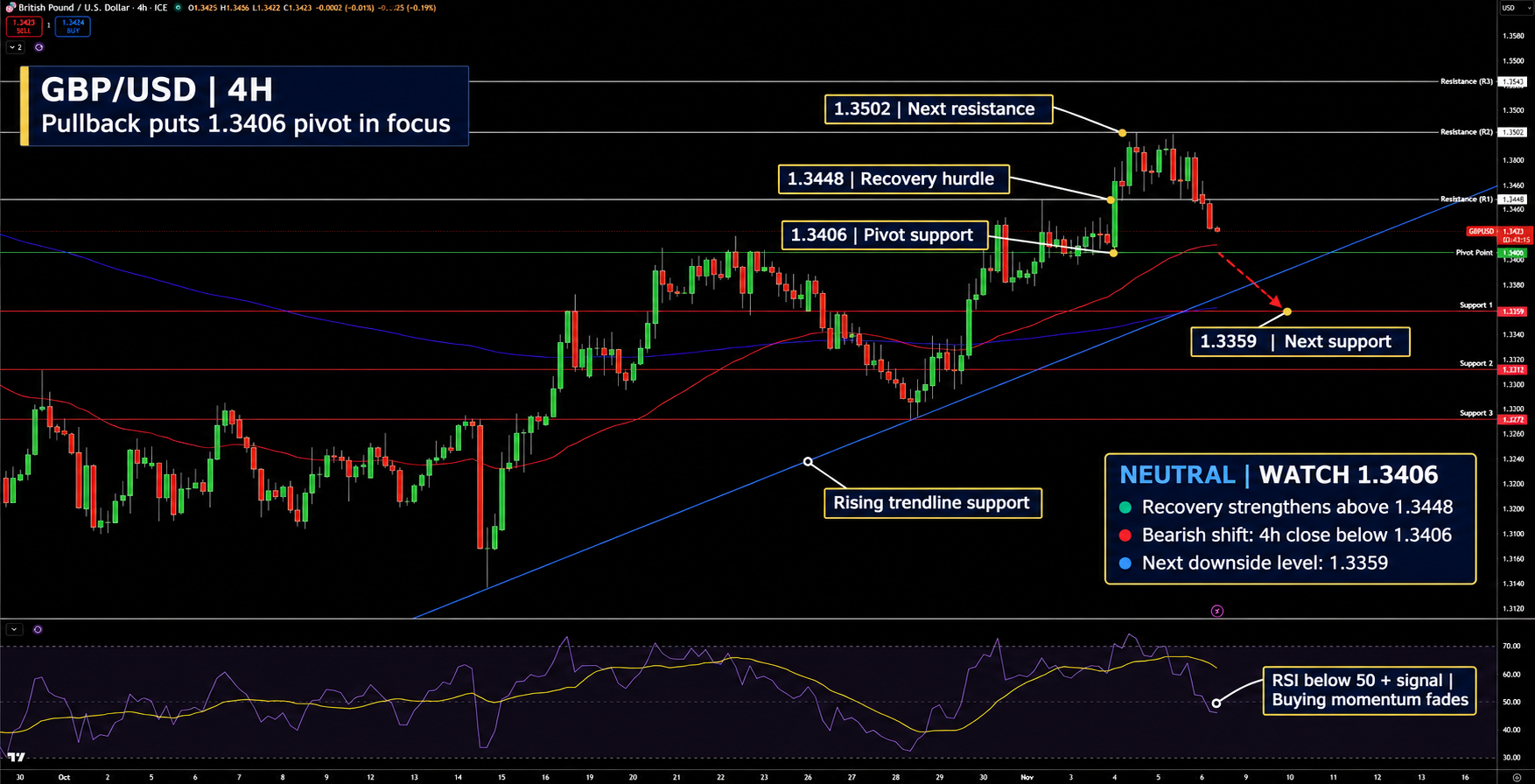
GBP/USD trades near 1.3423 on the four-hour chart after retreating from 1.3502 and losing 1.3448. Price remains above both moving averages and its rising trendline, a line connecting higher lows. The pullback has therefore weakened short-term momentum without yet breaking the broader recovery structure.
The 1.3406 pivot is immediate support, followed by 1.3359. Resistance stands at 1.3448, then 1.3502. RSI has fallen below 50 and its signal line, showing fading buying momentum. I remain neutral, watching for a successful hold near 1.3406 before considering renewed upside. Reclaiming 1.3448 would strengthen that case. A four-hour close below 1.3406 would shift the immediate bias bearish toward 1.3359.