



Dollar: Resilient Jobs Keep Further Fed Tightening in Play
October payrolls increased by 165,000, while unemployment stood at 4.1%, according to the Bureau of Labor Statistics. That resilience gives the Federal Reserve room to focus on inflation rather than immediately supporting growth. For the dollar, the support comes from the prospect of higher interest rates, which can make dollar assets more attractive.
Reuters reported Monday that recent Fed comments reinforced expectations of further tightening despite volatility in technology shares. That leaves the dollar supported by economic data as well as policy expectations. A recovery in demand for riskier investments could reduce defensive dollar buying, but it would not by itself remove the case for higher rates.
Euro: Inflation Pressure Meets Higher Borrowing Costs
The European Central Bank held interest rates unchanged on October 29. Its policy statement warned that higher energy costs could lift inflation and weaken growth. At the accompanying press conference, Christine Lagarde left a December increase in play, while making clear that incoming data would determine the decision.
The ECB is also assessing how higher long-term borrowing costs could restrain lending and spending. Higher expected policy rates can support the euro, but yields, the returns investors receive on bonds, can also rise because of concern about government finances. That form of tightening can weaken confidence. December’s decision remains open.
Sterling: BoE Hike Leaves Energy Costs in Focus
The Bank of England raised Bank Rate by 0.25 percentage points to 4% on November 5. Eight policymakers backed that increase; one preferred a larger move. The Bank’s policy statement cited stronger-than-expected activity and growing energy-related inflation pressure, but stressed that future decisions remain conditional on the evidence.
Sustained easing in energy costs could reduce the need for further tightening. For sterling, the question is whether inflation pressure lasts long enough to require higher rates despite the cost to household spending and business demand.
EUR/USD Price Forecast
Every new EUR/USD analysis as it publishes, today's technical signal and key levels, live price — on one page.
See all EUR/USD forecastsThe BLS release calendar lists US consumer inflation for November 10, followed by producer inflation on November 13. Consumer prices track what households pay; producer prices measure prices received by domestic producers. Strong readings could reinforce expectations for higher US rates. Softer figures would give euro and sterling investors more room to focus on domestic conditions.
US Dollar Index Technical Analysis: 102.259 Rejection Tests Recovery
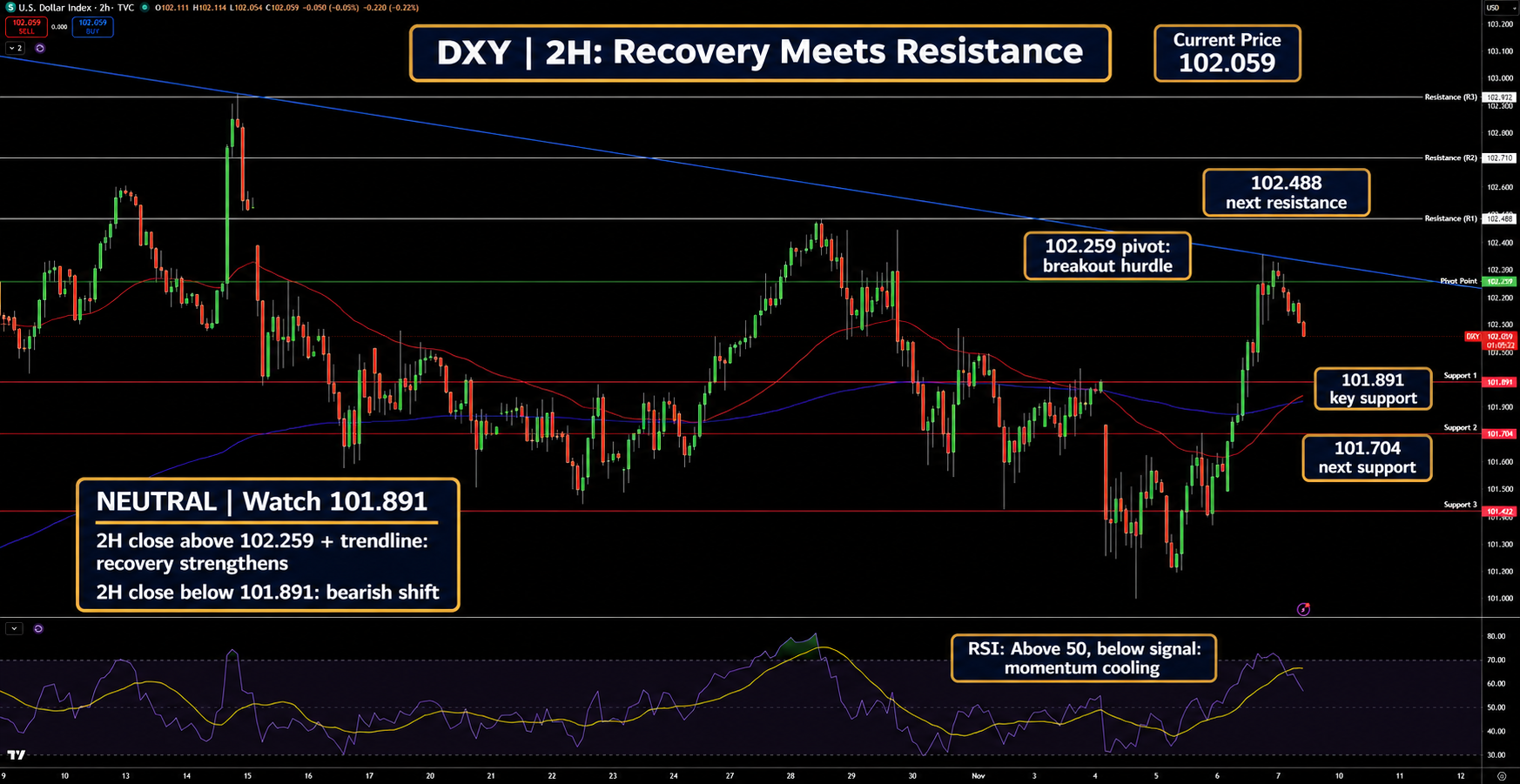
The US Dollar Index trades near 102.059 on the two-hour TVC chart after rejecting the descending trendline, a line connecting lower highs, and 102.259 pivot, a marked reference level. Price remains above both moving averages, which track average prices over time, suggesting a pullback within the rebound.
Resistance, where sellers may return, starts at 102.259, then 102.488. Support, where buyers may step in, stands at 101.891, followed by 101.704.
RSI, a gauge of buying and selling strength, remains above 50 but has crossed beneath its signal line, a slower average of RSI. My bias is neutral while DXY holds above support at 101.891. A two-hour close above 102.259 and the trendline would favour renewed upside; below 101.891 would turn the immediate bias bearish.
GBP/USD Technical Analysis: Trendline Bounce Reclaims 1.3373 Pivot
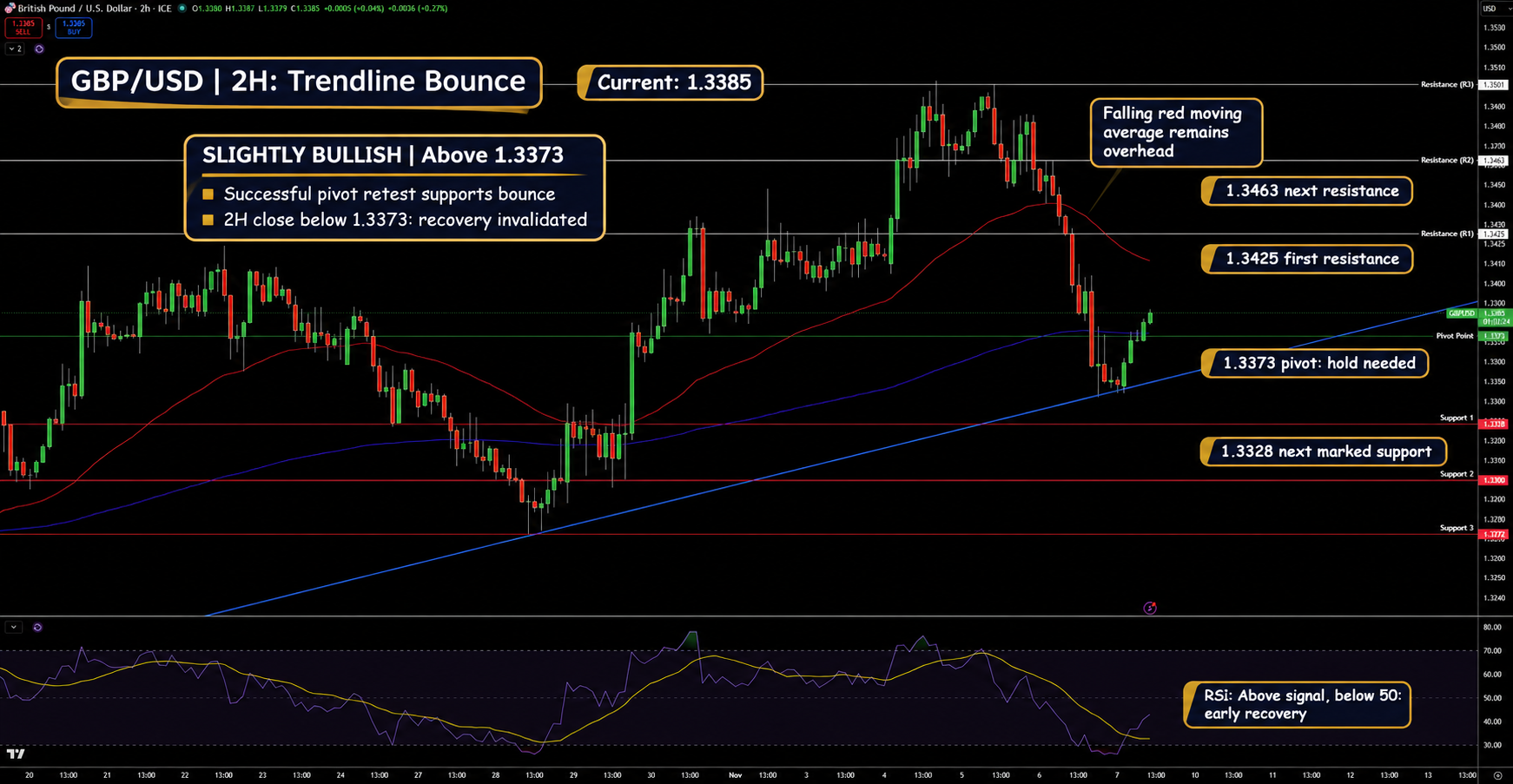
GBP/USD trades near 1.3385 on the two-hour ICE chart after rebounding from its rising trendline, which connects higher lows. Buyers have reclaimed the 1.3373 pivot and blue moving average, although the falling red moving average remains overhead.
Resistance stands at 1.3425, followed by 1.3463. The pivot at 1.3373 offers initial support, with 1.3328 the next marked floor beneath the rising trendline.
RSI has recovered from below 30, the conventional oversold threshold, and crossed above its signal line, but remains below 50. I am slightly bullish while 1.3373 holds. Clearing the red moving average would strengthen the bounce; a two-hour close below 1.3373 would invalidate the immediate recovery setup.
EUR/USD Technical Analysis: Rebound Tests 1.11632 Pivot After Sharp Selloff
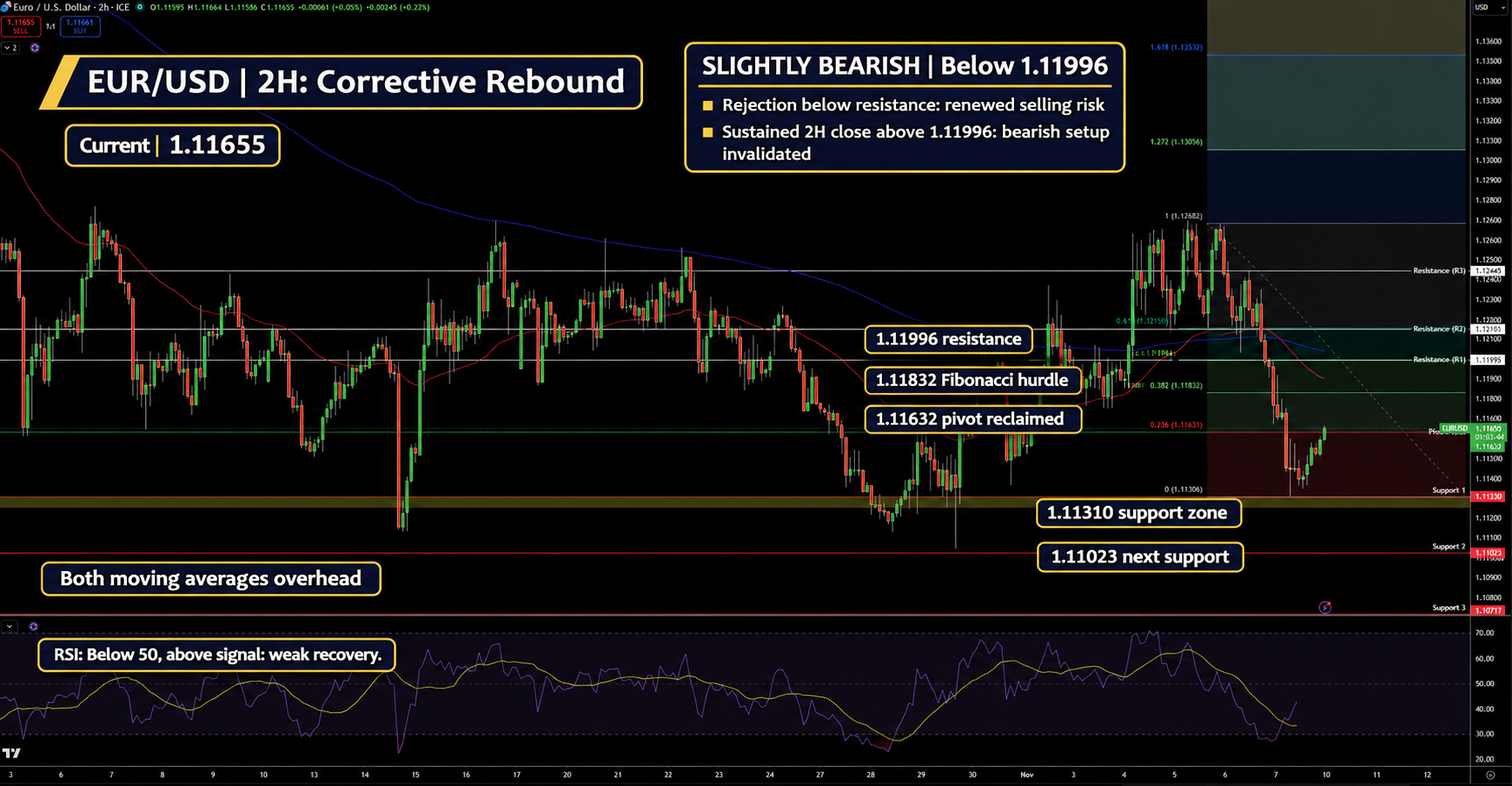
EUR/USD trades near 1.11655 on the two-hour ICE chart after bouncing from the shaded support zone around 1.11310. Price has edged above the 1.11632 pivot, but both moving averages remain overhead.
The first Fibonacci recovery barrier, measuring how much of the decline has been retraced, is 1.11832. Resistance follows at 1.11996. Support sits at 1.11310, then 1.11023. Holding the pivot would give buyers room to extend the bounce.
RSI has recovered above its signal line but remains below 50. I lean slightly bearish, treating this as a corrective rebound. Rejection beneath 1.11996 would favour renewed selling; a sustained two-hour close above it would invalidate the immediate bearish setup.