
Market Overview
The broad-based US dollar failed to stop its downward trend and remained under pressure on the day. As of now, the US Dollar Index (DXY), which measures the value of the Greenback against a basket of six major currencies, is hovering near a two-week low of 98.26.
However, the reason for its bearish bias could be attributed to multiple factors, including the resolution of Greenland-related disputes, mixed US labor data, and ongoing speculation surrounding the Federal Reserve’s leadership and future policy direction.

Greenland Deal Resolution Eases Tensions
The US Dollar initially gained some ground earlier in the week after a framework agreement on Greenland’s future was reached between the United States and the European Union. During a meeting between US President Donald Trump and NATO Secretary General Mark Rutte, both sides agreed on a framework addressing Greenland’s entitlements. In addition, President Trump lifted the 10% tariffs on several EU countries and made it clear that the US would not try to take Greenland by force.
Therefore, these developments helped ease geopolitical concerns and gave the dollar a short-term boost, but it later fell again as markets worried about the Fed’s leadership and future policy plans.
Mixed US Jobless Data Adds to Uncertainty
On the data front, US labor market figures released by the Department of Labour also contributed to the mixed sentiment. Weekly initial jobless claims rose slightly to 200,000 for the week ending January 17, missing the initial estimate of 212,000 but marginally higher than the previous week’s revised figure of 199,000. Meanwhile, the four-week moving average decreased by 3,750 to 201,500. Continuing jobless claims also fell by 26,000 to 1.849 million for the week ending January 10.
Therefore, the mixed US labor data added uncertainty for traders, limiting the US dollar’s gains, as slightly higher jobless claims and falling continuing claims signaled a stable but cautious economic outlook.
GBP/USD Price Forecast
Every new GBP/USD analysis as it publishes, today's technical signal and key levels, live price — on one page.
See all GBP/USD forecastsDollar Index Price Outlook: DXY Stabilizes Near $98.45 as Trendline Support Comes Into Focus
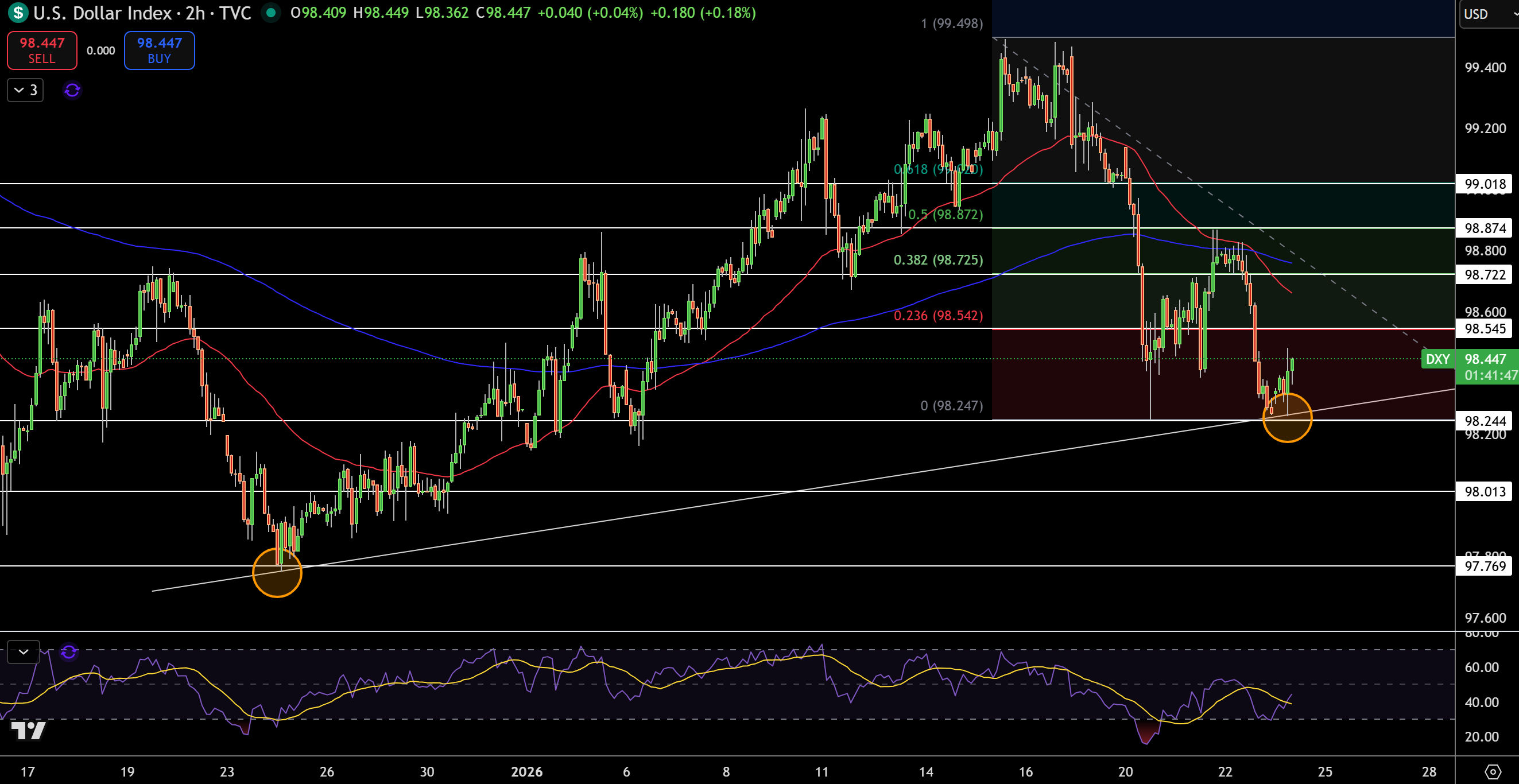
The US Dollar Index is trading around $98.45, attempting to stabilize after a sharp pullback from the $99.50 area. On the 2-hour chart, price recently tested a rising trendline near $98.25, where buyers stepped in, as shown by long lower candlestick wicks.
The structure has shifted into a short-term descending channel, while the broader uptrend remains intact above the trendline. Key support sits at $98.25–$98.00, followed by $97.77. On the upside, resistance aligns at $98.72, then $98.87, matching the 38.2% and 50% Fibonacci retracement zones.
The 200-EMA is acting as dynamic resistance, while RSI has rebounded from near-oversold levels, suggesting downside momentum is slowing.
Trade idea: Buy on a hold above $98.25, target $98.85, stop below $97.95.
GBP/USD Price Outlook: Sterling Near $1.3490 as Descending Trendline Caps Recovery
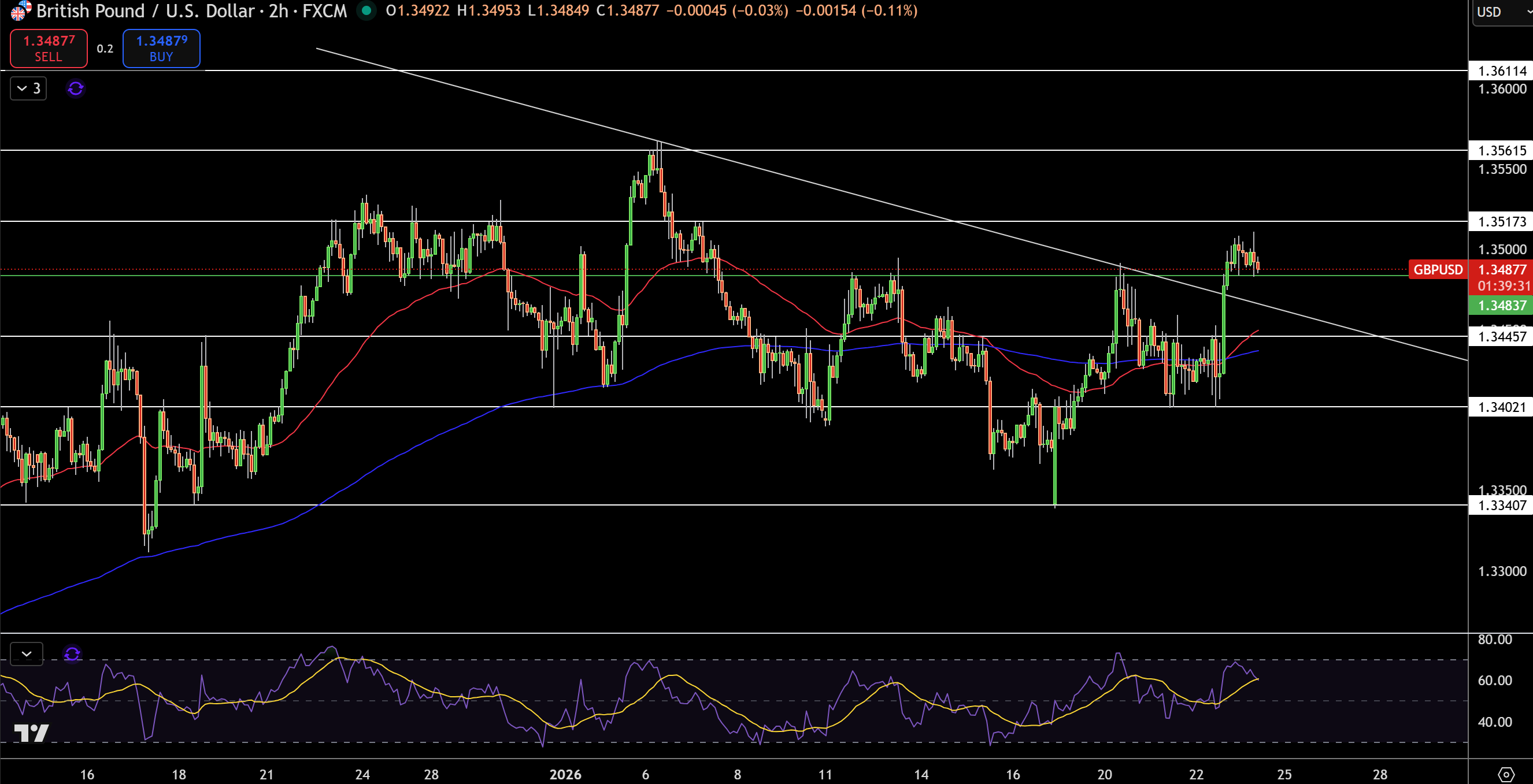
GBP/USD is trading around $1.3490, struggling to extend gains after a rebound from the $1.3340 support zone. On the 2-hour chart, price has pushed above the 50-EMA but remains capped by a long-term descending trendline, keeping the broader structure mixed. Recent candlesticks show upper wicks near $1.3515, signaling selling interest at resistance.
A horizontal resistance band sits between $1.3500–$1.3560, while support is layered at $1.3445, followed by $1.3400, where the 200-EMA and prior demand align. The move resembles a short-term range rather than a breakout. RSI is holding near 60, indicating improving momentum but not strong acceleration.
Trade idea: Sell near $1.3500, target $1.3420, stop above $1.3560.
EUR/USD Price Outlook: EUR Holds $1.1730 as Rebound Tests Key Fib
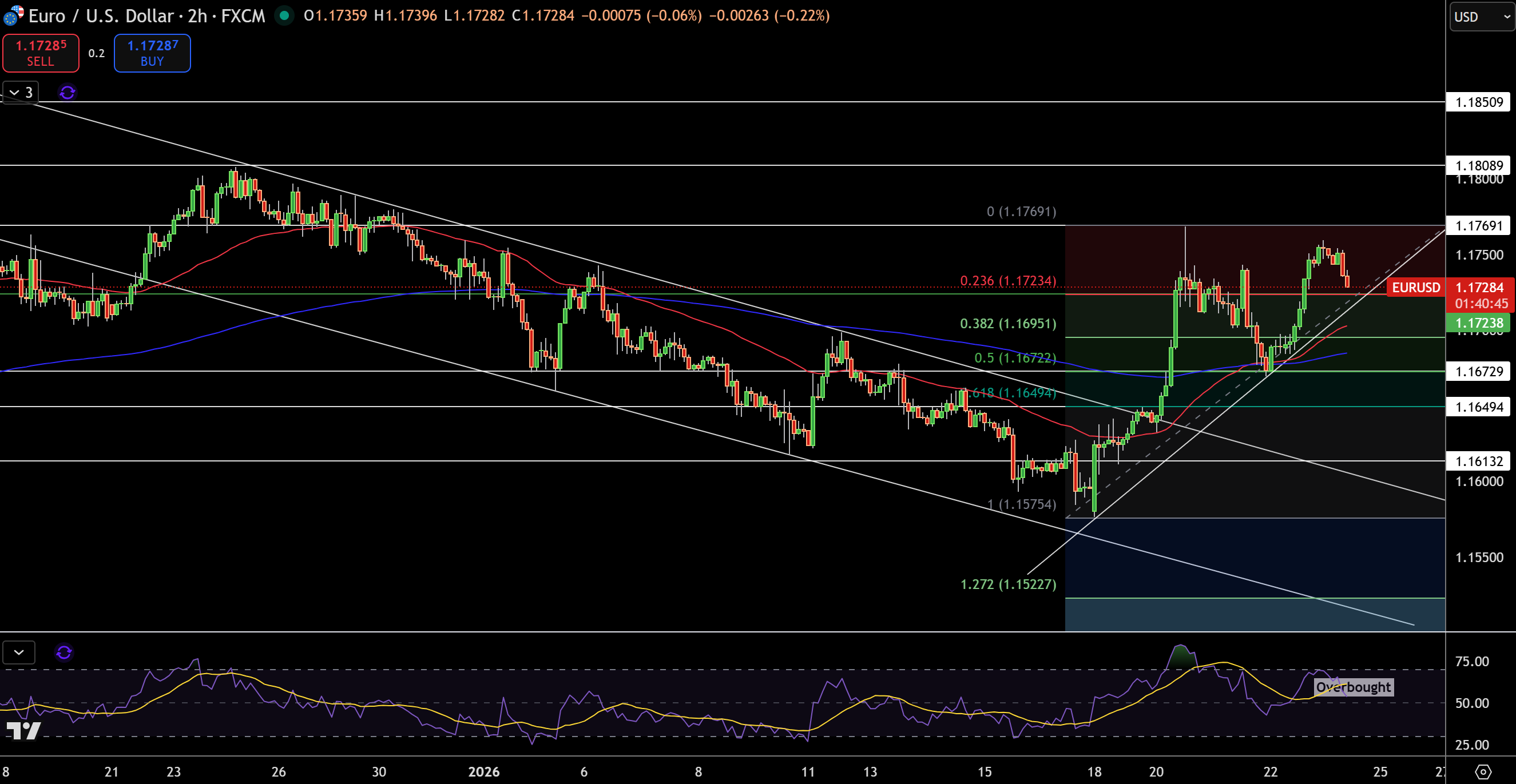
EUR/USD is trading near $1.1730, pausing after a sharp rebound from the $1.1575 low. Price has broken out of a descending channel and is now moving within a short-term rising structure, but recent candlesticks show upper wicks near $1.1769, signaling supply.
The recovery has stalled around the 23.6% Fibonacci retracement at $1.1723, with higher resistance at $1.1769 and $1.1810. On the downside, former support at $1.1695 and $1.1672 aligns with the 38.2% and 50% Fib levels and the 200-EMA, forming a key demand zone. RSI has cooled from overbought territory toward 60, suggesting momentum is slowing but not reversing.
Trade idea: Buy on dips near $1.1695, target $1.1765, stop below $1.1645.