
Market Overview
During the European session, the US Dollar (USD) attempted a modest rebound from its lowest level since late October. The move remains limited as soft labor market readings and rising expectations of a Federal Reserve rate cut continue to restrain dollar strength.

Labor Market Weakness Weighs on the Dollar
Fresh data from Automatic Data Processing showed private payrolls declining by 32K in November, following a 47K increase in October and falling well short of expectations for a 5K rise. The contraction signals a deeper slowdown in hiring momentum and reinforces concerns about underlying economic conditions.
The weaker labor backdrop has added pressure on the USD, which has struggled to regain traction against major peers.
Rate-Cut Expectations Support Risk Assets
Recent US macro data has strengthened market confidence in a 25-basis-point rate cut at the upcoming Federal Open Market Committee (FOMC) meeting. Expectations of lower borrowing costs have supported risk sentiment, benefiting equity markets and safe-haven metals, while keeping the dollar’s recovery in check.
Focus Turns to Upcoming US Data Releases
With dovish expectations limiting upside potential for the USD, traders are looking to upcoming data for clearer direction. The US Personal Consumption Expenditure (PCE) Price Index due Friday remains a key release for assessing the Fed’s policy outlook.
GBP/USD Price Forecast
Every new GBP/USD analysis as it publishes, today's technical signal and key levels, live price — on one page.
See all GBP/USD forecastsBefore that, Thursday’s economic docket, including Challenger Job Cuts and Weekly Initial Jobless Claims, will also be monitored for additional signals on labor market conditions.
US Dollar Index (DXY) – Technical Analysis
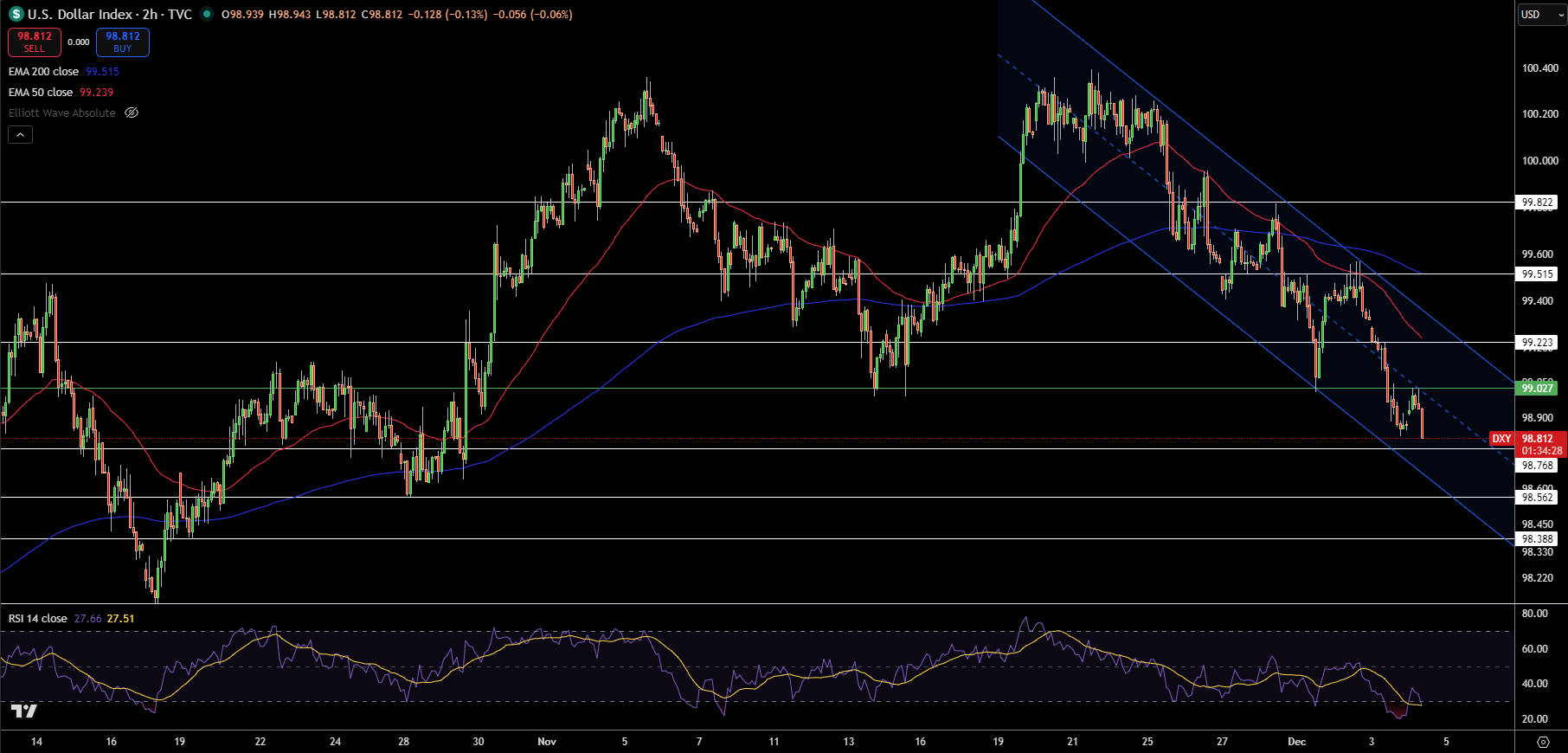
The Dollar Index is trading around $98.81, extending its decline inside a well-defined descending channel. Price has broken below the $99.02 level, turning it into near-term resistance, while candles show persistent lower highs and lower lows, confirming controlled bearish pressure. Both the 50-EMA at $99.23 and 200-EMA at $99.51 sit well above current levels, reinforcing the downside bias.
RSI is hovering near 27, signaling oversold conditions, though no reversal pattern is visible yet. A sustained drop beneath $98.76 opens the path toward the next structural support at $98.56 and potentially $98.38.
For buyers to regain momentum, DXY must reclaim $99.02 and close above the 50-EMA, which would indicate early stabilization.
GBP/USD Technical Analysis
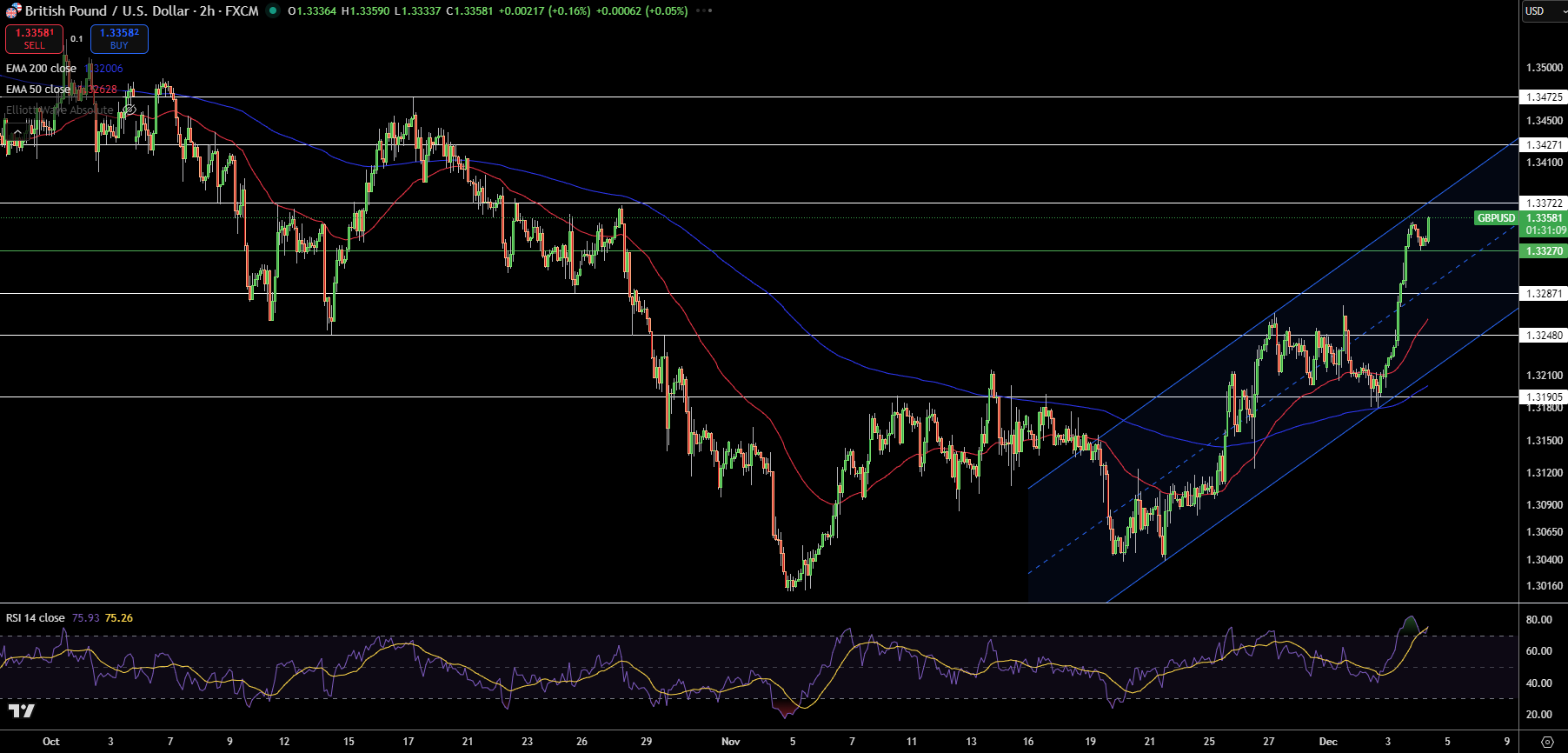
GBP/USD trades near $1.3358 after extending its rally within a rising channel that has guided price action since mid-November. The pair broke above the $1.3327 region, where the 50-EMA recently provided support, and continues to hold well above the 200-EMA at $1.3220. The breakout sequence shows strong bullish conviction, with consecutive wide-bodied candles confirming momentum.
The RSI is hovering above 75, signaling overbought conditions and raising the risk of a corrective pause. If buyers cool off, price may revisit the channel’s midline or the $1.3327 area for validation.
As long as the structure remains intact and price stays within the channel, the short-term bias remains upward despite stretched momentum.
EUR/USD Technical Forecast
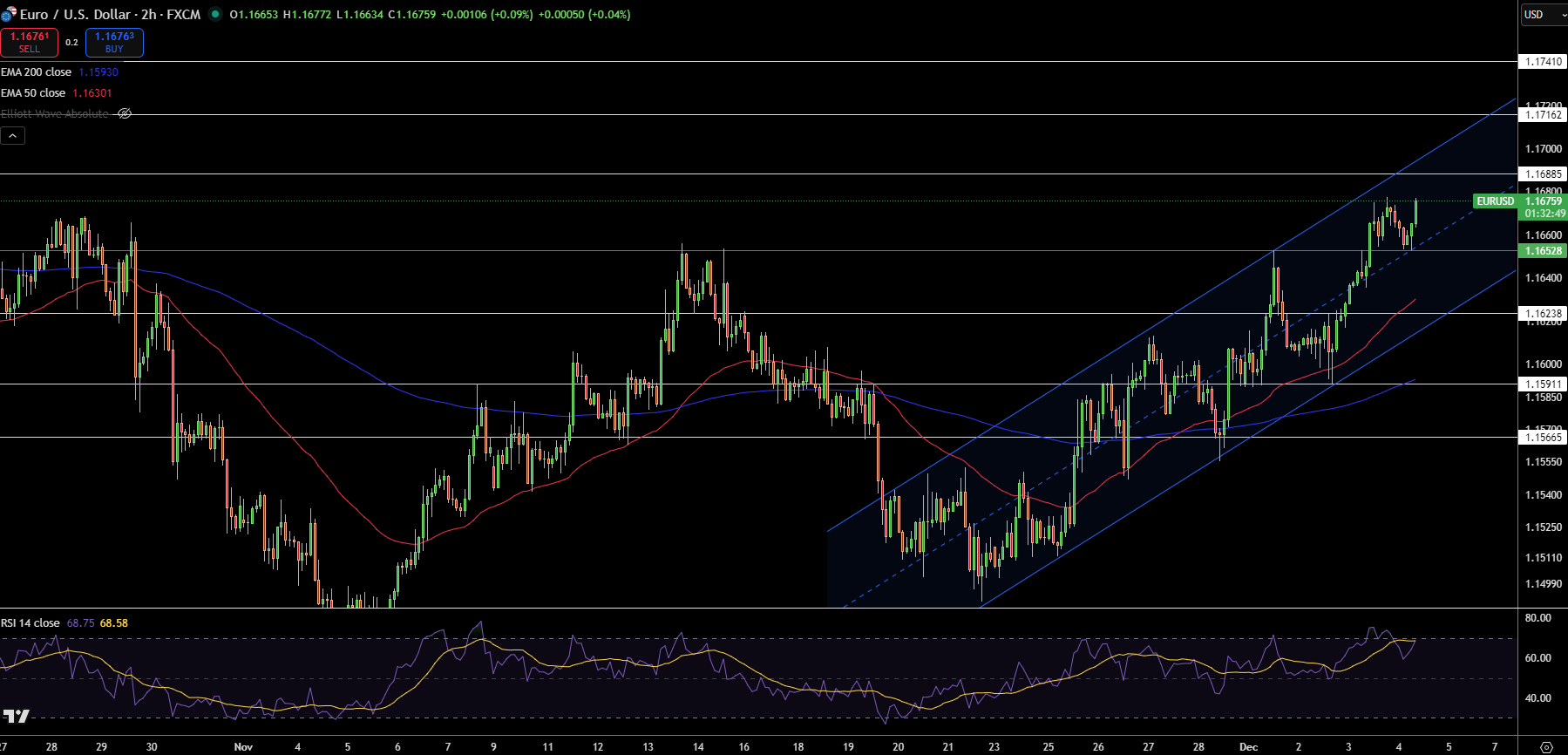
EUR/USD is trading around $1.1676, continuing its climb inside a well-defined ascending channel. The pair recently bounced from the mid-channel region near $1.1652, with bullish candles showing steady higher lows. Price is also holding above the 50-EMA at $1.1630 and the 200-EMA at $1.1593, reinforcing the broader upward structure.
The next resistance sits near $1.1688, where prior reactions occurred. A clean close above this zone could open the path toward the upper channel boundary. RSI is holding near 69, showing firm buying interest but approaching overbought conditions.
If momentum cools, a pullback toward $1.1652 or the channel floor remains possible. As long as the pair trades within the channel, the short-term bias stays constructive.