
Market Overview
In early European trading, the US Dollar (USD) edged toward a two-week low as markets increased their bets on another Federal Reserve rate cut this month. While the US economy continues to show resilience, recent remarks from Fed officials have strengthened expectations for additional easing.
These shifting rate forecasts have pulled the dollar lower, with traders positioning for cheaper credit and softer yields in the near term.

Key Data Releases in Focus
Attention now turns to today’s US ISM Manufacturing PMI, a release that could influence short-term price direction. The start of a new month also brings several important ISM Manufacturing PMI, giving traders more data to assess the Fed’s path forward.
Market Sentiment and Short-Term Outlook
The dollar’s pullback reflects cautious sentiment across financial markets, with investors evaluating how potential rate cuts may shape broader economic conditions. Traders remain focused on incoming data and Fed commentary for signals that could adjust expectations.
A stronger-than-expected ISM Manufacturing PMI could offer the USD temporary support, while weaker results would likely add pressure and extend the currency’s recent slide.
US Dollar Index (DXY) – Technical Analysis
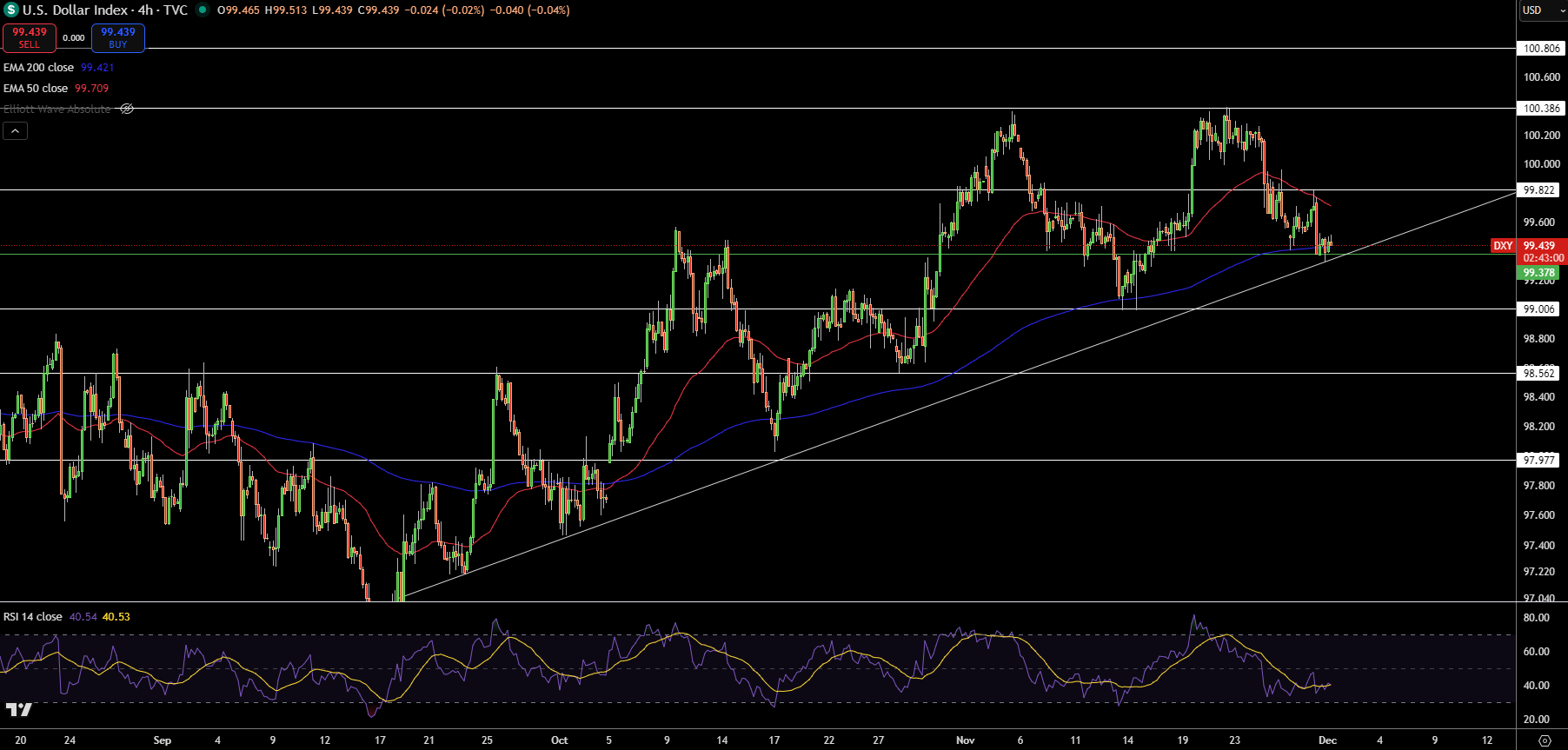
The US Dollar Index is testing a key ascending trendline after slipping from last week’s highs. Price is holding just above 99.35, where the trendline, the 50-EMA, and recent swing lows converge, creating an important short-term decision area. If buyers defend this zone, DXY could rebound toward 99.82 and 100.38, where previous rallies stalled.
GBP/USD Price Forecast
Every new GBP/USD analysis as it publishes, today's technical signal and key levels, live price — on one page.
See all GBP/USD forecastsThe RSI is stabilizing near 40, showing the market is cooling but not yet signaling strong downside momentum.
A clean break below the trendline would weaken the broader structure and expose 99.00, followed by 98.56. For now, the index is neutral, with direction hinging on how it reacts around current support.
GBP/USD Technical Analysis
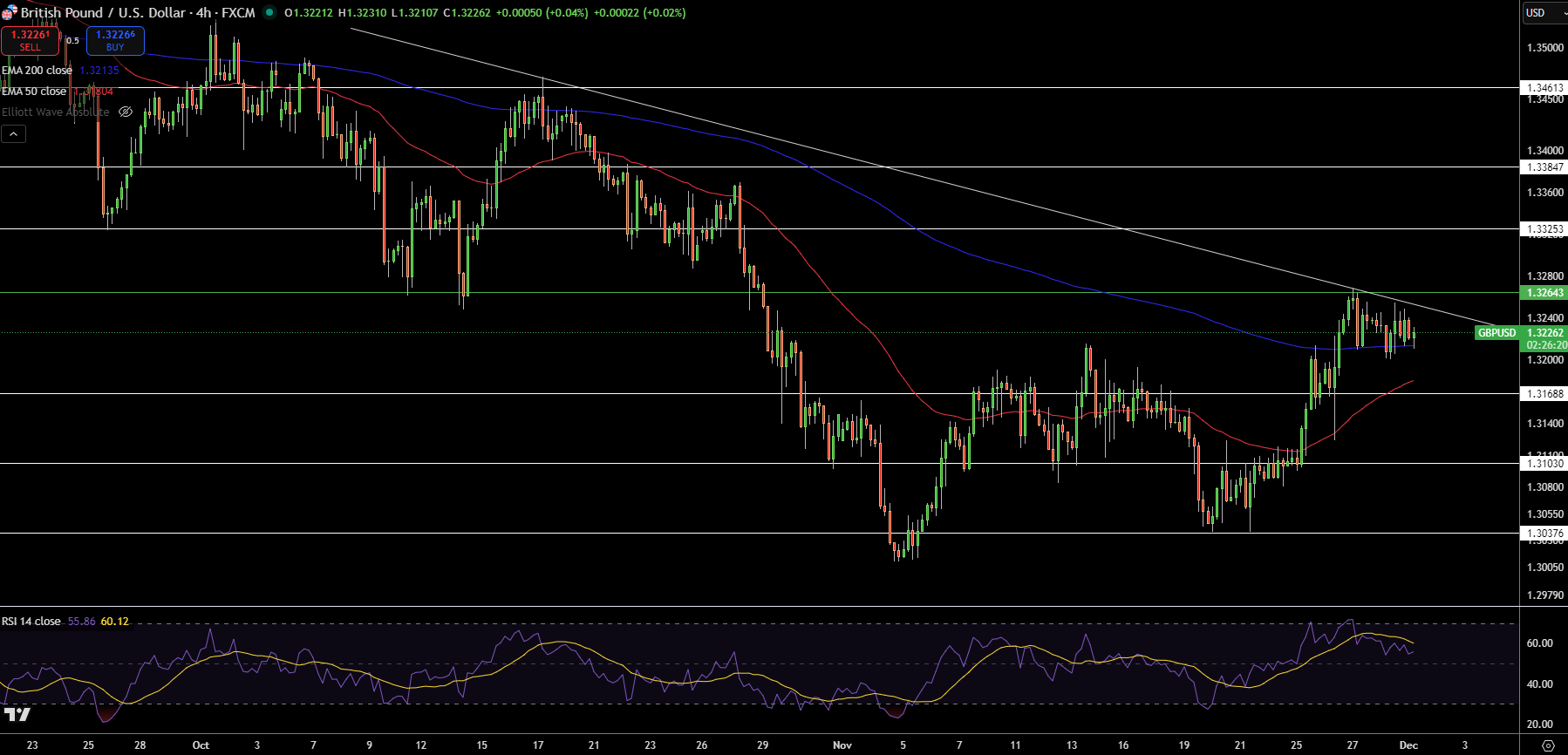
GBP/USD is pulling back after testing the descending trendline near $1.3280, a level that has capped every rally since September. The pair is still trading above the 50-EMA, while the 200-EMA near $1.3213 acts as a secondary support zone. RSI sits around 54, reflecting a mild loss of momentum without signaling exhaustion.
If buyers defend $1.3200, the pair could attempt another push toward $1.3325. A break above the trendline would mark a shift in structure, opening the door toward $1.3385.
Failure to hold $1.3200 risks a deeper slide back toward $1.3160, where previous reaction lows align with short-term support. GBP/USD remains at a technical decision point as traders wait for direction.
EUR/USD Technical Forecast
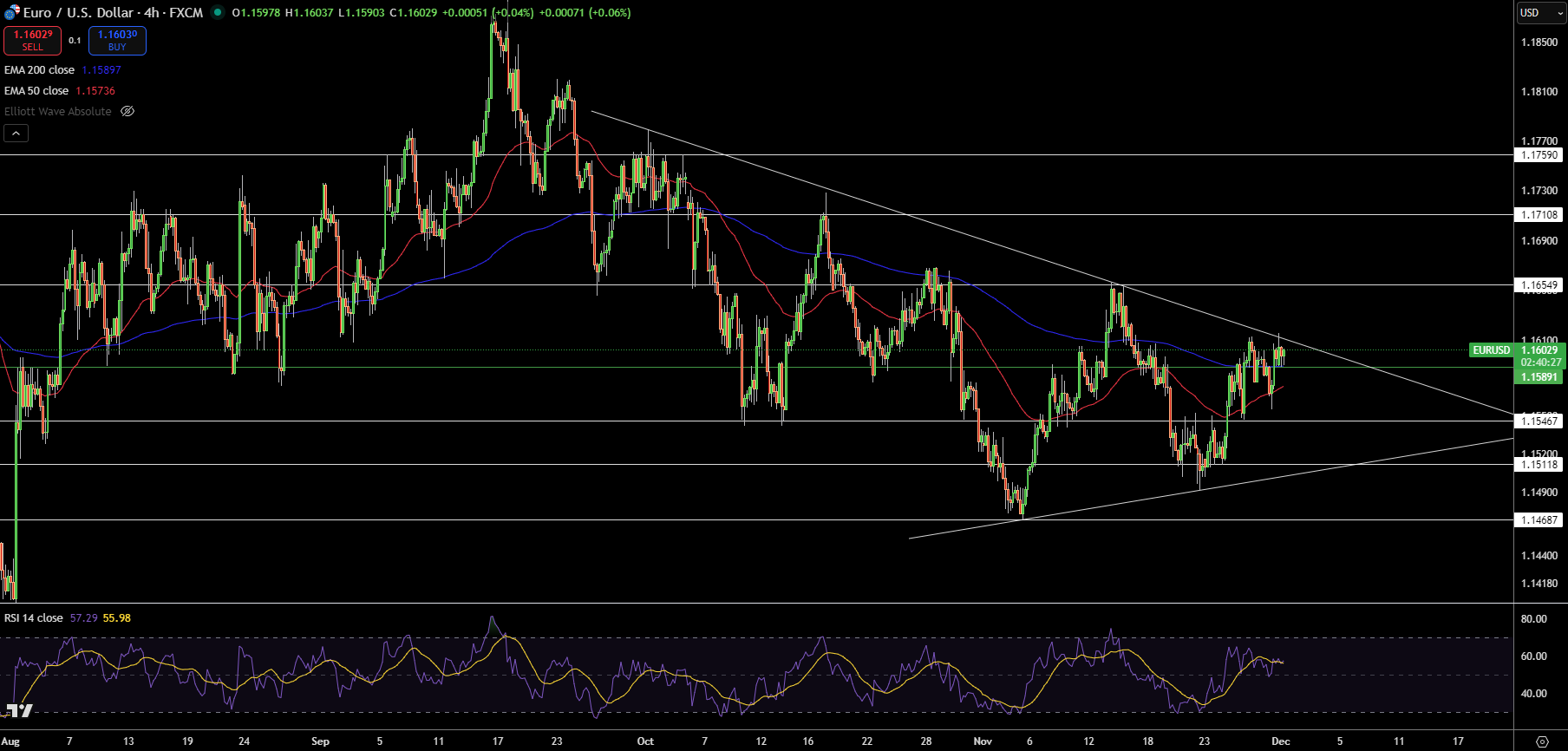
EUR/USD is pressing into a major descending trendline after rebounding from the $1.1515 support zone. The pair is trading above both the 50-EMA and 200-EMA on the 4-hour chart, showing improving short-term momentum. Price is testing $1.1600, but the trendline overhead remains a firm barrier that has rejected every rally since September.
RSI sits near 56, suggesting moderate strength without signs of overextension. If buyers clear the trendline, EUR/USD could move toward $1.1655. Failure to break higher would likely drag the pair back toward $1.1545, where the rising lower-boundary trendline offers secondary support.