



Market Overview
The early European trading session on the dollar saw it take a bit of a hit. Despite that, the dollar index (DXY) had managed to hold steady at 97.95 level. However, the dollar’s troubles were compounded by growing expectations that the Federal Reserve might ease up on monetary policy in 2026, and a fair amount of uncertainty surrounding a potential new Fed chair nomination.

Fed Rate Cut Expectations and Political Uncertainty Weigh on the Dollar
Traders and investors are really keeping a very close eye on the Federal Reserve at the moment, waiting for any signals on when and how they might be cutting interest rates in the future. Currently, markets are pricing in at least two rate cuts for 2026, although most people don’t think anything big will happen before June.
The Fed themselves only see one cut next year, but with the Fed being pretty divided on things it’s left people in the market feeling pretty unsure about what might happen next with US monetary policy.
On top of that, traders are also keeping an eye on who President Donald Trump might pick as the next Fed chair to replace Jerome Powell – any news on this could make markets get a bit more agitated and trigger a big move in the dollar either up or down.
Looking forward, traders will keep a close eye on US economic indicators, comments from the Fed, and what’s happening in politics – all of that is likely to play a big role in how the dollar does in the early months of 2026. If the markets get a bit more of a clear sense of what’s going on with interest rates or who’s going to be leading the Fed, we could see some pretty big short-term moves in the currency.
GBP/USD Price Forecast
Every new GBP/USD analysis as it publishes, today's technical signal and key levels, live price — on one page.
See all GBP/USD forecastsUS Dollar Index (DXY) – Technical Analysis
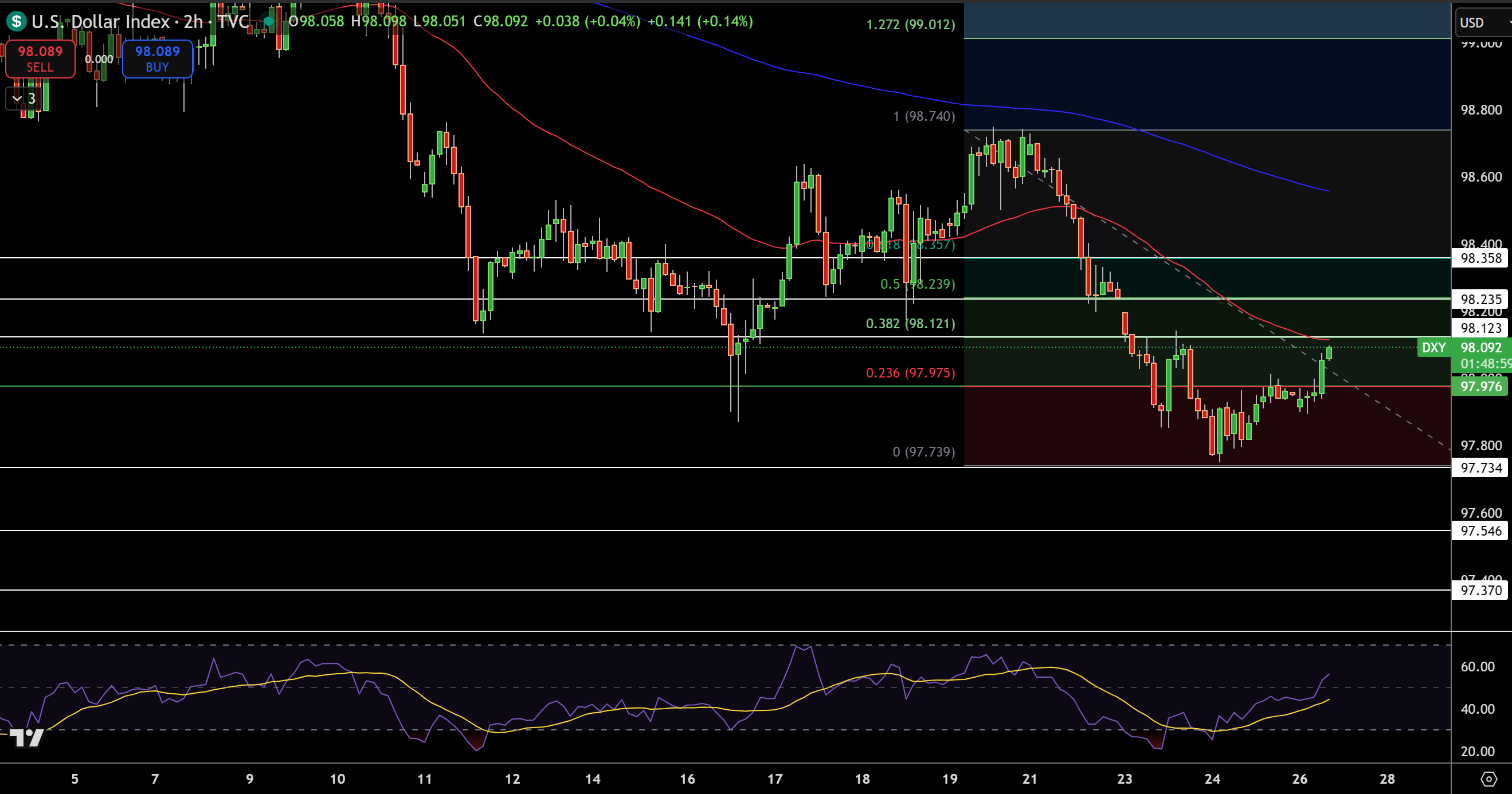
The US Dollar Index (DXY) is hovering around 98.09, trying to stabilise after bouncing back from that pretty low 97.74, but the overall look is still pretty corrective. It’s still got that 100-EMA at 98.70 capping it and keeping upside momentum in check.
This latest little bounce has actually pushed the DXY back above that 23.6% Fib level at 97.98 but buying pressure is already starting to dwindle around the 38.2% zone at 98.12–98.24.
Unless the DXY can get back above 98.35 then we’re still looking at the risk of more sideways trading or a little dip down towards 97.74, and even deeper support at 97.55 if selling pressure kicks in again.
GBP/USD Technical Analysis
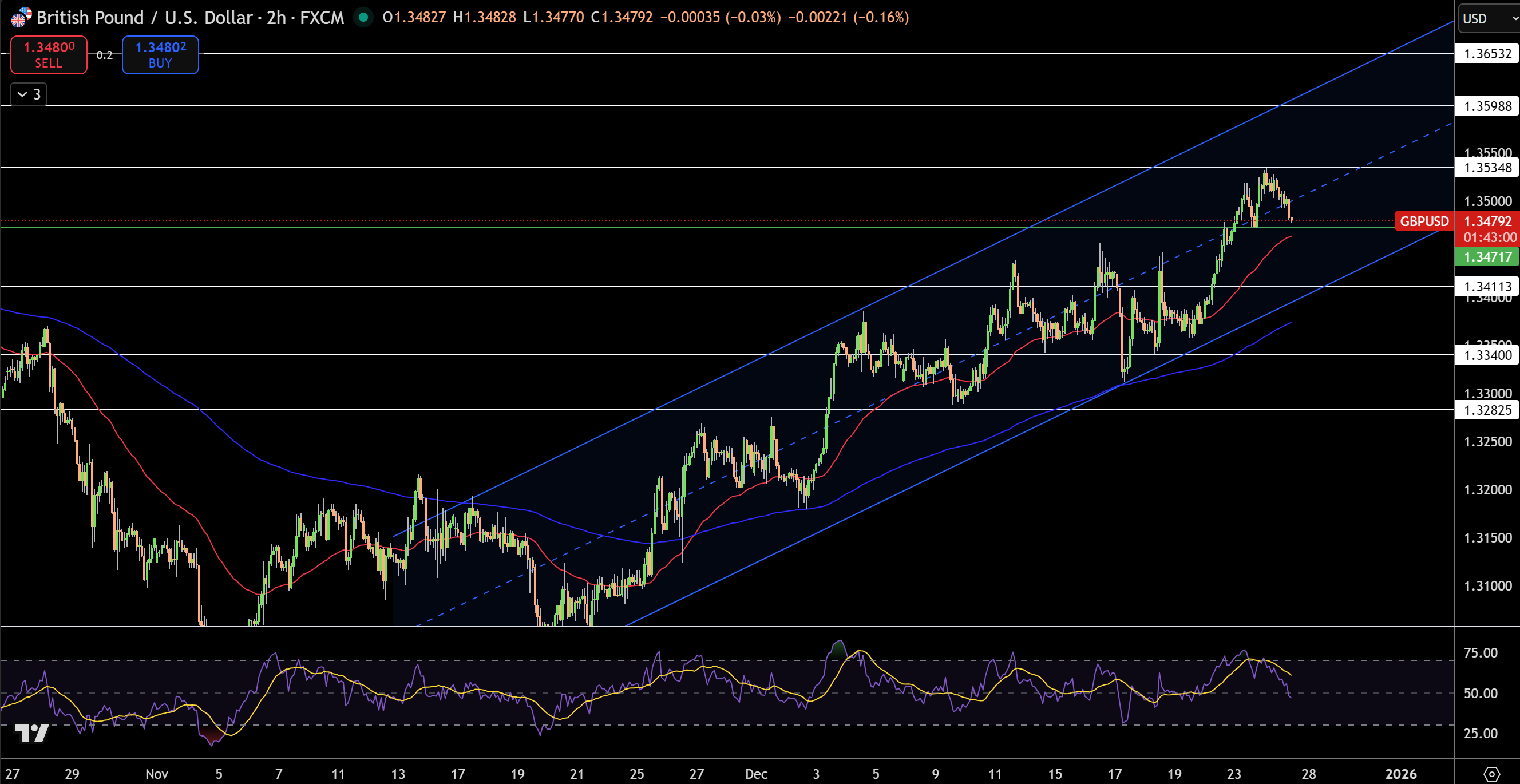
GBP/USD is hanging around $1.3479, easing a bit after failing to hold onto that swing high around $1.3535. For now, it’s finding support near that 50-EMA at $1.3470, while the 100-EMA close to $1.3340 is a stronger support level below that.
The RSI has cooled right back down from the low-70s towards the mid-50s, which suggests momentum is slowing rather than turning around. As long as this $1.3410–$1.3470 range holds, dips are likely to attract some buyers. A break below $1.3340 could open the door to something more serious.
EUR/USD Technical Forecast
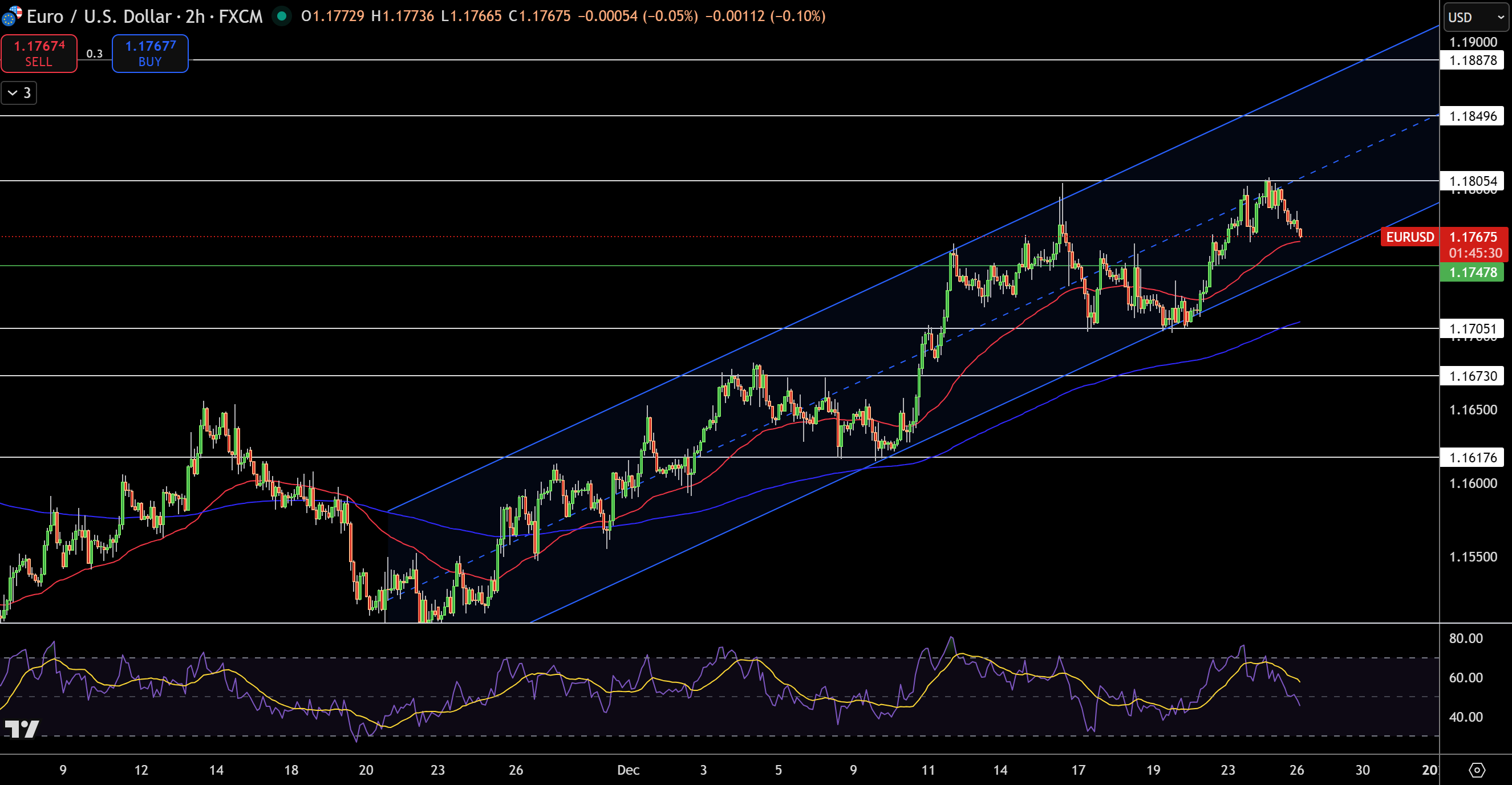
EUR/USD is dangling around $1.1767, easing a bit after failing to get any real momentum going near the upper boundary of its rising channel on the 2-hour chart. The pair is holding onto support around that 50-EMA at $1.1745 which is still doing a pretty good job of keeping things moving, while the 100-EMA near $1.1705 is even deeper down and should act as a bit of a buffer against a more serious sell-off.
As long as $1.1740 is holding, EUR/USD may just consolidate for a bit before another go at going higher. A break below $1.1705 would suggest we will see something deeper though.


