


The Dollar/Yen reached its highest level since January 23 last week with the rally primarily driven by the widening spread between U.S. Government Bond yields and Japanese Government Bond yields. The catalyst behind the widening interest rate differential was solid U.S. economic data, rising U.S. Treasury yields and expectations for further rate hikes later this year.
The USD/JPY settled at 110.759, up 1.407 or +1.29%.
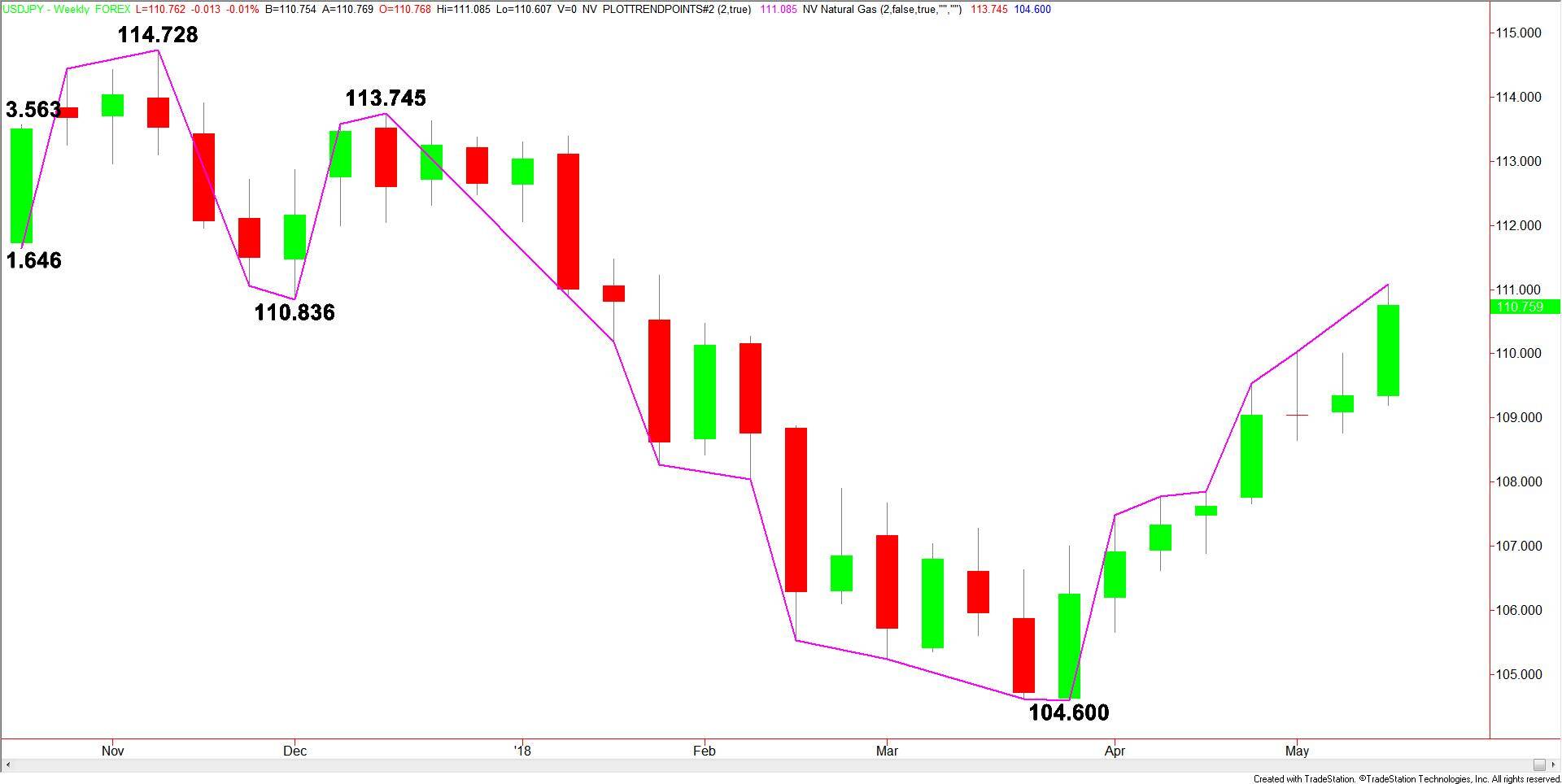
To put it another way, the rally since the March 26 bottom at 104.600 is essentially being fueled by the divergence between the monetary policies of the hawkish U.S. Federal Reserve and the dovish Bank of Japan.
In economic news, Japan’s economy contracted more than expected at the start of this year, breaking the longest run of growth seen for decades, in a blow to Prime Minister Shinzo Abe’s reflationary ‘Abenomics’ policies.
Wednesday’s data marked the end to eight straight quarters of economic expansion, which was the longest sequence of growth since a 12-quarter run between April-June 1986 and January-March 1989 during the asset-inflated bubble economy.
The economy shrank by 0.6 percent on an annualized basis, a much more severe contraction than the median estimate for an annualized 0.2 percent. Fourth quarter growth was revised to an annualized 0.6 percent, down from the 1.6 percent estimated earlier.
In the U.S. last week, the yield on U.S. 10-year Treasury note hit a new multiyear high, returning to a level not seen since 2011.
The 10-year yield briefly hit 3.128 percent, its highest level since July 8, 2011 when the note yielded as high as 3.184 percent. The 30-year bond yield also briefly hit a new high; it topped 3.2640 percent overnight, its highest level since October 3, 2014 when the 30-year yielded as high as 3.276 percent.
Forecast
There are no major reports in Japan this week. Most eyes will be on the FOMC Meeting Minutes on Wednesday. The Fed minutes should contain no surprises especially after the hawkish comments from several Fed officials last week. Investors will be looking for any comments on whether the Fed is considering three more rate hikes in 2018. They’re also going to be looking for any comments or concerns about an inversion of the yield curve.
To recap last week’s Fed comments:
Loretta Mester, president and CEO of the Federal Reserve Bank of Cleveland expressed support for the gradual increase in U.S. interest rates.
John Williams, president of the Federal Reserve Bank of San Francisco said that the Fed’s era of market hand-holding is nearing an end and that he thinks the time is approaching to phase out forward guidance.
Federal Reserve Bank of Atlanta President Raphael Bostic says he’s aware of the dangers of an inverted yield curve, which in the past has been viewed as a sign of impending recession.
Federal Reserve Bank of Dallas President Robert Kaplan cautioned against speeding up the pace of interest-rate increases by the U.S. central bank, in part due to concerns over a narrowing spread between short-term borrowing costs and longer-term yields.
Traders will also get the opportunity to respond to U.S. data on Core Durable Goods Orders and a speech by Fed Chair Jerome Powell on Friday.
The USD/JPY should continue to rise if investors keep betting that the Federal Reserve will stay the course and raise rates three times this year. Rising inflation, which threatens Treasury prices because it erodes the purchasing power of their fixed payments, puts upward pressure on rates.
After the Fed already approved a one-quarter point-hike in March, the market is now pricing in a 95 percent chance of a June increase, and a 72 percent chance for September. December is a question mark. But if it becomes relevant then the USD/JPY should surge to the upside.