



The European Central Bank faces an increasingly uncomfortable choice: risk tightening monetary policy too little as an extended energy shock threatens to entrench inflation, or tighten too much and amplify meaningful strains in sovereign bond markets.
Officials want to prevent the energy crisis from becoming embedded in the regional economy and have left open an option of a hike this week. But for now, the most likely outcome is a hold at the meeting concluding on Thursday, 29 October, with a 25-basis-point rate hike anticipated in December under a quarterly pace of hiking once fresh projections become available.
The Governing Council may begin laying the groundwork for such a December move in its communications this week, even if it stops short of any explicit commitment. The message being that the ECB remains data-dependent, but that the balance of risks has shifted towards inflation running hotter than previously anticipated.
With the Iran war prolonged and energy markets edging beyond even an ECB adverse scenario presented last month, the likelihood of rates being raised above neutral, and staying there for some period after, is becoming harder to dismiss. Further tightening next year can no longer be ruled out.
Inflation’s Second Round Is the ECB’s Real Concern
The crucial question is if elevated energy prices may increasingly affect domestic price-setting, wage negotiations and inflation expectations.
Headline inflation rose to 3.8% year over year last month (Figure 1) – nearly double a central-bank objective. This is even as core inflation nudged up only one tenth to 2.5%. Nevertheless, the longer headline inflation stays elevated, the harder it becomes to dismiss second-round effects that could make an external shock considerably harder to reverse.
Figure 1. Euro area headline inflation sharply rose last month
Euro area headline and core harmonised index of consumer prices, annual rates of change, %
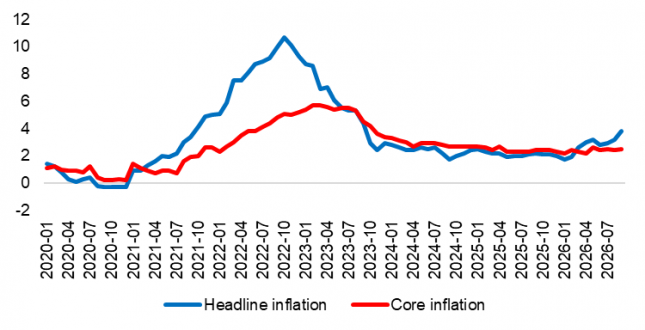
As I said on Bloomberg – for the ECB, an inflation overshoot is today a far greater medium-run risk than an undershoot. The nominal neutral rate — the rate consistent with the economy operating at its potential without monetary policy pushing demand in either direction — may also be drifting slightly higher from a starting point around 2% as persistent inflation and geopolitical uncertainty reshape the policy backdrop.
The euro should furthermore be watched closely. Its depreciation (Figure 2) adds to the inflationary impulse by making energy and other imports more expensive – amplifying inflationary dynamics and strengthening the case for monetary tightening.
Figure 2. The euro has depreciated against a basket of currencies
Daily nominal effective exchange rate of the euro, index level
EUR/USD Price Forecast
Every new EUR/USD analysis as it publishes, today's technical signal and key levels, live price — on one page.
See all EUR/USD forecasts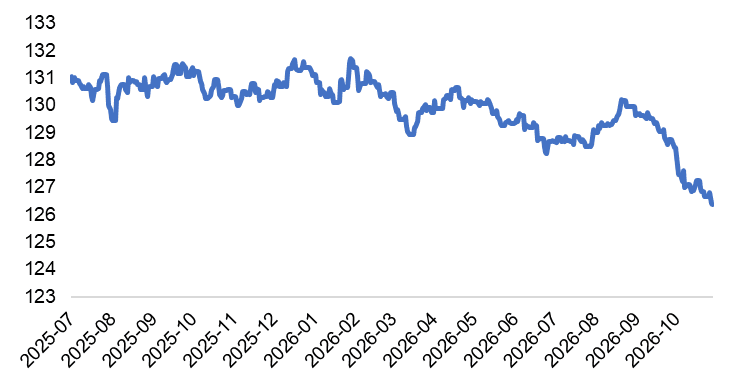
Sovereign Bonds: from Fiscal Squeeze to Debt-crisis Risk
The euro area’s underlying macroeconomic outlook has proven resilient to date, but that resilience is becoming more vulnerable to a market-driven shock. Sovereign yields have risen on two fronts: German risk-free rates have climbed as investors price a more restrictive ECB, while credit spreads have widened as fiscal and political risks intensify and speculative selling has risen. The yield on 10-year French debt recently surpassed 5% for the first time since 2002.
Much of the spread widening across the region may remain defensible. Investors are entitled to demand greater compensation for fiscal uncertainty, political instability and the prospect of persistently higher borrowing costs. Nevertheless, before a recent pull-back, French yields had been approaching a tipping point at which the market’s reassessment risks becoming self-reinforcing – such a watershed may be further tested as 2027 elections approach.
Higher borrowing costs, fiscal uncertainty and the prospect of an early change in ECB leadership could prove a dangerous combination for market confidence. The concern may not be that any sovereign debt crisis is inevitable, but rather that the risks are considerable.
Globally, debt has reached roughly USD 365trn. The key question being increasingly how much governments must refinance at today’s higher rates, rather than simply how much debt they may have accumulated. France, Italy and Germany alone face more than EUR 3.5trn in refinancing through the end of this decade. Debt that may have appeared manageable when financing costs were near zero can appear different when it must be rolled over at materially higher rates.
An easing of the Iran war, lower energy prices and a retreat in expectations of further rate increases could quickly relieve a significant share of the market pressure. But if, conversely, there were further inflationary shocks, forcing rates higher still, a fiscal squeeze could transform into a fuller debt crisis. Under such an adverse scenario, widening credit spreads and rising term premia — rather than risk-free rates — could become the dominant drivers of yields as investors question debt sustainability and market liquidity.
The ECB’s Dilemma: Tighten Monetary Policy, Contain Financial Fragmentation
The ECB cannot afford to let tighter monetary policy transform into any uncontrolled tightening of financial conditions. If disorderly sovereign-market pressures were to meaningfully escalate, its response would firstly be the use of communications. As bond markets have been handling the ECB’s tightening for it – with higher yields curbing economic growth and resultantly curtailing energy transfer to inflation, the ECB could respond by trying to talk down rate-hike expectations.
Alternatively, the ECB could warn against speculative dislocations – emphasising its readiness to act against unwarranted fragmentation and making clear that it would not tolerate market dysfunction threatening the transmission of its monetary policy. Such signals may prove adequate to discourage investors from testing the limits of its resolve.
If any such verbal intervention were activated and fails, the Transmission Protection Instrument (TPI) remains the main backstop.
Crucially, the TPI presents the possibility of addressing pressures in individual government bond markets absent easing monetary conditions across the whole of the euro area. The ECB could, in principle, tighten its overall policy stance to contain inflation while using such targeted interventions to counter destabilising market fragmentation.
TPI activation is neither imminent nor inevitable, but the instrument remains available if a disorderly sell-off in France were to re-escalate or further spread to Italy, Belgium or Greece.
The ECB may be approaching a December rate hike, but its real test will be whether it can keep inflation expectations anchored without allowing higher yields to compromise a resilient recovery.
Dennis Y. Shen is a macroeconomist and the former Chair of the Macroeconomic Council of a European credit rating agency. He is an external lecturer at the International School of Management (Germany) and a member of the supervisory board of Visioneers gGmbH.