
The US XRP-spot ETF market extended its inflow streak to 14 consecutive sessions on Thursday, December 4. However, inflows were the third weakest since launch, weighing on sentiment. Yen carry trade unwind risks added to the negative sentiment as markets bet on Fed rate cuts and a BoJ rate hike.
XRP slid into the $2.0 battleground on Friday, December 5, as crypto-spot ETF flows triggered a bout of profit-taking after XRP failed to break resistance at $2.2.
However, softer US inflation data bolstered bets on a December Fed rate cut, suggesting a potential bear trap and setting the stage for a Santa rally.
Below, I will explore the key drivers behind recent price trends, the medium-term (4-8 week) outlook, and the key technical levels traders should watch.
XRP-Spot ETF Inflow Streak Hits Fourteen
The US XRP-spot ETF market saw net inflows of $12.84 million on Thursday, December 4, taking the total inflow haul to $887.12 million. Key flow trends included:
- Franklin XRP ETF (XRPZ) topped the Thursday table with $5.7 million in net inflows.
- Canary XRP ETF (XRPC) led the since launch table, with net inflows of $358.88 million, benefiting from a first-to-market advantage.
- The US XRP-spot ETF market decoupled from the BTC-spot ETF market for the second time in the week. US BTC-spot ETF issuers reported $194.6 million in net outflows on December 4.
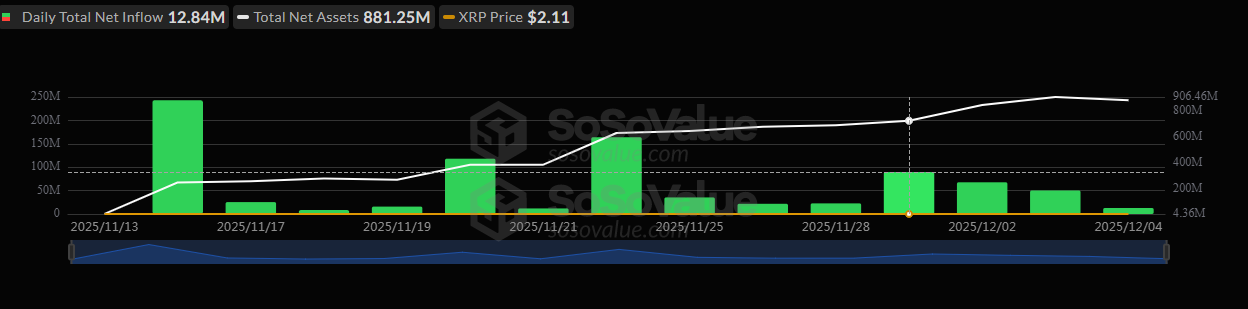
Traders should closely monitor XRP-spot ETF flows, with the numbers for Friday, December 5, expected later today.
XRP-spot ETF flow trends support a bullish short- to medium-term price outlook. Legislative developments are also likely to boost institutional and retail demand.
Bitcoin Price Forecast
Every new Bitcoin analysis as it publishes, today's technical signal and key levels, live price — on one page.
See all Bitcoin forecastsCFTC Opens the Door to Crypto-Spot ETFs
On Thursday, December 4, the CFTC opened the door for major brokerages to offer crypto-spot ETFs, broadening the investor base. The CFTC announced:
“Commodity Futures Trading Commission Acting Chairman Caroline D. Pham today announced that listed spot cryptocurrency products will begin trading for the first time in US federally regulated markets on CFTC registered futures exchanges.”
The CFTC added:
“The announcement marks a significant step forward in the Trump administration’s pledge to usher in a Golden Age of innovation and make America the crypto capital of the world.”
The announcement was significant. The listing on US federally regulated markets on CFTC-registered futures exchanges was another crypto step into TradFi, broadening the potential investor pool. Nate Geraci, President at NovaDius Wealth Management, commented on the announcement, stating:
“IMO, basically paves the way for every major brokerage to offer spot crypto trading & feel comfortable from a regulatory perspective. Huge.”
While US regulators became more crypto-friendly, Fed rate cut and BoJ rate hike bets caused market volatility.
US Inflation Cools, Raising Yen Carry Trade Unwind Risks
US economic indicators supported a December Fed rate cut, with inflation indicators cooling. The Core PCE Price Index increased by 2.8% year-on-year in September, down from 2.9% in August. Meanwhile, Michigan Inflation Expectations fell from 4.5% in November to 4.1% in December.
According to Polymarket, the odds of a 25-basis-point rate cut stood at 94% on Friday, December 5.
Typically, Fed rate cuts lower borrowing costs, fueling demand for risk assets. However, a Fed cut will likely coincide with a Bank of Japan rate hike, raising risks of a yen carry trade unwind.
This week, Bank of Japan Governor Kazuo Ueda signaled a December rate hike, while stating policymakers had yet to reach a consensus on the neutral interest rate, raising uncertainty about the number of rate hikes until monetary policy is neither accommodative nor restrictive.
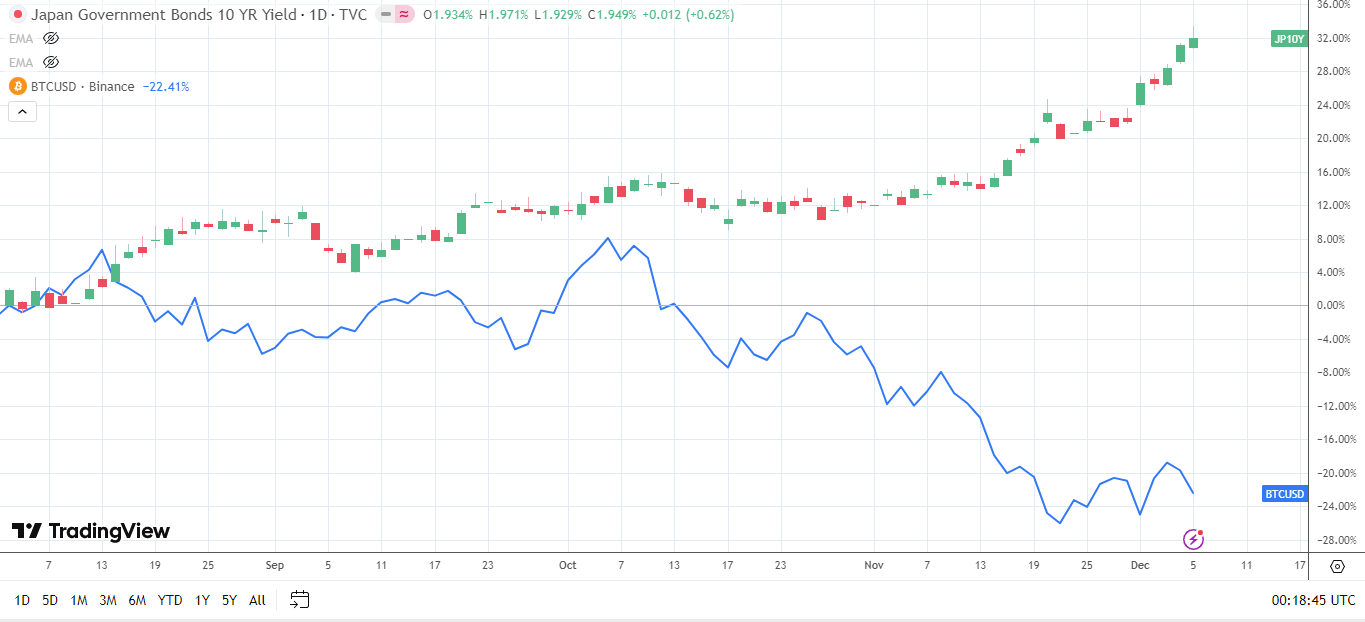
10-year Japanese Government Bond (JGB) yields soared to 1.971% on Friday, their highest level since 2007.

Here’s why traders need to monitor JGB yields and USD/JPY trends:
Crypto traders will be mindful of the implications of BoJ policy decisions after the market disruption in August 2024. The BoJ cut purchases of JGBs and raised interest rates on July 31, 2024, increasing borrowing costs while narrowing the US-Japan rate differential.
Typically, higher borrowing costs and a narrowing rate differential lead to selling foreign assets and the buying back of the yen to repay cheap yen-based loans, defined as a yen carry trade unwind.
The 2024 yen carry trade unwind led to a Bitcoin slide from a July 2024 high of $69,912 to an August low of $49,561. The inverse correlation between 10-year JGB yields and Bitcoin (BTC) prices reestablished in October, as evidenced in the chart below.
Bullish Medium-Term Outlook Intact
Several key price events may act as tailwinds for XRP, including:
- Broadening investor access to spot ETFs.
- The progress of crypto-friendly legislation, including the Market Structure Bill.
- December and March Fed rate cut expectations.
In my view, these price catalysts support a near-term (1-4 weeks) move to $2.35 and a medium-term (4-8 weeks) climb toward $3.
Downside Risks to Bullish Outlook
While several tailwinds could trigger a bullish trend reversal, headwinds for XRP linger. These include:
- The Bank of Japan and the Fed’s monetary policy decisions and forward guidance trigger market disruption.
- The MSCI delists digital asset treasury companies (DATs). Delistings could reduce demand for XRP as a treasury reserve asset.
- The Market Structure Bill gets delayed in the Senate.
- OCC rejects Bitcoin’s application for a US-chartered banking license.
- XRP-spot ETFs report extended outflows.
These events could push XRP below $2, exposing the November low of $1.82 before a longer-term return to $3.
Despite the headwinds, in my opinion, spot ETF inflows, an improving regulatory environment, and a dovish Fed will likely send the token toward $3.
In summary, the short-term outlook remains cautiously bullish, while the medium- to longer-term outlook is constructive.
Financial Analysis
Technical Outlook: EMAs Signal Caution
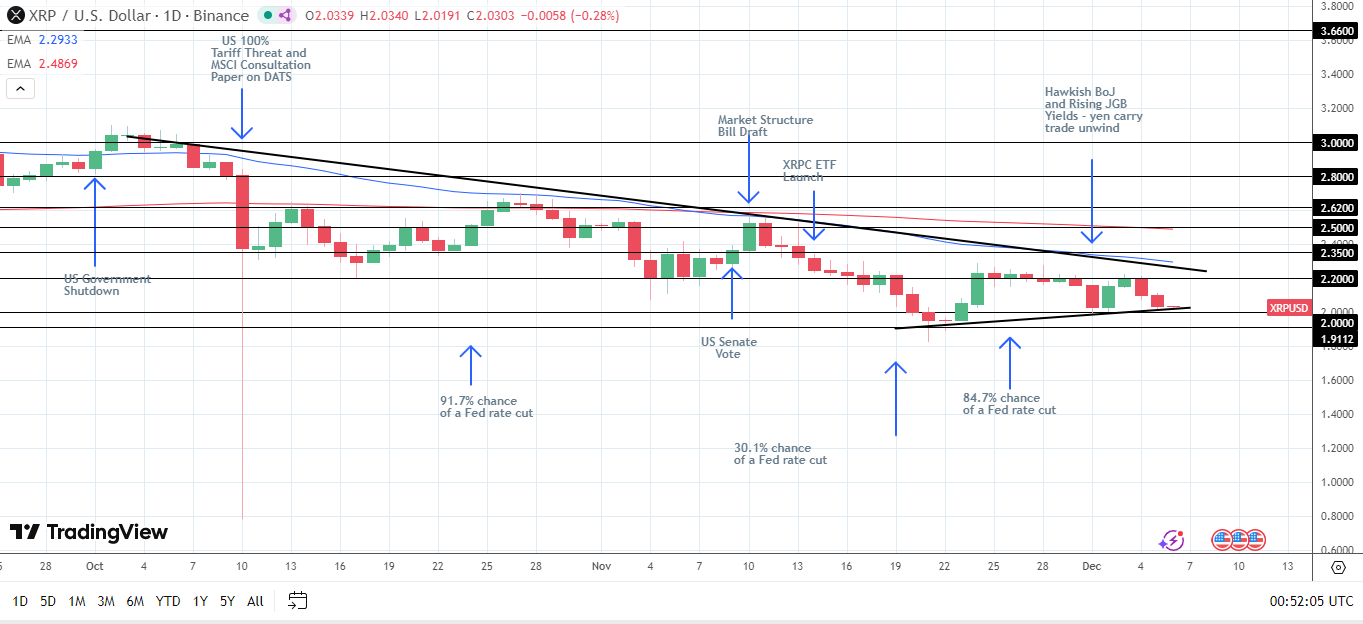
XRP fell 2.9% on Friday, December 5, following the previous day’s 4.56% loss, closing at $2.0361. The token mirrored the broader market, which fell 2.86%.
Friday’s sell-off left XRP below the 50-day and 200-day Exponential Moving Averages (EMAs), reaffirming a bearish bias. However, fundamentals have shifted from the technical trend, supporting a bullish outlook.
Key technical levels to watch include:
- Support levels: $2, $1.9112, and $1.8239.
- 50-day EMA resistance: $2.2934.
- 200-day EMA resistance: $2.4869.
- Resistance levels: $2.2, $2.35, $2.5, $2.62, $2.8, $3.0, and $3.66.
Holding above the $2.0 psychological support level would bring the 50-day EMA into play. A sustained move above the 50-day EMA would pave the way to the $2.35 resistance level.
Importantly, a break above the 50-day EMA would signal a near-term bullish trend reversal. A bullish trend reversal would support a medium-term (4-8 weeks) move to the 200-day EMA and the $2.5 level.

Fundamental Indicators: Corporate Signals, Policy Decisions
Near-term price drivers include:
- XRP-spot ETF daily flow trends.
- Blue-chip companies’ stances on XRP as a treasury reserve asset.
- Regulatory milestones: Ripple’s application for a US-chartered bank license, the progress of the Market Structure Bill on Capitol Hill.
- MSCI’s decision on DAT listings.
- The Fed and the BoJ’s interest rate decisions and policy outlooks.
Bullish Scenario: What Happens if $2.0 Holds?
Avoiding a sustained drop below $2.0 and the lower trendline would pave the way to the upper trendline. Breaking above the upper trendline would align with the medium-term $2.5 price target and a longer-term (8-12 weeks) return to $3.
However, a move below $1.8239 would invalidate the medium-term bullish structure.
Outlook: $2.0 Support Pivotal for Medium-Term Upside
XRP will face a crucial test on Saturday, December 6, with the $2.0 psychological support level in play. Spot ETF flows for the previous session will be key for near-term price trends. Strong inflows on expectations of multiple Fed rate cuts would likely kickstart a recovery of the fourth quarter’s losses. XRP has plunged 28.59% in Q4.