
Renewed speculation about BlackRock (BLK) launching an iShares XRP Trust boosts demand for XRP. The largest ETF issuer by assets under management has remained silent on its plans for a broader crypto-spot ETF product suite.
The US XRP-spot ETF market would significantly benefit from an iShares XRP Trust launch, given the iShares Bitcoin Trust’s (IBIT) dominance in the BTC-spot ETF market.
Progress toward crypto-friendly legislation and XRP-spot ETF inflows contributed to the recovery from sub-$1.80 levels.
Strong demand for XRP-spot ETFs, regulator-related developments, and a potential iShares XRP Trust launch support a bullish price outlook for XRP.
Below, I will explore the key drivers behind recent price trends, the medium-term (4-8 weeks) outlook, and the key technical levels traders should watch.

BlackRock in the Spotlight Amid XRP-Spot ETF Launch Chatter
BlackRock’s absence from the US XRP-spot ETF market raised concerns about a lack of institutional demand. However, US XRP-spot ETF issuers have reported total net inflows of $1.14 billion since their launch, indicating robust institutional demand.
Notably, there’s no single dominant ETF issuer in the US XRP-spot ETF market, opening the door for BlackRock to launch an iShares XRP Trust.
Crypto commentator Chad Steingraber, with almost 70,000 followers on X (formerly Twitter), fueled speculation about BlackRock launching an XRP-spot ETF, stating:
“BlackRock is aggressively staffing up its crypto ETF division to expand its product suite right now. Not later… NOW. They will launch their XRP, SOL ETFs in 2026 as the next set. BlackRock’s goal is to have $100Billion AUM’s per fund.”
XRP would likely target a new all-time high if demand for an iShares XRP Trust mirrors the substantial inflows into the iShares Bitcoin Trust. For context, the iShares Bitcoin Trust reported total net inflows of $62.25 billion since launching on January 11, 2024.
IBIT ranked #6 on the US ETF leaderboard by year-to-date flows. Notably, IBIT ranked above the GLD ETF and was the only crypto-spot ETF in the top 25.
The SEC facilitated the launch of crypto-spot ETFs in the third quarter, allowing ETF issuers to assess the demand backdrop. The SEC approved the Generic Listing Standards (GLS) for Commodity-Based trust shares in September. Under the GLS, ETF issuers no longer need to file 19b-4s, removing the SEC review process, typically the full 240 days.
Bitcoin Price Forecast
Every new Bitcoin analysis as it publishes, today's technical signal and key levels, live price — on one page.
See all Bitcoin forecastsCrypto Legislation Sets the Stage for a Breakout 2026
In addition to the SEC’s shift in stance toward crypto, progress toward a crypto-friendly regulatory environment would incentivize BlackRock to launch an XRP-spot ETF.
Analysts expect the passing of the Market Structure Bill to boost demand for crypto. XRP is likely to be a key beneficiary given the end of the SEC vs. Ripple case and the token’s increased sensitivity to legislative developments. Clear rules of the road would alleviate concerns about a shift in policy toward crypto and risks of further enforcement action.
For context, XRP rallied 14.69% on July 17, as investors reacted to the US House of Representatives passing the Market Structure Bill to the Senate. In contrast, BTC rose by just 0.39% on the day.
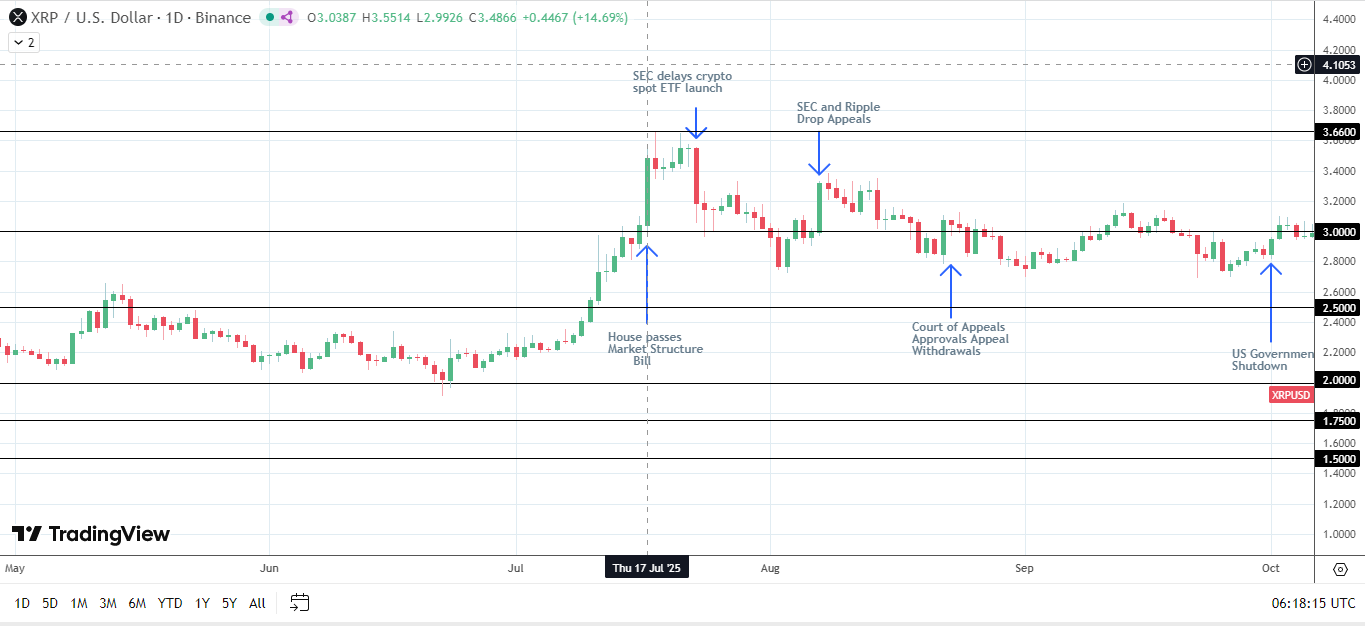
However, the US government shutdown and delays to the Market Structure Bill markup became a headwind for XRP in the second half of 2025.
Bipartisan support for the Market Structure Bill reinforces XRP’s constructive price bias, with the markup expected in early January.
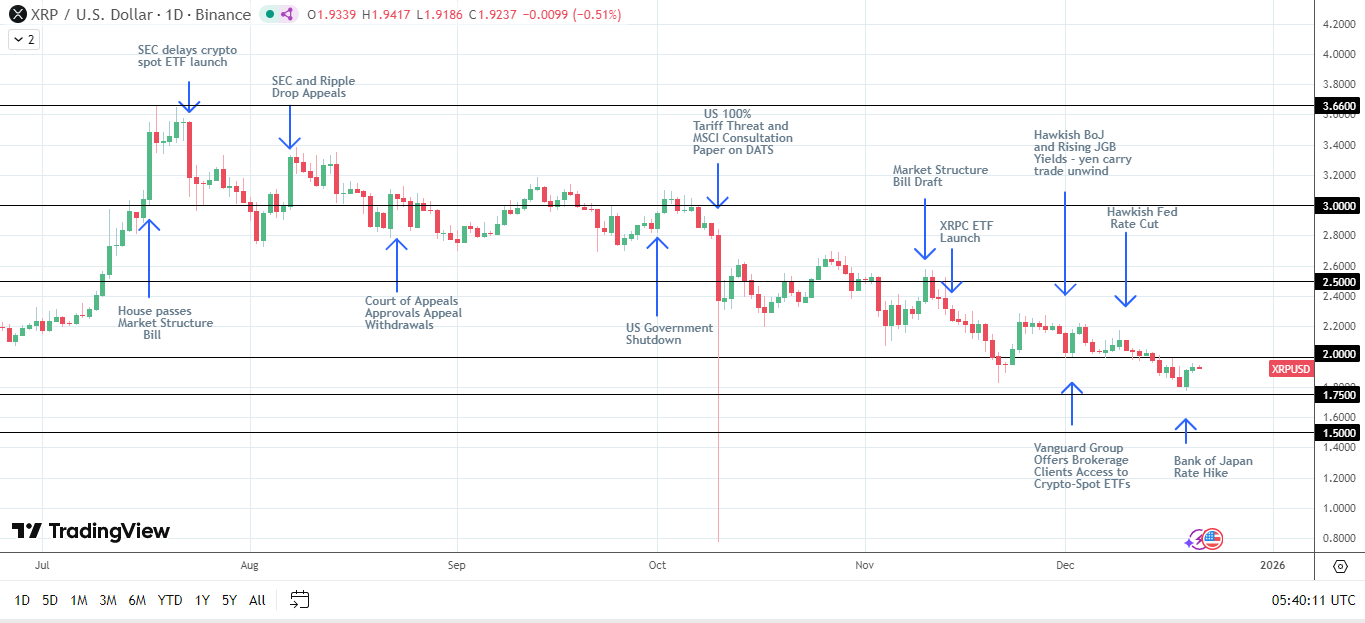
Medium- and Long-Term Outlook Remains Constructive
Legislative developments, XRP-spot ETF inflows, and a potential iShares XRP ETF suggest a bullish short- to medium-term price outlook.
Considering H2 2025 price trends and the current market dynamics, the short-term (1-4 weeks) outlook remains cautiously bullish, despite the current pullback, with a $2.0 price target. The medium-term (4-8 weeks) and longer-term (8-12 weeks) outlooks remain bullish, with price targets of $2.5 and $3.0, respectively.
Key Downside Risks That Could Alter the Outlook
Several scenarios could unravel the positive outlook. These include:
- The Bank of Japan announces a neutral interest rate of between 1.5% and 2.5%, signaling multiple rate hikes.
- US economic data and the Fed temper bets on a March rate cut.
- The MSCI delists digital asset treasury companies (DATs). Delistings would likely reduce interest in XRP as a treasury reserve asset.
- Partisan opposition to the Market Structure Bill.
- BlackRock stays silent on plans for an iShares XRP Trust.
- XRP-spot ETFs report outflows.
These scenarios would likely send XRP toward $1.75, indicating a bearish trend reversal.
In summary, the short-term outlook remains cautiously bullish as fundamentals offset the bearish technicals. Meanwhile, the medium- to longer-term outlooks are constructive.
Technical Indicators Continue to Signal Caution
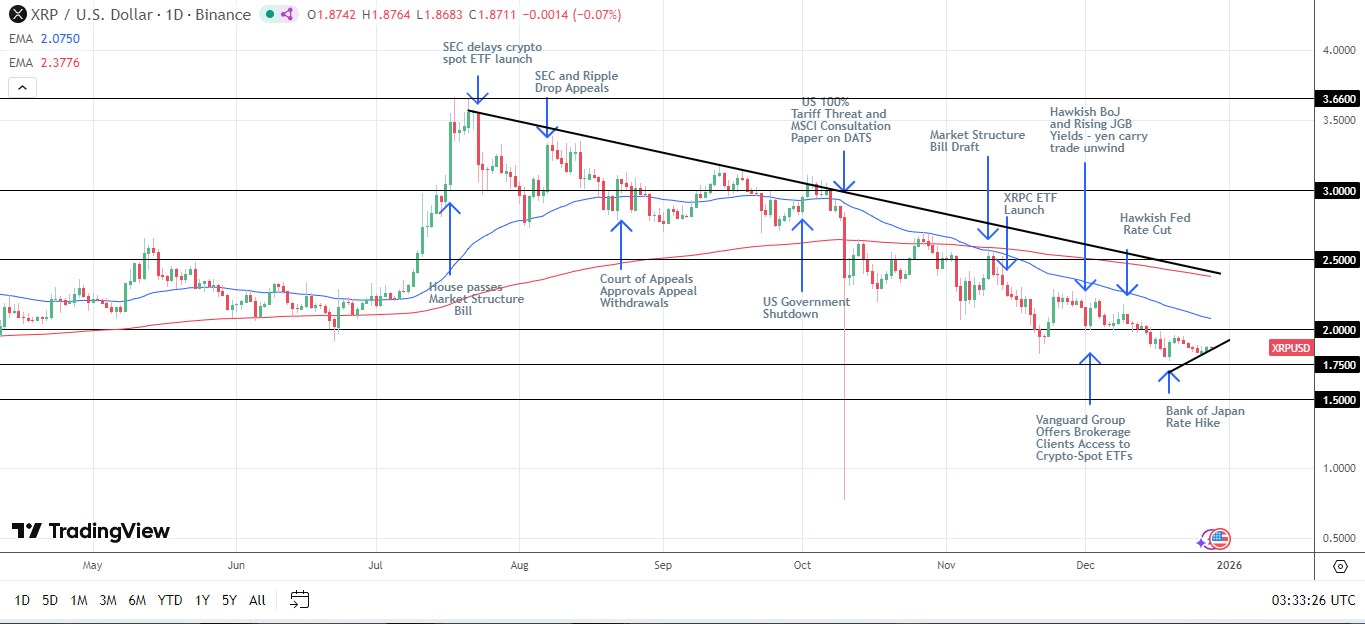
XRP climbed 1.56% on Saturday, December 27, following the previous day’s 0.61% gain, closing at $1.8725. The token outperformed the broader crypto market, which advanced 0.85%.
Despite Saturday’s gain, XRP traded below the 50-day and 200-day Exponential Moving Averages (EMAs), suggesting a bearish bias. While technicals remain bearish, bullish fundamentals are building, countering the technical structure.
Key technical levels to watch include:
- Support levels: $1.75, and then $1.50.
- 50-day EMA resistance: $2.0750.
- 200-day EMA resistance: $2.3776.
- Resistance levels: $2, $2.5, $3.0, and $3.66.
Looking at the daily chart, a break above the $2.0 psychological level would enable the bulls to target the 50-day EMA. A sustained move through the 50-day EMA would signal a near-term bullish trend reversal, paving the way toward the 200-day EMA and the $2.5 resistance level.
A sustained breakout above the EMAs would reinforce the constructive medium-term outlook and the longer-term (8-12 weeks) $3.0 price target.
Fundamental Indicators: Crypto Legislation, Fed, BoJ, and Spot ETFs
Near-term price drivers include:
- XRP-spot ETF flow trends.
- US economic data and March Fed rate cut bets.
- US crypto-related regulatory updates.
- The BoJ’s neutral interest rate.
What Break Above $2.0 Could Mean for XRP
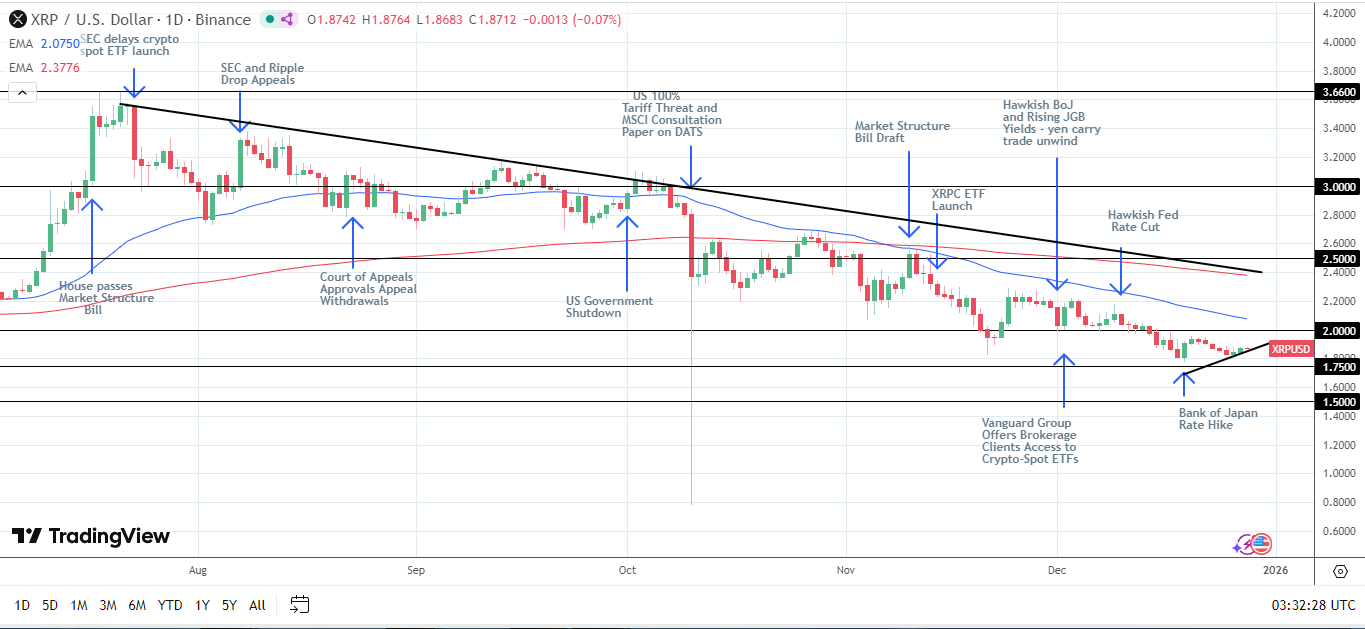
XRP’s price recovery from sub-$1.8 formed a short-term bullish structure, affirming the bullish short- to medium-term outlook.
Breaking above $2.0 would bring the upper trendline and the $2.5 resistance level into play. A sustained breakout above the upper trendline would indicate a bullish trend reversal, affirming the price targets.
- Medium-Term (4-8 weeks): $2.5.
- Longer-term (8–12 weeks): target of $3.0.
However, rejection at $2.0 and a sustained drop below the lower trendline would invalidate the bullish short- to medium-term outlook, and signal a bearish trend reversal.
Outlook: Policy Signals and ETF Flows Remain the Key Drivers
Looking ahead, Fed and BoJ forward guidance, US economic data, XRP-spot ETF flows, and legislation-related chatter are likely to influence near-term price trends.
Increased expectations of a March Fed rate cut and a less hawkish BoJ policy stance would likely lift sentiment. Stronger XRP-spot ETF inflows and growing bipartisan support for the Market Structure Bill would add to the positive outlook.
In summary, rising institutional demand for XRP-spot ETFs and the progress of the Market Structure Bill support a medium-term (4–8 weeks) move to $2.5. A March Fed rate cut and the Senate passing the Market Structure Bill would affirm the longer-term (8–12 weeks) price target of $3.0.
Looking further ahead, a break above the all-time high $3.66 is likely if the Fed and BoJ signal dovish rate paths and the Senate passes the Market Structure Bill over the 6-12 month time horizon.