
XRP consolidated the Bank of Japan-induced rally on Saturday, December 20, as fears of a yen carry trade unwind subsided. A 25-basis-point rate hike and a cautious policy outlook, with interest rates sitting well below the BoJ’s 1% to 2.5% neutral rate, was enough for crypto investors to buy the dip.
The BoJ’s interest rate decision coincided with another week of strong inflows into XRP-spot ETFs. XRP-spot ETF issuers reported inflows despite the market jitters over the BoJ rate hike in the lead-up to Friday’s decision.
Robust demand for spot ETFs, a cautious BoJ policy stance, and progress toward crypto-friendly legislation support a bullish price outlook.
Below, I will explore the key drivers behind recent price trends, the medium-term (4-8 weeks) outlook, and the key technical levels traders should watch.
BoJ Policy Outlook: Inflation and Market Disruption
The BoJ ensured there was no market disruption on Friday, December 19, delivering a highly anticipated 25-basis-point rate hike. BoJ Governor Ueda referenced the Bank’s neutral rate, highlighting that the rate hike lifted interest rates to 0.75%, still below the lower band of the neutral rate.
Notably, the BoJ Governor did not offer a narrower neutral rate range, leaving uncertainty about the number of potential rate hikes through 2026. A 1% neutral rate would signal one rate hike to reach monetary policy normalization, neither accommodative nor restrictive. Crucially, a 1% neutral rate would leave US-Japan rate differentials in favor of the US dollar, boosting yen carry trades into risk assets.
Japan’s recent inflation data suggests that a 1% neutral rate may be too low, raising the risk of a neutral rate of between 1.5% and 2%. There is also Fed Chair Powell’s replacement to consider. A dovish Fed Chair, pushing for aggressive rate cuts, would also hit yen carry trade profitability.
However, a 2% neutral rate would narrow the rate differential sharply, drive yen demand, and send Japanese Government Bond (JGB) yields higher. These events would likely trigger a yen carry trade unwind, similar to the mid-2024 unwind.
As the dust settles from Friday’s BoJ interest rate decision, focus will likely shift to the Fed. Nevertheless, monitoring USD/JPY trends, 10-year JGB yields, and the Nikkei 225’s path remain crucial. A USD/JPY fall toward 130 and a spike in 10-year JGB yields, coupled with a Nikkei 225 plunge, would signal a yen carry trade unwind.
On Friday, December 19, 10-year JGB yields soared 2.91% to close at 2.018%. However, USD/JPY rallied 1.45% to close at 157.703, with the Nikkei 225 ending the session up 1.03%, bolstering XRP demand on Saturday, December 20.
Bitcoin Price Forecast
Every new Bitcoin analysis as it publishes, today's technical signal and key levels, live price — on one page.
See all Bitcoin forecasts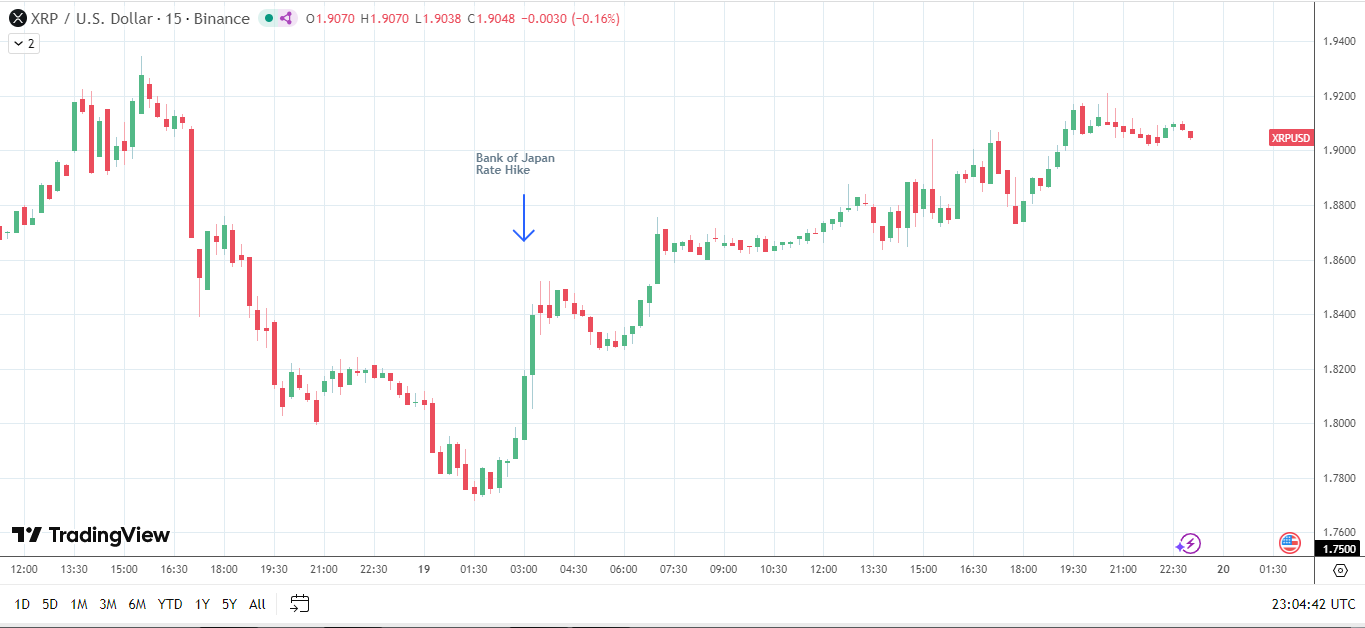
US XRP-Spot ETF Market Extends Weekly Streak
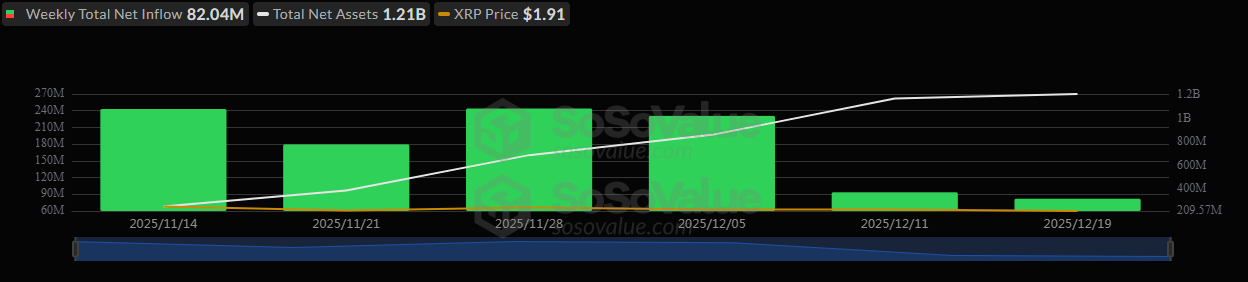
While the BoJ gave XRP a much-needed boost, XRP-spot ETF issuers reported strong institutional demand. The US XRP-spot ETF market saw $82.04 million of net inflows in the reporting week ending December 19. Significantly, the US XRP-spot ETF market extended its inflow streak to six consecutive weeks.
In contrast, the US BTC-spot ETF market reported net outflows of $497.1 million in the week, signaling a potential XRP-BTC decoupling. Given increased utility, a decoupling would be a significant tailwind for XRP.
Medium- and Long-Term Outlook Remains Constructive
Robust demand for XRP-spot ETFs, coupled with the BoJ’s policy stance, reinforces the bullish short- to medium-term price outlook.
Meanwhile, updates on the Market Structure Bill’s progress on Capitol Hill were also positive, raising hopes that crypto-friendly legislation would become effective in Q1 2026.
While the BoJ and the Fed’s policy stances remain key, legislative developments, rising institutional demand, and increased adoption are tailwinds for XRP.
Considering the current market dynamics, the short-term (1-4 weeks) outlook has turned bullish, with a $2 price target. The medium-term (4-8 weeks) and longer-term (8-12 weeks) outlooks remain bullish, with price targets of $2.5 and $3.0, respectively.
Downside Risks to the Bullish Scenario
Several scenarios could derail the bullish outlooks. These include:
- The Bank of Japan declares a neutral interest rate of between 1.5% and 2.5% and the need to combat inflation aggressively.
- US economic data and Fed speakers support a hawkish Fed policy stance.
- The MSCI delists digital asset treasury companies (DATs). Delistings would likely reduce interest in XRP as a treasury reserve asset.
- US Senate challenges the Market Structure Bill.
- XRP-spot ETFs report outflows.
These events would likely push XRP toward $1.75, signaling a bearish trend reversal.
In summary, the short-term outlook has turned cautiously bullish as fundamentals, overriding the bearish technicals. Meanwhile, the medium- to longer-term outlooks are constructive.
Financial Analysis
Technical Outlook: EMAs Signal Caution
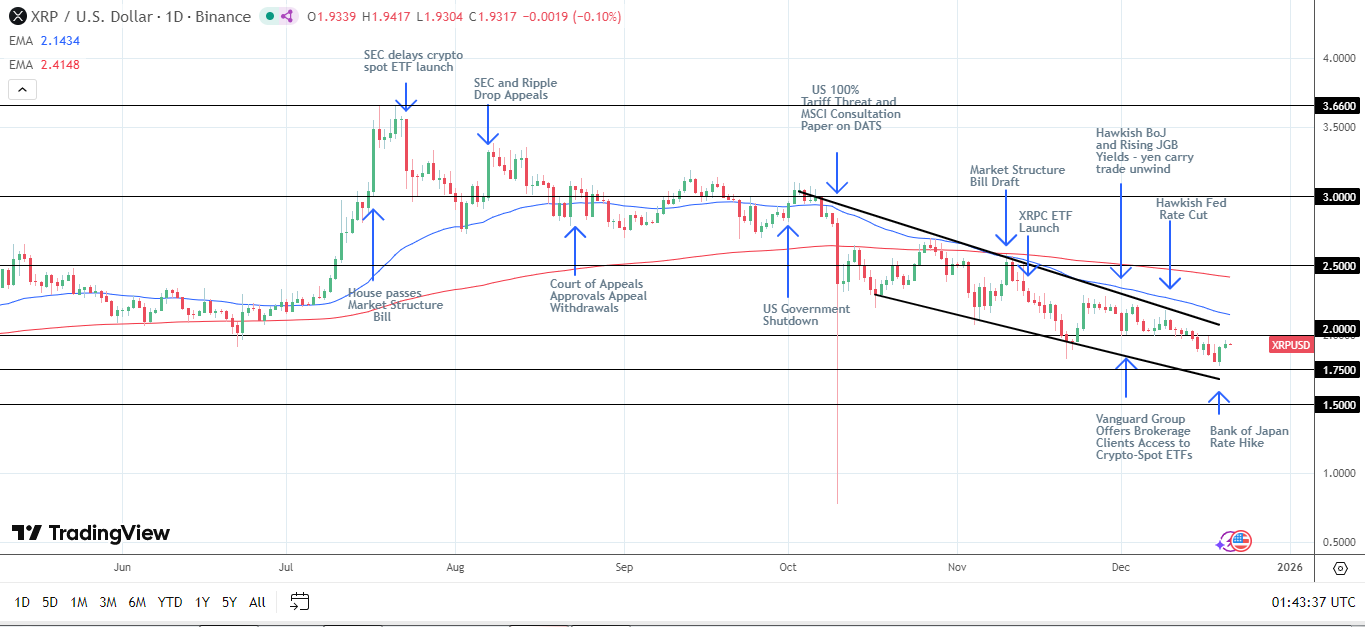
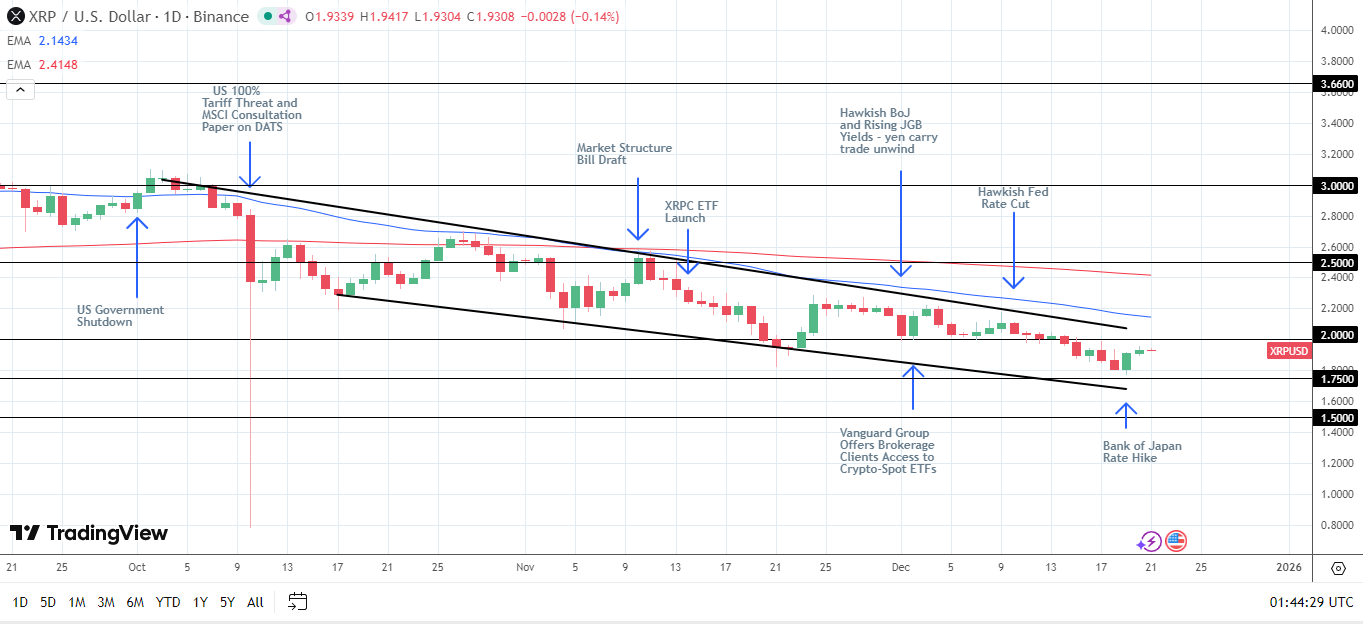
XRP gained 1.29% on Saturday, December 20, following the previous day’s 5.6% rally, closing at $1.9336. The token outperformed the broader crypto market, which gained 0.24%.
Despite Saturday’s gain, XRP remained well below the 50-day and 200-day Exponential Moving Averages (EMAs), signaling a bearish bias. While technicals remain bearish, fundamentals are increasingly outweighing the technical structure.
Key technical levels to watch include:
- Support levels: $1.75, and then $1.50.
- 50-day EMA resistance: $2.1434.
- 200-day EMA resistance: $2.4148.
- Resistance levels: $2, $2.5, $3.0, and $3.66.
Looking at the daily chart, a breakout above the $2 psychological level would bring the 50-day EMA into play. A sustained move through the 50-day EMA would indicate a near-term bullish trend reversal, paving the way toward the 200-day EMA and the $2.5 resistance level.
A breakout above the EMAs would reinforce the medium-term outlook, and the longer-term (8-12 weeks) $3.0 price target.
Fundamental Indicators: BoJ, Fed, and ETF Demand
Near-term price drivers include:
- XRP-spot ETF flows.
- US economic indicators and March Fed rate cut bets.
- US crypto-related legislative updates.
- The BoJ’s neutral interest rate.
Bearish Structure At Risk: What Happens if XRP Reclaims $2.0?
Despite reclaiming the $1.9 handle, the bearish structure remains intact. However, a breakout above $2.0 would open the door to retesting the upper trendline. A sustained move through the upper trendline would signal a bullish trend reversal, affirming the bullish price targets.
- Medium-Term (4-8 weeks); $2.5.
- Longer-term (8–12 weeks) target of $3.0.
However, rejection at the $2.0 psychological level and a break below the lower trendline would invalidate the bullish medium-term outlook and reinforce the bearish structure.
Outlook: $2.0 Remains the Pivot Level
Looking ahead, XRP-spot ETF flows and updates from Capitol Hill will dictate near-term trends. Crucially, the Market Structure Bill could unlock the door to a wider investor base, potentially tilting the supply-demand balance firmly in XRP’s favor.
In summary, strong institutional demand for XRP-spot ETFs and the US legislative developments suggest a medium-term (4–8 weeks) move to $2.5. A March Fed rate cut and the Senate passing the Market Structure Bill would support the longer-term (8–12 weeks) price target of $3.0.
Meanwhile, over the 6-12 month timeline, reclaiming the all-time high $3.66 would bring $5 into play.