
XRP snapped a five-day losing streak on Friday, December 26, potentially signaling the start of a rebound toward $2. Robust institutional demand coincided with fading bets on a Bank of Japan rate hike, lifting sentiment.
Grayscale’s Head of Research, Zach Pandl, highlighted the key drivers going into 2026, with fundamentals likely to send crypto prices higher.
Shifting BoJ and Fed policy stances, legislative developments, and demand for spot ETFs support a bullish price outlook for XRP.
Below, I will explore the key drivers behind recent price trends, the medium-term (4-8 weeks) outlook, and the key technical levels traders should watch.

XRP Rebounds as Macro Headwinds Begin to Ease
XRP has failed to revisit $2.0 since the December 15 reversal. The token faced increasing selling pressure in December amid fears of a hawkish Bank of Japan rate hike. A hawkish Fed rate cut added to the selling pressure, sending XRP to a December low of $1.7712.
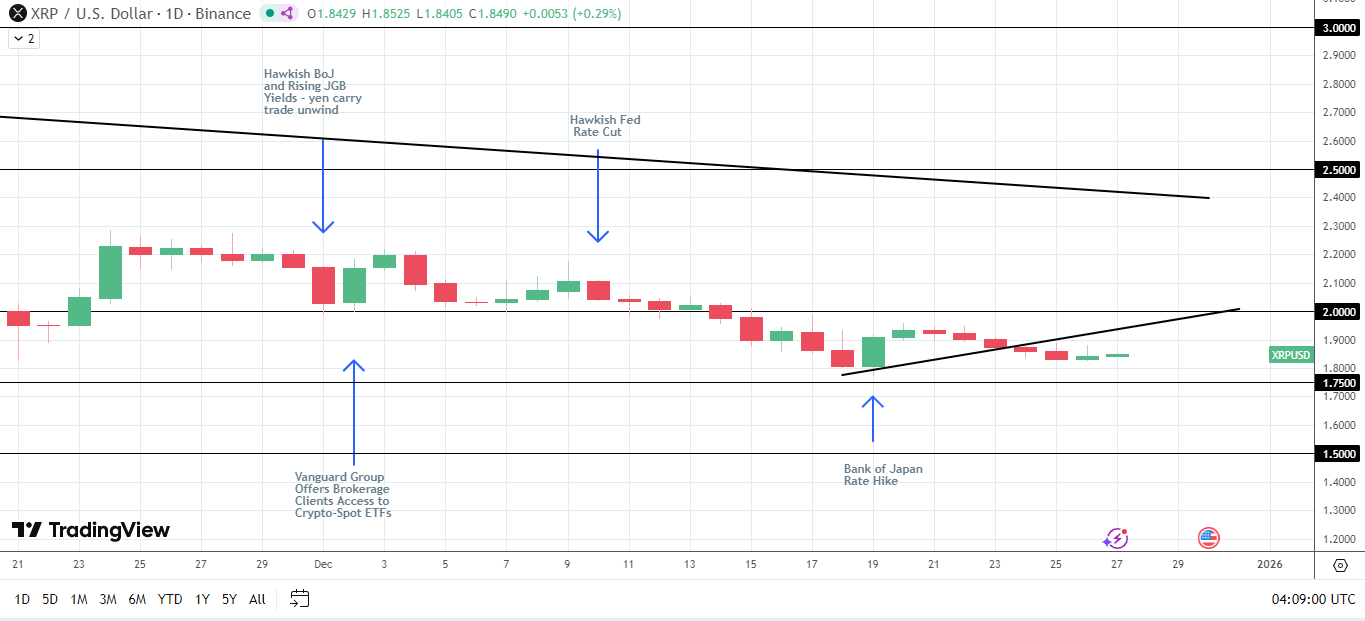
Bank of Japan Rate Expectations Shift, Supporting Risk Appetite
However, rising bets on a March Fed rate cut, a dovish BoJ rate hike, on softer Japanese inflation numbers, have changed the narrative. Crucially, the softer Japanese data is likely to support a lower BoJ neutral rate, neither accommodative nor restrictive. A lower neutral rate would indicate a wider-than-expected US-Japan rate differential, fueling yen carry trades into risk assets.
Bitcoin Price Forecast
Every new Bitcoin analysis as it publishes, today's technical signal and key levels, live price — on one page.
See all Bitcoin forecastsYen Carry Trades Re-Enter Focus as JGB Yields Retreat
XRP’s inverse correlation with 10-year Japanese Government Bond (JGB) yields has underscored market sensitivity to the BoJ’s rate path. 10-year JGB yields remained above 2%, but have eased back from this week’s high of 2.1%, providing market relief.
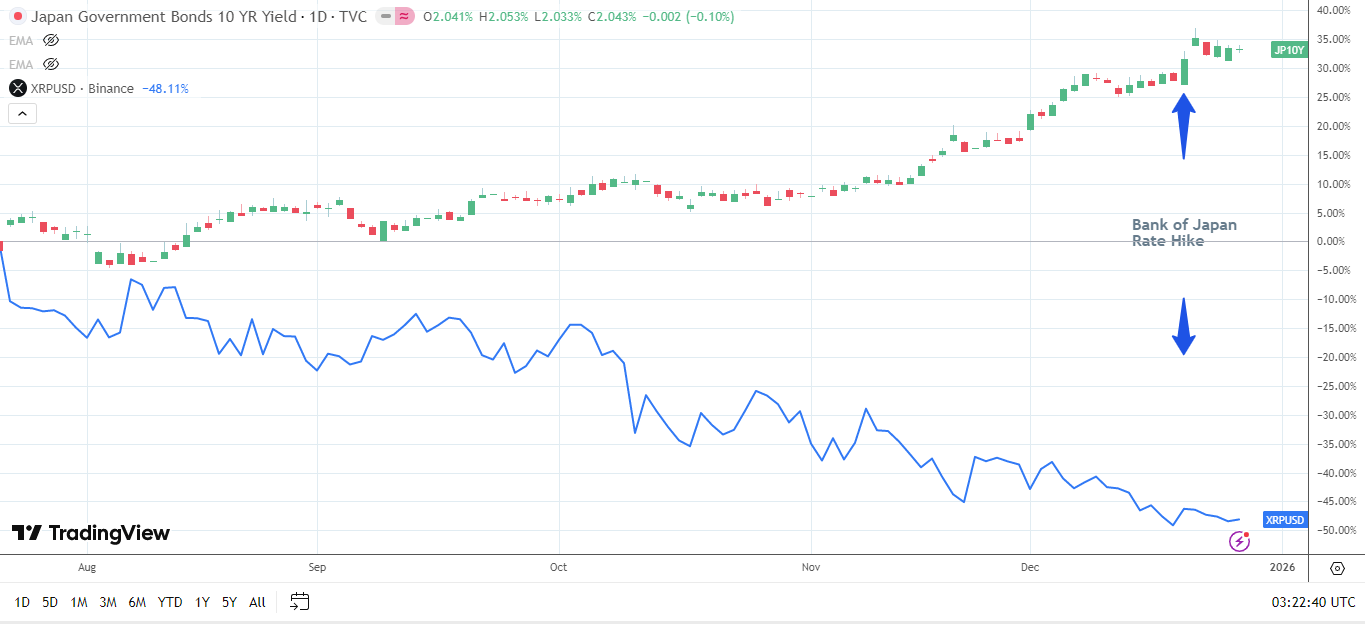
Fed Rate Cut Expectations Improve Risk Sentiment
Meanwhile, market bets on a March Fed rate cut have also provided much-needed support. On December 10, the Fed cut interest rates – typically a bullish event. However, the Fed’s dot plot signaled a single rate cut in 2026, sending XRP below $2.0.
Since the December 10 rate cut, US economic data have raised expectations of a March cut, boosting demand for risk assets. Inflation softened in November, and unemployment rose, delivering the FOMC doves the perfect mix to push for further monetary policy easing.
According to the CME FedWatch Tool, the probability of a March cut has risen from 48.7% on December 24 to 53.3% on December 26. While the uptick on Friday drove buyer demand for XRP, the chances of a March Fed rate cut have fallen this week, leaving XRP in negative territory for the week.
While a Fed rate cut would narrow the US-Japan rate differential, a less hawkish BoJ rate path would likely leave yen carry trades profitable enough to bolster demand for risk assets.
The current market dynamics support a bullish short- to medium-term price outlook.

XRP-Spot ETF Inflows Reflect Steady Institutional Demand
Easing fears of a yen carry trade unwind and rising bets on a March Fed rate cut have bolstered demand for US XRP-spot ETFs.
The US XRP-spot ETF market saw total net inflows of $64 million in the shortened reporting week ending December 26. Notably, XRP-spot ETFs extended their inflow streak to seven consecutive weeks, bringing total net inflows to $1.14 billion.
By contrast, the US BTC-spot ETF market had net outflows of $415.1 million in the reporting week ending December 26.
Grayscale’s Zach Pandl discussed the crypto-spot ETF market outlook on the Paul Barron podcast on December 26. Some key takeaways from the session included:
- Institutional investors to drive crypto ETF flows in 2026.
- Large-cap crypto-linked ETFs are likely to benefit from institutional demand.
- Asset tokenization, bringing traditional assets onto blockchain, is a mega trend for crypto in 2026.
- Bipartisan support for the crypto regulations in January is likely to send crypto prices higher.
- Partisan opposition to crypto legislation would be a downside risk.
- Institutional investors will likely target higher yields in DeFi products, boosting XRP and ETH demand.
- A low interest rate and a higher inflation backdrop would increase demand for alternative stores of value.
Zach Pandl’s outlook aligned with the key XRP price drivers outlined in recent weeks, supporting the constructive outlook.
Medium- and Long-Term Outlook Remains Constructive
Increased bets on a March Fed rate cut and easing concerns about aggressive BoJ rate hikes support a positive outlook for XRP. Stronger demand for XRP-spot ETFs and bipartisan support for the Market Structure Bill would add to the upbeat narrative for 2026.
Considering the current market dynamics, the short-term (1-4 weeks) outlook remains cautiously bullish, despite the current pullback, with a $2.0 price target. The medium-term (4-8 weeks) and longer-term (8-12 weeks) outlooks remain constructive, with price targets of $2.5 and $3.0, respectively.
Key Downside Risks That Could Alter the Outlook
Several events could reverse the positive price outlook narrative. These include:
- The Bank of Japan declares a neutral interest rate of between 1.5% and 2.5%, indicating multiple rate hikes.
- US economic data and the Fed cool bets on a March rate cut.
- The MSCI delists digital asset treasury companies (DATs). Delistings would likely reduce interest in XRP as a treasury reserve asset.
- The Market Structure Bill faces partisan opposition.
- XRP-spot ETFs report outflows.
These scenarios would likely push XRP toward $1.75, signaling a bearish trend reversal.
In summary, the short-term outlook remains cautiously bullish as fundamentals counter the bearish technicals. Meanwhile, the medium- to longer-term outlooks are constructive.
Technical Indicators Continue to Signal Caution
XRP gained 0.61% on Friday, December 26, partially reversing the previous day’s 1.55% loss to close at $1.8437. The token tracked the broader crypto market, which advanced 0.47%.
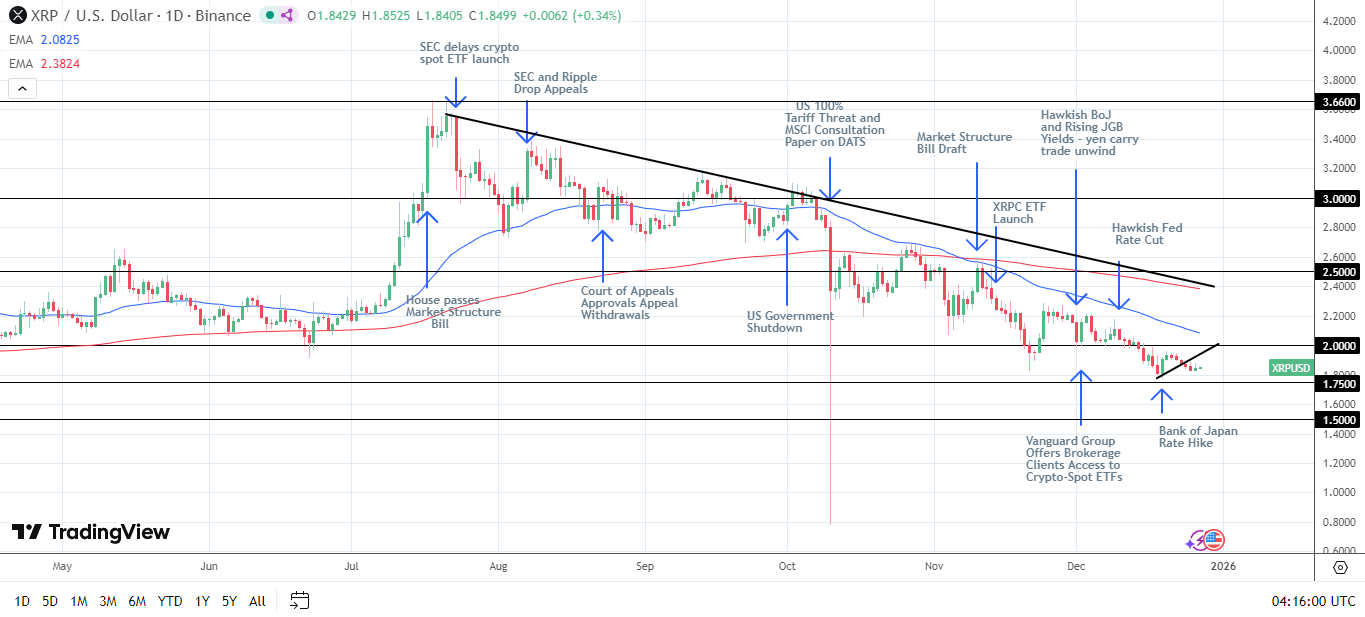
Despite Friday’s gain, XRP remained below the 50-day and 200-day Exponential Moving Averages (EMAs), indicating a bearish bias. While technicals remain bearish, bullish fundamentals are developing, outweighing the technical structure.
Key technical levels to watch include:
- Support levels: $1.75, and then $1.50.
- 50-day EMA resistance: $2.0825.
- 200-day EMA resistance: $2.3824.
- Resistance levels: $2, $2.5, $3.0, and $3.66.
Looking at the daily chart, a breakout above the $2.0 psychological level would open the door to testing the 50-day EMA. A sustained move through the 50-day EMA would indicate a near-term bullish trend reversal, bringing the 200-day EMA and the $2.5 resistance level into play.
A sustained break above the EMAs would affirm the constructive medium-term outlook and the longer-term (8-12 weeks) $3.0 price target.
Fundamental Indicators: ETF Demand, Central Banks, and Crypto Legislation
Near-term price drivers include:
- XRP-spot ETF flows.
- US economic indicators and March Fed rate cut bets.
- US crypto-related legislative updates.
- The BoJ’s neutral interest rate.
What a Reclaim of $2.0 Could Mean for Price Structure
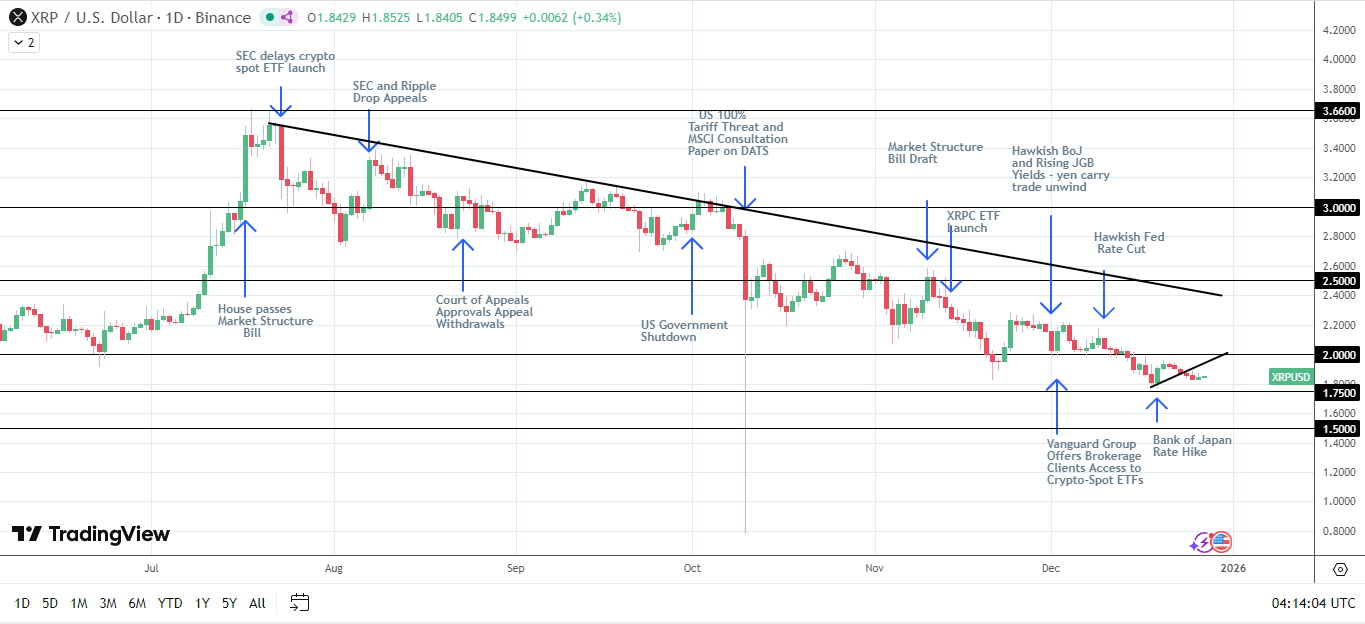
Despite the five-day losing streak, XRP’s short-term bullish structure remained intact, reinforcing the positive short- to medium-term outlook.
Reclaiming $2.0 would enable the bulls to target the upper trendline and the $2.5 resistance level. A sustained move through the upper trendline would signal a bullish trend reversal, reinforcing the price targets.
- Medium-Term (4-8 weeks): $2.5.
- Longer-term (8–12 weeks): target of $3.0.
However, rejection at $2.0 and a sustained pullback from the lower trendline would invalidate the bullish short- to medium-term outlook, and indicate a bearish trend reversal.
Outlook: Policy Signals and ETF Flows Remain the Key Drivers
Looking ahead, Fed and BoJ rate paths, US economic indicators, XRP-spot ETF flows, and regulation-related news are likely to dictate near-term price trends.
Rising bets on a March Fed rate cut and a more dovish BoJ policy outlook would likely lift demand for XRP. Stronger XRP-spot ETF inflows through institutional demand build will also boost broader market sentiment.
In summary, rising institutional demand for XRP-spot ETFs and the progress of the Market Structure Bill support a medium-term (4–8 weeks) move to $2.5. A March Fed rate cut and the Senate passing the Market Structure Bill would reinforce the longer-term (8–12 weeks) price target of $3.0.
Looking further ahead, a break above the all-time high $3.66 is likely if the Fed and BoJ adopt dovish stances and the Senate passes crypto legislation over the 6-12 month time horizon.