
XRP is caught in a rare tug-of-war: institutional money is flowing in at a steady pace, yet prices remain pinned below key resistance as large holders quietly distribute supply. With Washington on the brink of reshaping crypto regulation and ETFs absorbing record volumes, the next move may hinge less on charts—and more on politics.
The US XRP-spot ETF market extended its inflow streak to six consecutive weeks in the reporting week ending Friday, December 19. Robust institutional demand for XRP-spot ETFs has been crucial, delivering key support as XRP faces downside pressure from whale offloads.
Below, I will explore the key drivers behind recent price trends, the medium-term (4-8 weeks) outlook, and the key technical levels traders should watch.

Crypto Regulatory Landscape Set for Another Seismic Shift
XRP remains particularly sensitive to legislative developments on Capitol Hill, given Ripple’s five-year legal battle with the SEC. Regulatory clarity would alleviate concerns about future enforcement under a Democratic-led SEC, unlocking the door to more regulatory-conservative investors.
On Monday, December 22, Michael Selig officially became the Chair of the Commodities Futures Trading Commission (CFTC). Chair Selig, alongside SEC Chair Paul Atkins, is expected to work closely to deliver on President Trump’s push to make the US the global leader in the digital asset space.
CFTC Chair Selig shared his view on crypto-related regulatory developments on X (formerly Twitter), stating:
“Today begins a new chapter for the CFTC. We are at a unique moment as a wide range of novel technologies, products, and platforms are emerging, retail participation in the commodity markets is at an all-time high, and Congress is poised to send digital asset market structure legislation that will cement the U.S. as the Crypto Capital of the World to the President’s desk.”
Looking ahead, the CFTC Chair added:
“No agency is better suited to pioneer common-sense rules of the road for the new financial markets of America’s Golden Age than the Commodity Futures Trading Commission. Under my leadership, the CFTC will conquer these great frontiers and ensure that the innovations of tomorrow are Made in America.”
White House AI and Crypto Czar David Sachs called Chair Selig and Chair Atkins the dream team, set to establish clear rules of the road for the 21st century.
Bitcoin Price Forecast
Every new Bitcoin analysis as it publishes, today's technical signal and key levels, live price — on one page.
See all Bitcoin forecastsMarket Structure Bill Key to Demand Outlook
XRP’s reaction was limited to the official announcement, with traders awaiting the Market Structure Bill’s markup. Bipartisan support for the markup, expected in early January, would signal crypto-friendly legislation in effect within Q1 2026. Analysts expect crypto-friendly legislation to be a key price catalyst for XRP.
Pro-crypto SEC and CFTC Chairs, combined with the prospect of crypto-friendly regulations, support a bullish short- to medium-term price outlook.
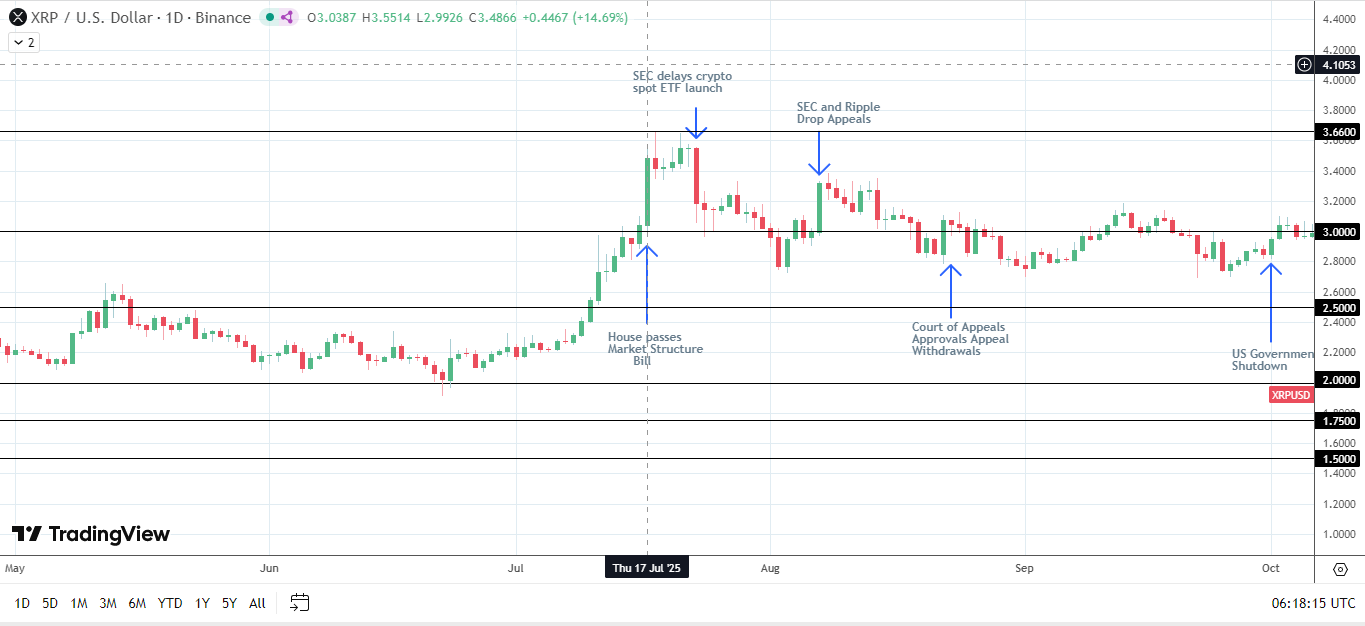
For context, the House of Representatives passed the Market Structure Bill to the Senate on July 17, triggering a 14.69% XRP rally on the day. The broader crypto market rose by a more modest 1.78%, underscoring XRP’s sensitivity to legislative developments.
Whales Counter XRP-Spot ETF Demand
The US XRP-spot ETF market reported net inflows of $82.04 million after net inflows of $93.57 million in the previous week.
While weekly inflows trended lower for the third consecutive week, BTC-spot and ETH-spot ETFs faced heavy outflows, underscoring strong institutional demand for XRP.
However, XRP has fallen 2.31% month-to-date in December, following a 14.09% loss in November. XRP whales have reportedly been reducing their positions, keeping an XRP rally under wraps. Crypto enthusiast Diana, with over 12,000 followers on X, commented on the XRP spot-Whale dynamic, stating:
“Big early holders – whales – are selling on exchanges like Binance. Not panic selling. This is planned distribution into deep institutional liquidity. [,,,] ETFs are absorbing supply quietly. Whales are selling loudly and fast. That clash keeps prices stuck in a range. This is why price hasn’t exploded yet, not because demand is fake, but because supply is still being released.”
With XRP-spot ETF demand crucial to the token’s price outlook, new spot ETF filings and launches are likely to influence sentiment.
There are 10 XRP active ETP filings according to Bloomberg Intelligence. The total number of XRP-spot ETFs would rise from five to 15, potentially boosting inflows and tilting the supply-demand balance in XRP’s favor. With the whale offload likely to abate, the prospect of more spot ETF launches reinforces the bullish price outlook.
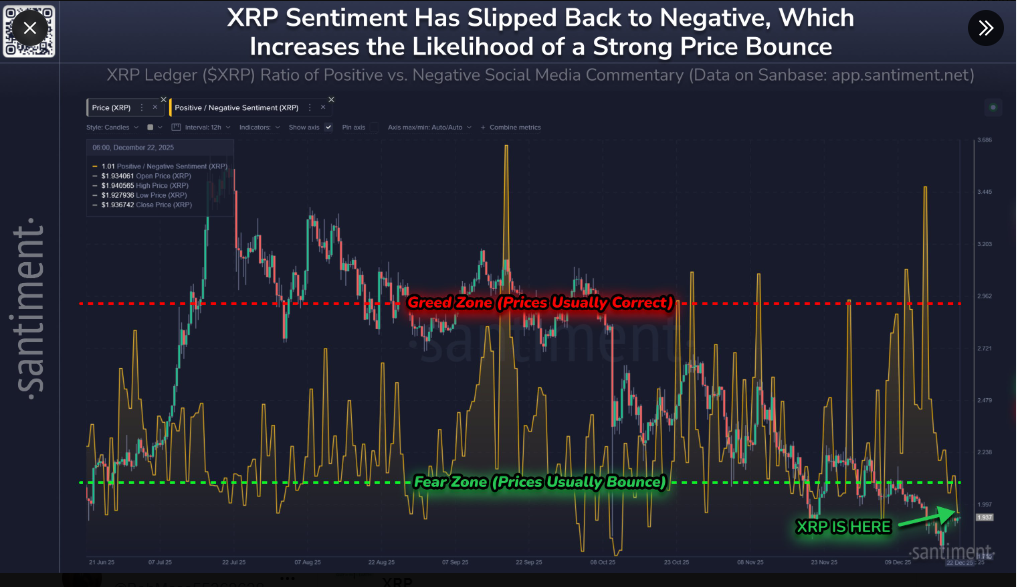
Market intelligence platform Santiment also signaled a potential XRP rally, stating:
“XRP is seeing far more aggressive social media commentary than average. Historically, this setup leads to price rises. When retail has doubts about a coin’s ability to rise, the rise becomes significantly more likely.”
Santiment’s XRP chart shows sentiment in the Fear zone, a bullish price indicator.
Medium- and Long-Term Outlook: Constructive Bias Builds
Market sentiment toward the Fed and the BoJ’s rate paths, coupled with demand for XRP-spot ETFs and the Market Structure Bill’s progress on Capitol Hill, supports a bullish outlook. The prospect of Fed rate cuts and easing inflation adds to the market optimism. Typically, lower borrowing costs and cooling inflation boost flows into risk assets.
Considering these market dynamics, the short-term (1-4 weeks) outlook remains cautiously bullish, with a $2 price target. The medium-term (4-8 weeks) and longer-term (8-12 weeks) outlooks remain constructive, with price targets of $2.5 and $3.0, respectively.
Downside Risks to the Bullish Scenario
Several scenarios could challenge the bullish outlooks. These include:
- The Bank of Japan announces a neutral interest rate of between 1.5% and 2.5% and the need to combat inflation aggressively.
- US inflation heats up, and the Fed pours cold water on a March rate cut.
- The MSCI delists digital asset treasury companies (DATs). Delistings would likely reduce interest in XRP as a treasury reserve asset.
- US Senate challenges the Market Structure Bill.
- XRP-spot ETFs report outflows.
These scenarios would likely push XRP toward $1.75, signaling a bearish trend reversal.
In summary, the short-term outlook remains cautiously bullish as fundamentals override the bearish technicals. Meanwhile, the medium- to longer-term outlooks are constructive.
Financial Analysis
Technical Outlook: EMAs Signal Caution
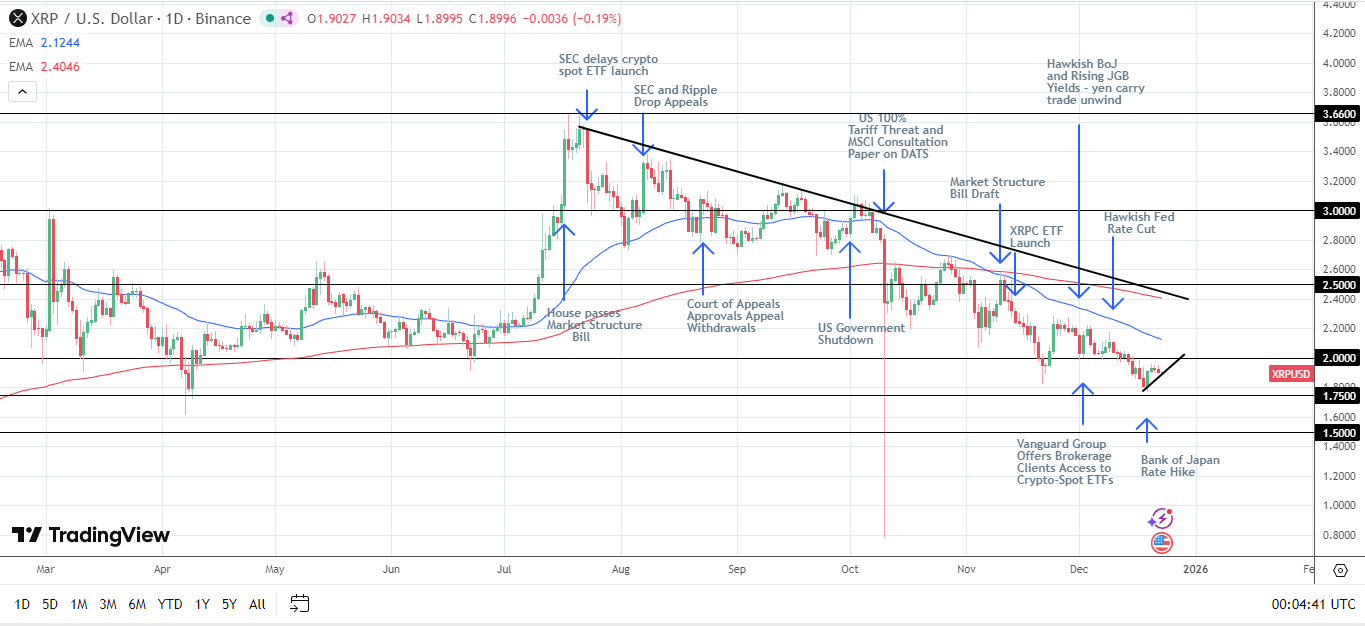
XRP fell 1.0% on Monday, December 22, following the previous day’s 0.58% loss, closing at $1.9032. The token underperformed the broader crypto market, which slipped 0.08%.
Monday’s losses left XRP below the 50-day and 200-day Exponential Moving Averages (EMAs), indicating a bearish bias. While technicals remain bearish, fundamentals are increasingly outweighing the technical structure.
Key technical levels to watch include:
- Support levels: $1.75, and then $1.50.
- 50-day EMA resistance: $2.1244.
- 200-day EMA resistance: $2.4046.
- Resistance levels: $2, $2.5, $3.0, and $3.66.
Looking at the daily chart, reclaiming the $2 psychological level would open the door to retesting the 50-day EMA. A breakout above the 50-day EMA would indicate a near-term bullish trend reversal, bringing the 200-day EMA and the $2.5 resistance level into play.
A sustained move through the EMAs would support the bullish medium-term outlook, and the longer-term (8-12 weeks) $3.0 price target.
Fundamental Indicators: BoJ, Fed, and ETF Demand
Near-term price drivers include:
- XRP-spot ETF flows.
- US economic data and March Fed rate cut bets.
- US crypto-related regulatory news.
- The BoJ’s neutral interest rate.
Bullish Structure Formation: What Happens if XRP Reclaims $2.0?
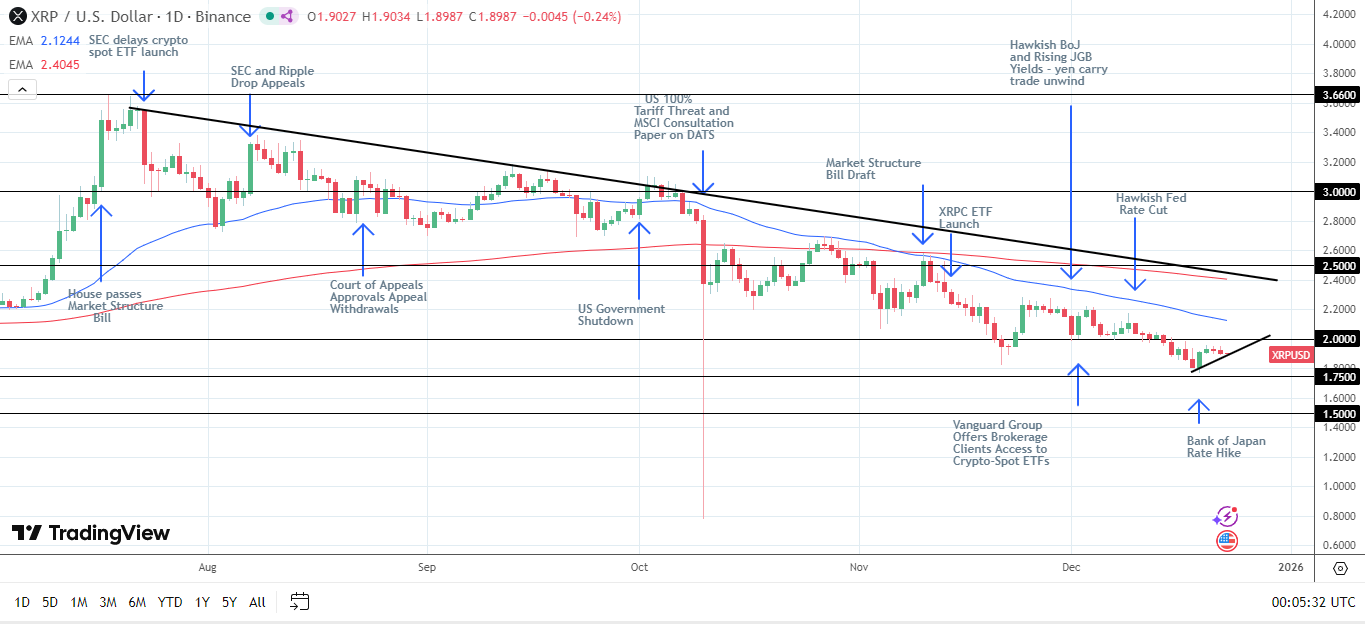
XRP’s break above $1.9 suggested the beginnings of a bullish structure formation, aligning with the bullish short- to medium-term outlook.
A break above $2.0 would bring the upper trendline and the $2.5 resistance level into play. A sustained move through the upper trendline would signal a bullish trend reversal, reinforcing the price targets.
- Medium-Term (4-8 weeks): $2.5.
- Longer-term (8–12 weeks): target of $3.0.
However, rejection at the $2.0 psychological level and a sustained break below the lower trendline would invalidate the bullish short- to medium-term outlook, and indicate a bearish trend reversal.
Outlook: $2.0 Remains the Pivot Level
Looking ahead, demand for XRP-spot ETFs, legislative developments on Capitol Hill, US economic data, and Fed and BoJ commentaries will influence near-term trends.
Rising bets on a March Fed rate cut and a cautious Bank of Japan policy stance would boost demand for XRP. Strong demand for spot ETFs will also deliver price support.
In summary, robust institutional demand for XRP-spot ETFs and legislative developments support a medium-term (4–8 weeks) move to $2.5. A March Fed rate cut and the Senate passing the Market Structure Bill would support the longer-term (8–12 weeks) price target of $3.0.
Over the 6-12 month timeline, a perfect storm of bullish events would support a return to the all-time high $3.66, bringing $5 into play.