
US economic data dampened bets on a March Fed rate cut, sending XRP lower for a fifth consecutive session.
On Friday, January 9, the US jobs report revealed lower unemployment and higher wages, weighing on demand for crypto. The labor market data followed reports of potential delays to the Market Structure Bill markup, fueling profit-taking.
Despite a five-day losing streak, XRP has gained 13% year-to-date, driven by robust demand for XRP-spot ETFs, the progress of the Market Structure Bill, and increased XRP utility. These key price catalysts continue to support a bullish medium-term price outlook.
Below, I will explore the key drivers behind recent price trends, the medium-term (4-8 weeks) outlook, and the key technical levels traders should watch.

US Jobs Report Sinks Fed Rate Cut Bets
US unemployment fell from 4.5% in November to 4.4% in December, while average hourly earnings rose from 3.6% to 3.8% in December. Typically, tighter labor market conditions and rising wages boost consumer spending, fueling demand-driven inflation. A higher inflation trajectory supports a more hawkish Fed rate path.
December’s jobs report coincided with upbeat consumer confidence numbers, adding to the positive consumption outlook. The Michigan Consumer Sentiment Index climbed from 52.9 in December to 54.0 in January.
According to the CME FedWatch Tool, the chances of a March Fed rate cut fell from 51.1% on January 2 to 28.7% on January 9. The sharp drop reflected the effect of US data on sentiment toward the Fed’s policy stance.
Despite the shifting sentiment toward the Fed’s rate path, robust demand for XRP-spot ETFs and the Market Structure Bill’s progress on Capitol Hill cushioned the downside.
Bitcoin Price Forecast
Every new Bitcoin analysis as it publishes, today's technical signal and key levels, live price — on one page.
See all Bitcoin forecastsMarket Structure Bill Developments in Focus
This week, news broke that the US Senate Agriculture Committee may delay its January 15 Market Structure Bill markup until the last week of January. Risks of a delay weighed on demand for XRP. However, updates from the US Senate Banking Committee were more optimistic, keeping alive hopes for crypto-friendly legislation in place in the first quarter.
The US Senate Banking Committee shared a statement from its chairman and Senator Tim Scott, stating:
“Chairman Senator Tim Scott is moving forward on digital asset market structure legislation – delivering clear rules that protect Main Street, keep innovation here at home, and safeguard US national security.”
Chairman and Senator Tim Scott stated:
“This legislation is about making America the crypto capital of the world – so that the next generation of jobs and innovation is built here, not overseas. When we set clear rules, we give entrepreneurs the confidence to start companies, hire workers, and grow right here in the United States. We also make it harder for criminals and foreign adversaries to use new technology to rip off Americans or undermine our financial system. After months of serious bipartisan work, it’s time to move this forward and deliver real results for the American people.”
Crypto-Legislation Pivotal for XRP
The approved draft text from the US Senate Banking Committee would put the onus on the US Senate Agriculture Committee to deliver a cleared text for merging. The merged text would then set the stage for a Senate floor vote. If passed, the Market Structure Bill would return to the House of Representatives and then to President Trump.
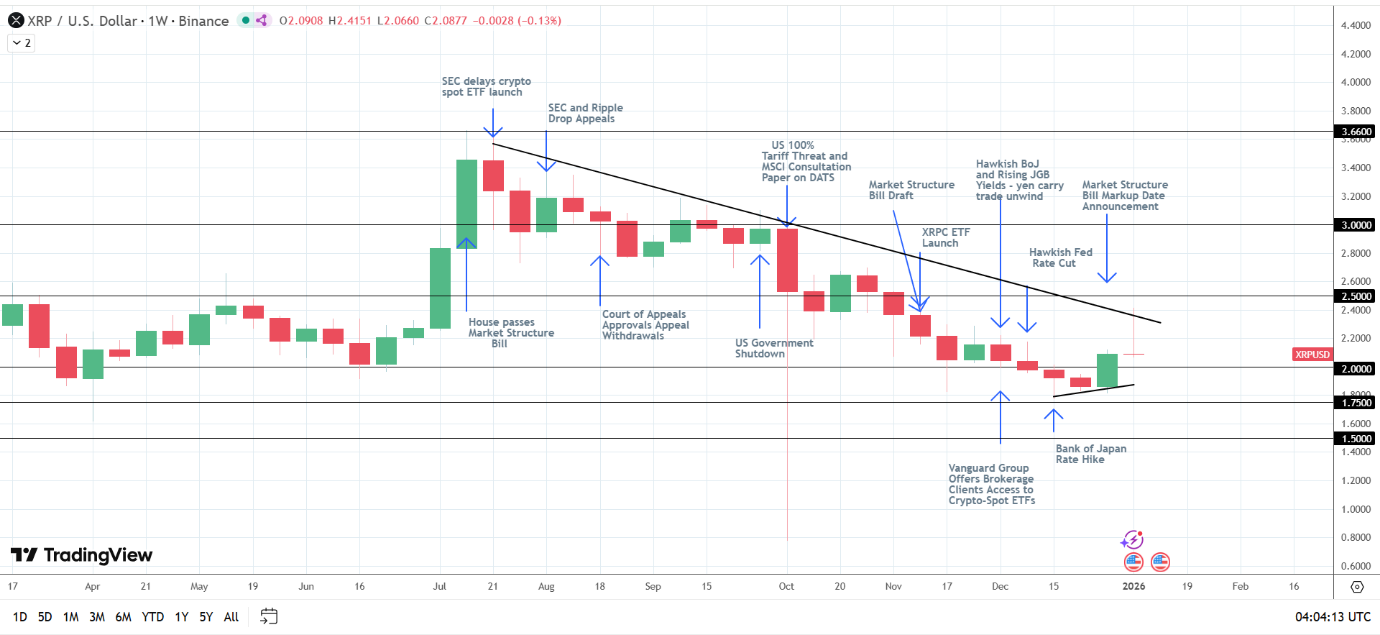
The Market Structure Bill’s progress remains key to XRP’s bullish short- to medium-term price outlook. XRP rallied 33% from December 31 to a January 6 high of $2.4151 after the US Senate Banking Committee announced a January 15 markup. Previously, XRP jumped 14.69% after the House of Representatives passed the Market Structure Bill to the Senate.
US XRP-Spot ETF Demand Outshines BTC
While crypto-related legislation remains pivotal, the US XRP-spot ETF market signaled a robust demand backdrop. US XRP-spot ETF issuers saw net inflows of $38.07 million in the reporting week ending January 9, extending their inflow streak to nine weeks.
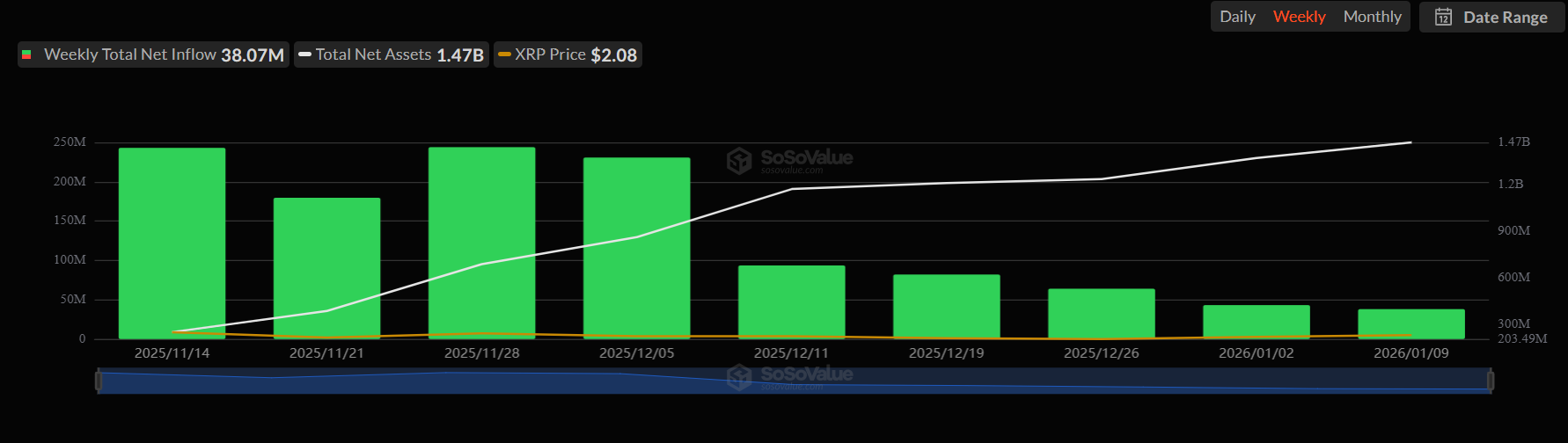
Weekly inflows were the lowest in the nine-week run, but outperformed the US BTC-spot ETF market. According to Farside Investors, US BTC-spot ETFs saw $680.9 million in net outflows for the reporting week ending January 9. Significantly, BTC dropped from a January 5 high of $95,075 to a January 9 low of $89,363, weighed by fading bets on a March Fed rate cut and outflows.
While BTC’s pullback weighed on XRP and the broader crypto market, a continued divergence in XRP-BTC flow trends could lead to a decoupling, reinforcing the positive outlook for XRP.
Steven McClurg, Canary Funds CEO, recently fueled speculation about a potential decoupling, stating:
“XRP, I believe, is going to be a divergent asset, actually. […] Altcoins typically follow Bitcoin, but there are a handful of assets that I do believe will diverge in this manner and just watching XRP perform as everything’s going straight down and we continue to get inflows every day and continue to hold up, I believe that it could look like another peak in XRP in 2026, when most of other crypto assets are going to be down.”
Despite recent losses, XRP has gained 13% year-to-date. Meanwhile, BTC and the broader crypto market cap have risen by a more modest 3.5% and 4.2%, respectively, signs of a potential decoupling.
XRP Bullish Price Outlook and Targets
The progress of the Market Structure Bill and robust demand for XRP-spot ETFs reaffirm the cautiously bullish short-term (1-4 weeks) outlook, with a $2.5 price target.
Meanwhile, increased real-world utility and optimism over the Senate passing the Market Structure Bill reinforce the positive longer-term price targets:
- Medium-term (4-8 weeks): $3.0.
- Longer-term (8-12 weeks): $3.66.
Key Risks to Bullish Scenario
Several scenarios could unravel the positive outlook. These include:
- The Bank of Japan declares a hawkish neutral interest rate (1.5%-2.5%), indicating multiple rate hikes. A higher neutral rate would likely trigger a yen carry trade unwind, derailing the short-term outlook.
- US economic data and the Fed are cooling bets on an H1 2026 rate cut.
- Market Structure Bill faces partisan challenges.
- XRP-spot ETFs report outflows.
These scenarios would likely trigger a sharper decline, pushing XRP below $2, which would indicate a bearish trend reversal.
Technical Analysis: Key Levels to Watch
XRP slipped 0.19% on Saturday, January 10, following the previous day’s 1.37%, closing at $2.0886. The token tracked the broader crypto market cap, which dropped 0.11%.
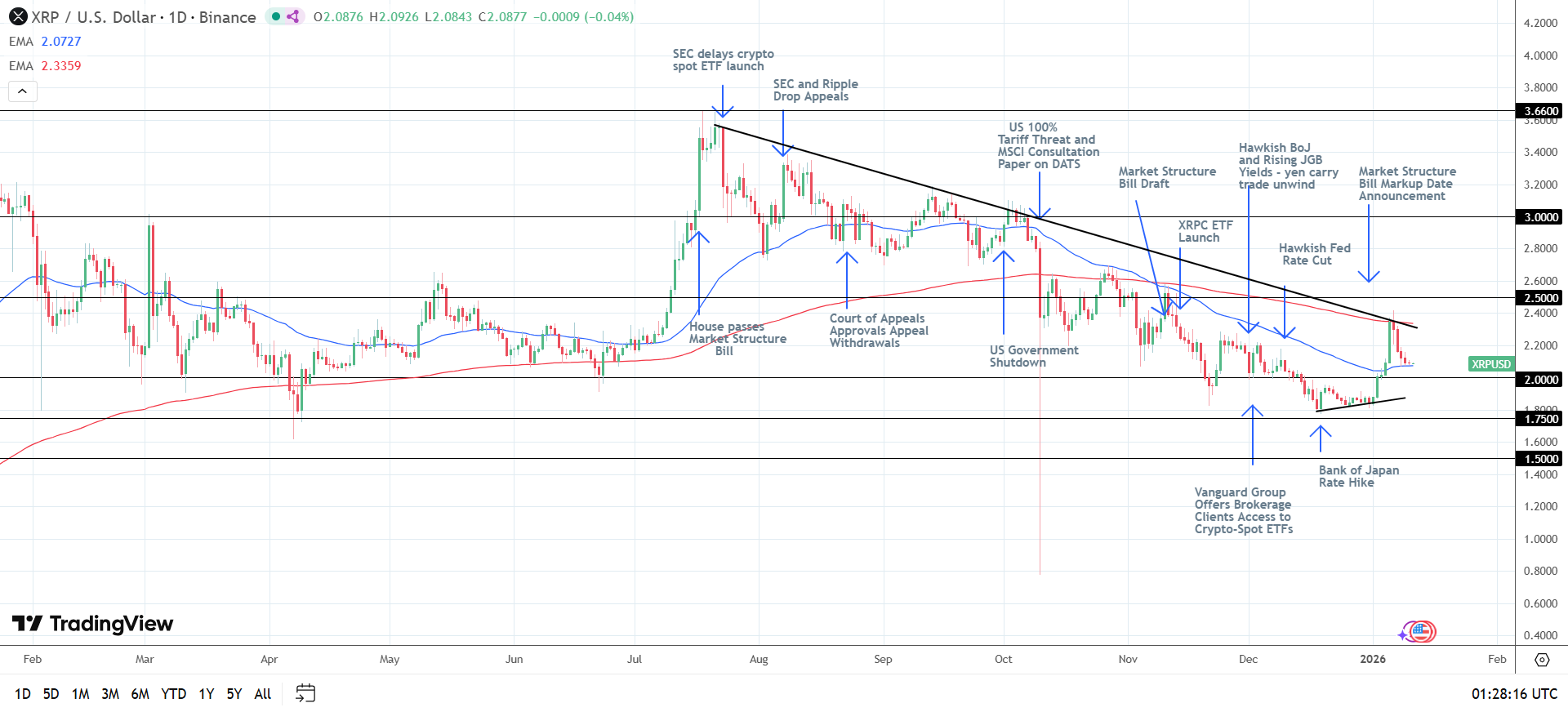
Five consecutive daily losses left XRP below the 200-day EMA, while remaining above the 50-day EMA. Despite the EMAs suggesting a bullish near-term but bearish longer-term bias, the fundamentals are bullish and dominate.
Key technical levels to watch include:
- Support levels: $2.0, $1.75, and then $1.50.
- 50-day EMA support: $2.0727.
- 200-day EMA resistance: $2.3359.
- Resistance levels: $2.5, $3.0, and $3.66.
Viewing the daily chart, a break above $2.2 would bring the 200-day EMA into play. A sustained move through the 200-day EMA would indicate a bullish trend reversal, paving the way toward the $2.5 resistance level.
Crucially, a sustained move through the 200-day EMA would reinforce the bullish medium-term outlook and the longer-term (8-12 weeks) $3.66 price target.
Fundamental Drivers to Monitor
Near-term price drivers include:
- XRP-spot ETF flow trends.
- US economic data and the Fed’s rate path.
- US crypto-related legislative developments.
Holding Above $2 Remains Critical
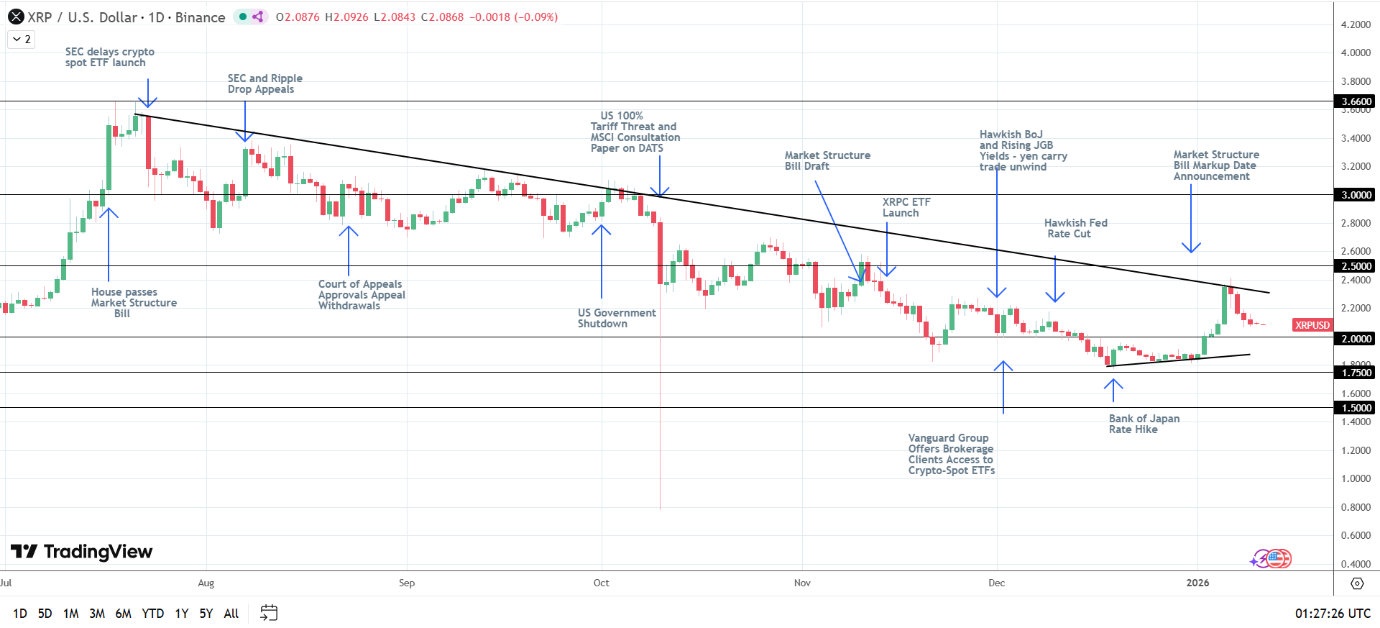
Avoiding a break below the $2 psychological support level remains crucial for the short- to medium-term outlook. Bullish fundamentals continue to outweigh bearish long-term technicals, indicating a rebound. Despite this recent pullback, January’s gains have reaffirmed the bullish structure and constructive short- to medium-term bias.
A breakout above the upper trendline would affirm the bullish trend reversal and validate the bullish structure, supporting the price targets:
- Medium-term (4-8 weeks): $3.0.
- Longer-term (8–12 weeks): target of $3.66.
However, a drop below $2.0 would expose the lower trendline. A breach of the lower trendline would invalidate the bullish structure, signaling a bearish trend reversal.
Outlook:
Looking ahead, the US economic data, central bank rhetoric, crypto-related regulatory developments, and XRP-spot ETF flows will influence the near-term price outlook.
Increased bets on a March Fed rate cut, and a dovish BoJ neutral rate (1%-1.25%) would likely lift sentiment. Strong demand for XRP-spot ETFs and bipartisan support for the Market Structure Bill would reaffirm the constructive bias.
In summary, institutional demand for XRP-spot ETFs and crypto-related regulatory developments support a medium-term (4–8 weeks) move to $3.0. A March Fed rate cut and the Senate passing the Market Structure Bill would reaffirm the longer-term (8–12 weeks) price target of $3.66.
Looking beyond the 12-week time horizon, these price catalysts are likely to drive XRP above its all-time high $3.66. A breakout above $3.66 would reaffirm $5 as the next key price target over a 6- to 12-month timeline.