
XRP snapped a mini-winning streak on Sunday, December 28, dampening hopes of reclaiming $2.0 before the new year. The number of active accounts dropped over two days, indicating profit-taking after the previous day’s rally.
Bitcoin (BTC) trended lower on Sunday, as US BTC-spot ETFs faced a second week of outflows, pushing XRP lower. BTC price trends continued to influence investor appetite for XRP despite the US XRP-spot ETF market extending its inflow streak to seven weeks.

Key technical indicators also remained bearish, weighing on sentiment. However, bullish fundamentals continue developing, signaling a constructive short- to medium-term bias.
Below, I will explore the key drivers behind recent price trends, the medium-term (4-8 weeks) outlook, and the key technical levels traders should watch.

US XRP-Spot and BTC-Spot ETF Market Flows Signal Decoupling
XRP remained under the influence of BTC on December 28. However, recent XRP-spot and BTC-spot ETF market flow trends suggest an XRP-BTC decoupling.
The US XRP-spot ETF market saw total net inflows of $64 million in the reporting week ending December 26. In contrast, the US BTC-spot ETF market had net outflows of $589.4 million.
XRP closed the week ending December 28 down 3.04% despite the robust demand for spot ETFs. Meanwhile, BTC fell by a more modest 0.92%. XRP-spot ETF market flows have yet to influence XRP price trends through shifts in the supply-demand balance.
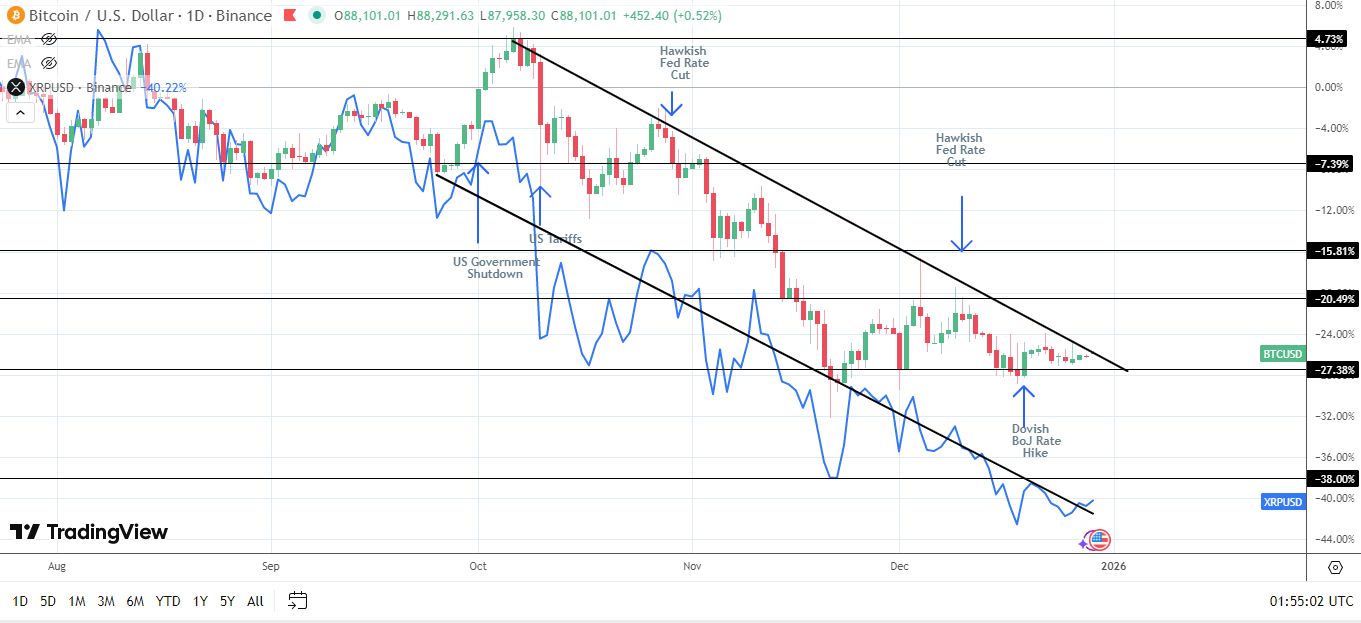
Notably, negative market shocks exposed XRP to larger losses, as BTC benefited from institutional money. The chart below captures the XRP-BTC price correlation, the effect of the US government shutdown, and central bank activity on price action.
Pro-crypto lawyer Bill Morgan commented on supply-demand factors and BTC’s ongoing influence on XRP, stating:
Bitcoin Price Forecast
Every new Bitcoin analysis as it publishes, today's technical signal and key levels, live price — on one page.
See all Bitcoin forecasts“I have criticized the supply shock theory as much as I previously criticized the inane Ripple escrow dump theory. Neither have any significant explanatory value in understanding XRP price movements. What does have explanatory value is what bitcoin’s price is doing? That is the predominant factor.”
Legislative Developments, Utility, and Spot ETF Flows Support an XRP Breakout
While XRP remains in BTC’s shadow, several events could enable XRP to break free from BTC’s influence. An XRP decoupling from BTC would likely reverse its 16% loss in H2 2025.
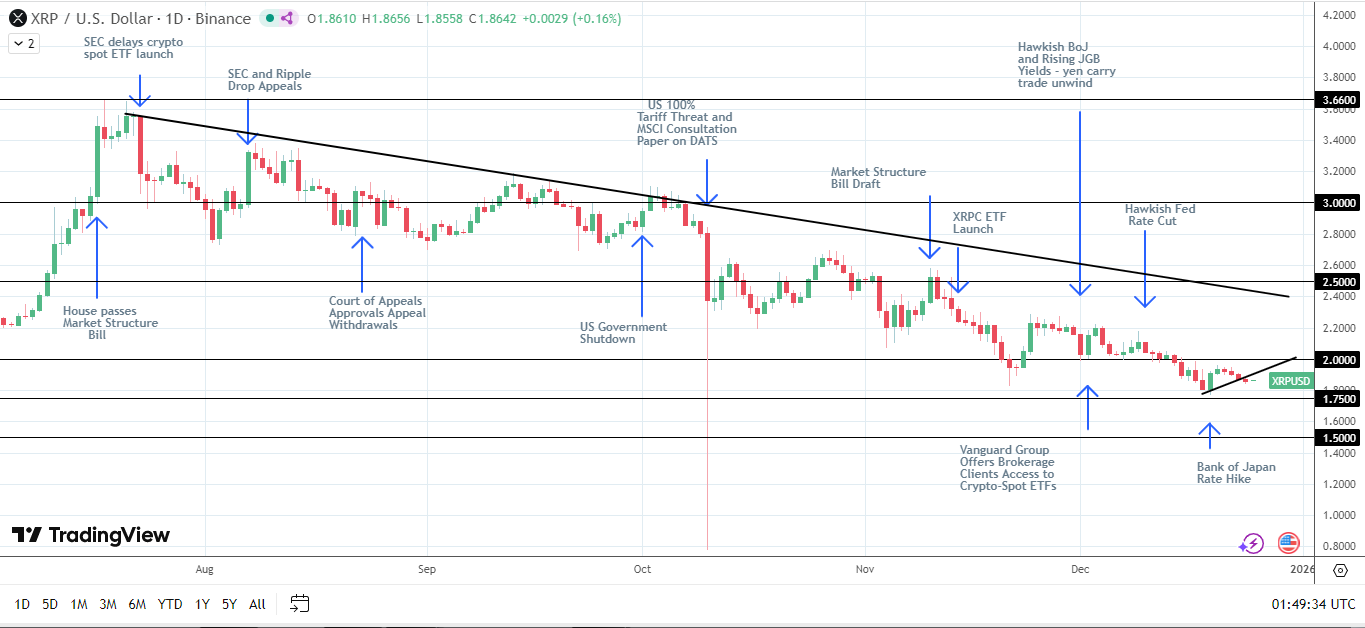
Progress toward crypto-friendly legislation remains a key price driver. The US government shutdown delayed a Market Structure Bill markup, sending XRP sharply lower. For context, XRP soared 14.69% on July 17 as investors reacted to the US House of Representatives passing the Market Structure Bill to the Senate.
A 48.5% reversal from a July 18 all-time high of $3.66 (Binance) highlights the potential upside if the Senate passes the Market Structure Bill. Crypto-friendly legislation will further legitimize XRP as a non-security asset, with real-world utility. These key elements, alongside regulations that protect investors, would likely unlock the door to a broader investor base.
Crypto experts also predict clear rules of the road to fuel institutional demand through XRP-spot ETFs. Last week, Zach Pandl, Head of Research at Grayscale, stated that bipartisan support for crypto regulation is likely to send crypto prices higher.
Crucially, Pandl sees a marked but selective surge in institutional demand in 2026. XRP’s key attributes put it center stage for institutional investors. Pandl remarked on the likely focal points for institutional investors, stating:
“It will be pretty selective. And starting with those major tokens, I think is very likely investors care about market cap. They will care about liquidity. They will care about use case of these assets. So it’ll absolutely start with just those largest cap assets.”
These scenarios also support the constructive short- to medium-term bullish bias for XRP.
Medium- and Long-Term Outlook Remains Bullish
The Market Structure Bill’s progress, increased XRP utility, and robust demand for XRP-spot ETFs reinforce the bullish short- to medium-term price outlook.
In consideration of the current market dynamics, the short-term (1-4 weeks) outlook remains cautiously bullish, with a $2.0 price target. The medium-term (4-8 weeks) and longer-term (8-12 weeks) outlooks remain bullish, with price targets of $2.5 and $3.0, respectively.
Key Downside Risks Expose Bullish Outlook
Several events could derail the positive outlook. These include:
- The Bank of Japan declares a hawkish neutral interest rate of between 1.5% and 2.5%, indicating multiple rate hikes.
- US economic indicators and the Fed are cooling expectations of a March rate cut.
- The MSCI delists digital asset treasury companies (DATs). Delistings would likely dampen interest in XRP as a treasury reserve asset.
- Lawmakers challenge the Market Structure Bill.
- XRP-spot ETFs report outflows.
These events would likely push the token toward $1.75, signaling a bearish trend reversal.
To summarize, the short-term outlook remains cautiously bullish as fundamentals outweigh the bearish technicals. Meanwhile, the medium- to longer-term outlooks are constructive.
Technical Indicators Continue to Signal Caution
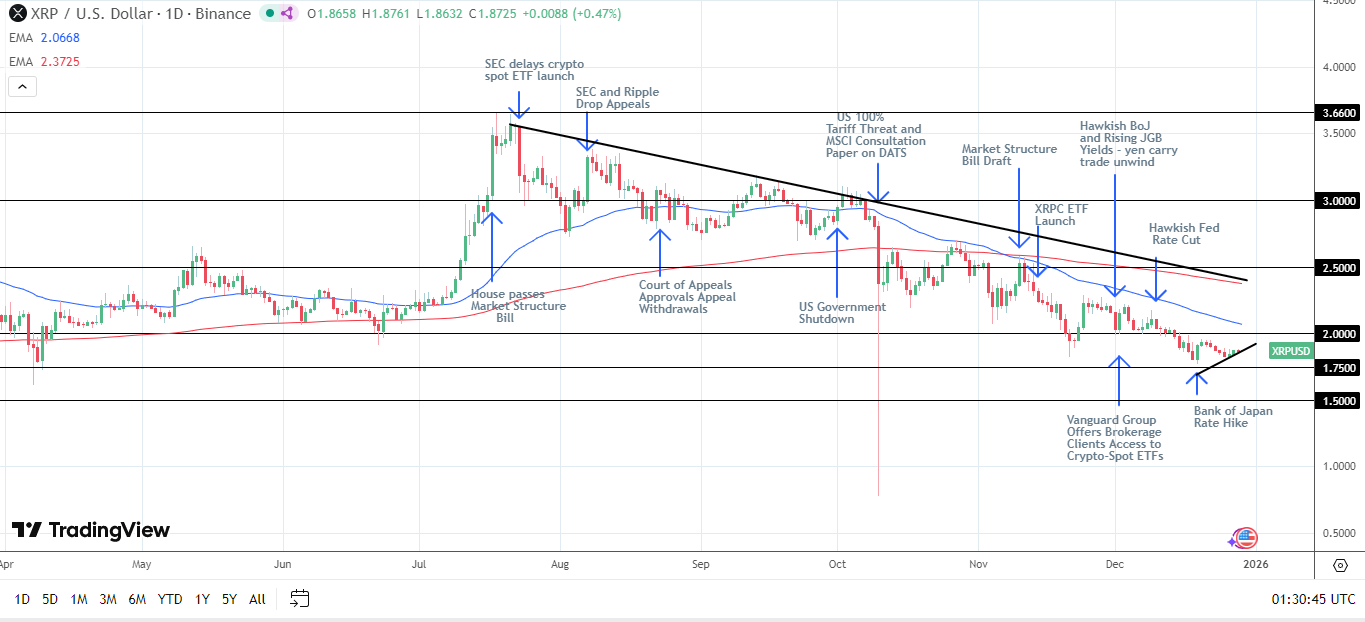
XRP fell 0.47% on Sunday, December 28, partially reversing the previous day’s 1.56% gain to close at $1.8637. The token underperformed the broader crypto market, which rose 0.13%.
Sunday’s loss left XRP trading below the 50-day and 200-day Exponential Moving Averages (EMAs), indicating a bearish bias. While technicals remain bearish, bullish fundamentals are developing, overshadowing the technical structure.
Key technical levels to watch include:
- Support levels: $1.75, and then $1.50.
- 50-day EMA resistance: $2.0668.
- 200-day EMA resistance: $2.3725.
- Resistance levels: $2, $2.5, $3.0, and $3.66.
Looking at the daily chart, a breakout above the $2.0 psychological level would bring the 50-day EMA into play. A sustained move through the 50-day EMA would indicate a near-term bullish trend reversal, opening the door to testing the 200-day EMA and the $2.5 resistance level.
A sustained break above the EMAs would affirm the constructive medium-term outlook and the longer-term (8-12 weeks) $3.0 price target.
Fundamental Indicators: Crypto Legislation, Fed, BoJ, and Spot ETFs
Near-term price drivers include:
- Demand for XRP-spot ETFs.
- US economic indicators and March Fed rate cut expectations.
- US crypto-related regulatory developments.
- The BoJ’s neutral interest rate.
What a Break Above $2.0 Could Mean for Price Structure
XRP has trended higher in recent sessions, forming a bullish structure and reinforcing the positive short- to medium-term price outlook.
Breaking above $2.0 would bring the upper trendline and the $2.5 resistance level into play. A sustained move through the upper trendline would signal a bullish trend reversal, reaffirming the price targets.
- Medium-Term (4-8 weeks): $2.5.
- Longer-term (8–12 weeks): target of $3.0.
However, rejection at $2.0 and a sustained break below the lower trendline would invalidate the bullish structure and indicate a bearish trend reversal.

Outlook: Legislation, Central Banks, and ETF Demand Remain the Key
Looking forward, BoJ and Fed speeches, US economic indicators, Market Structure Bill-related news, and XRP-spot ETF flows are likely to dictate near-term price trends.
Rising bets on a March Fed rate cut and a more dovish BoJ rate path would likely boost demand for risk assets. Increased inflows into XRP-spot ETFs and bipartisan support for the Market Structure Bill would contribute to the constructive bias.
In summary, rising institutional demand for XRP-spot ETFs and positive legislative developments support a medium-term (4–8 weeks) move to $2.5. A March Fed rate cut and the Senate passing the Market Structure Bill would reinforce the longer-term (8–12 weeks) price target of $3.0.
Looking beyond 12 weeks, these events would likely send XRP to its all-time high $3.66 over the 6-12 month time horizon.