
Profit-taking left XRP hovering below the $2.0 psychological level on Sunday, December 21, as the year-end approached. Despite improving fundamentals, technical indicators continued to indicate a bearish bias, leading to profit-taking on positive market events.
Last week, the Bank of Japan delivered a dovish rate hike, reducing demand for the yen, and crucially, easing fears of a yen carry trade unwind.
Meanwhile, weaker institutional demand for XRP-spot ETFs added to the negative sentiment.
Below, I will explore the key drivers behind recent price trends, the medium-term (4-8 weeks) outlook, and the key technical levels traders should watch.

Institutional Flows: XRP-Spot ETF Demand Weakens
The US XRP-spot ETF market reported net inflows of $13.21 million on Friday, December 19. XRP-spot ETF issuers reported $82.04 million in net inflows for the reporting week ending December 19, the lowest since launching in November.
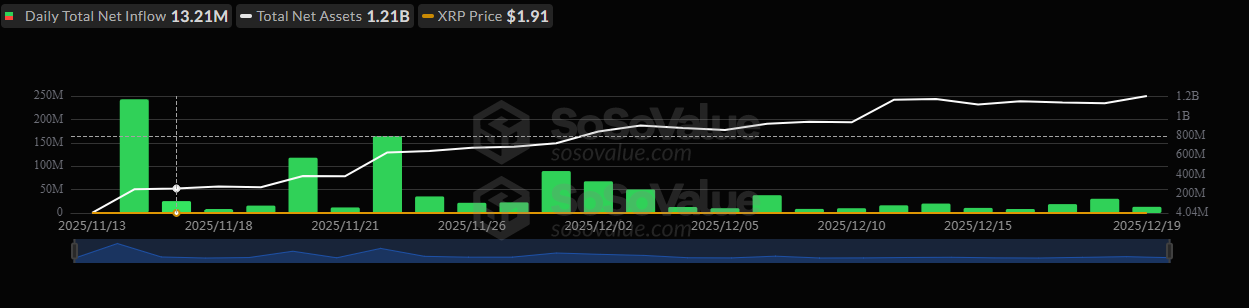
The US XRP-spot ETF market extended its winning streak to 25 consecutive days, with total net inflows of $1.07 billion. By contrast, the US BTC-spot ETF market reported total net inflows of $4.85 billion in the first 25 days of trading.
Bitcoin Price Forecast
Every new Bitcoin analysis as it publishes, today's technical signal and key levels, live price — on one page.
See all Bitcoin forecastsETF Market Comparison: The BlackRock Effect
The absence of a BlackRock-backed XRP product remains notable. BlackRock’s iShares Bitcoin Trust (IBIT) continues to dominate the US BTC-spot ETF market.
Since launch, IBIT has reported $62.5 billion in net inflows, topping the BTC-spot ETF table. Fidelity’s Wise Origin Bitcoin Fund (FBTC) ranked a distant second, with total net inflows of $12.2 billion. Meanwhile, the Grayscale Bitcoin Trust (GBTC) has reported total net outflows of $25.1 billion.
GBTC’s outflows have left the US BTC-spot ETF market with total net inflows of $57.4 billion, underpinning the importance of BlackRock’s presence in the BTC-spot ETF market. BlackRock’s absence from the US BTC-spot ETF market could have resulted in total net outflows and a materially different narrative for BTC and the broader market.
Structural Reasons for Modest XRP ETF Inflows
Several factors explain XRP’s comparatively modest ETF inflows:
- There are Five XRP-spot ETFs vs. 11 BTC-spot ETFs.
- The absence of a top 10 ETF issuer by AUM.
- Broader macroeconomic conditions. The US BTC-spot ETF market has reported total net outflows of $1.9 billion since XRP-spot ETFs began trading.
Solana Comparison and Broader Market Context
The Solana-spot ETF market is more comparable to the XRP-spot ETF market, given that there are six SOL-spot ETFs. Despite launching in October, the US SOL-spot ETF market has reported total net inflows of $741 million since launch, trailing the XRP-spot ETF market.
Despite net inflows since launch, SOL has plunged 40% in the fourth quarter, while XRP has dropped 33%. Meanwhile, BTC has declined a more modest 22% in the fourth quarter, while ETF issuers reported hefty outflows.
These trends suggest the broader macroeconomic backdrop and developments on Capitol Hill overshadowed institutional demand.
Macro Drivers: Fed, BoJ, and Capitol Hill
The US government shutdown and delay in crypto-friendly legislation have weighed on sentiment. A more hawkish Fed policy stance and anticipation of a Bank of Japan rate hike weighed on demand for crypto in the fourth quarter.
However, softer US inflation and weaker labor market conditions have increased the chances of a March Fed rate cut. According to the CME FedWatch Tool, the probability of a March cut rose from 47% on November 21 to 56.3% on December 19.
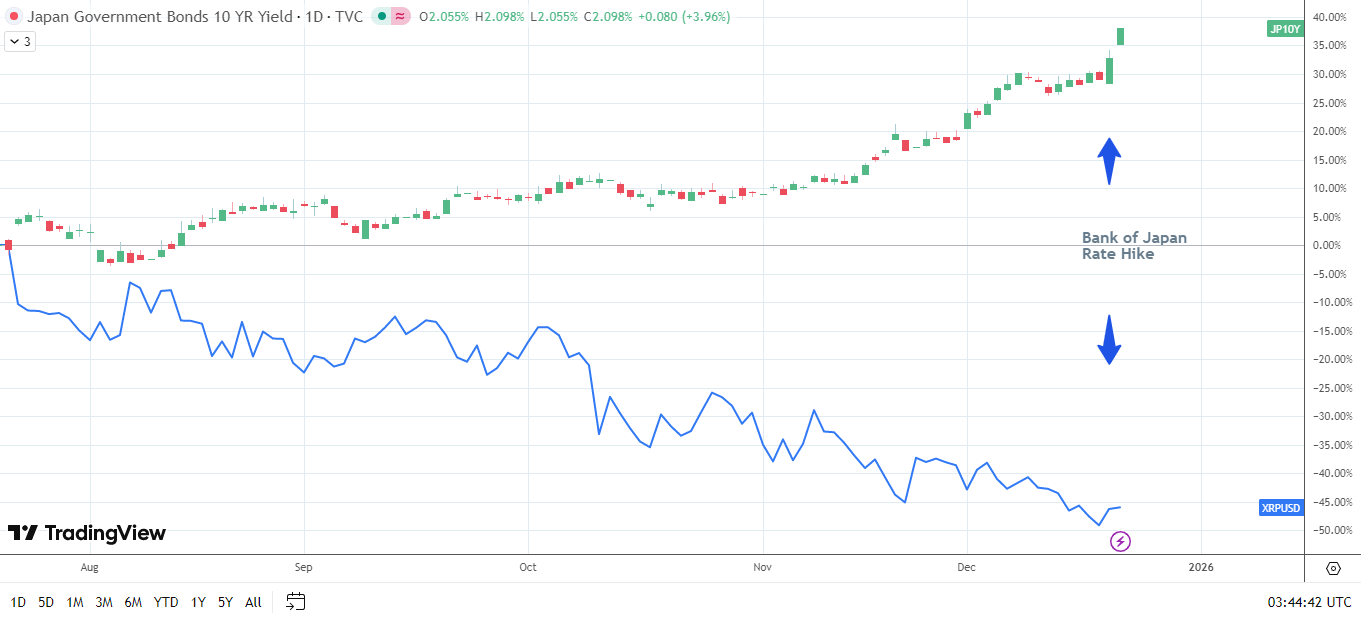
Meanwhile, last week’s dovish BoJ rate hike weighed on yen demand, triggering a 1.45% USD/JPY rally on Friday, December 19. While the yen fell sharply, 10-year Japanese Government Bond (JGB) yields broke above 2% for the first time since 2006. The weaker yen was crucial for market sentiment, breaking XRP’s inverse correlation with 10-year JGB yields.
Rising bets on a March Fed rate cut and easing fears of a yen carry trade unwind underpin a bullish short- to medium-term outlook for XRP.
Medium- and Long-Term Outlook: Constructive Bias Builds
Market sentiment toward the Fed and the BoJ’s rate paths, combined with the Market Structure Bill’s progress on Capitol Hill, supports a bullish outlook.
Despite the US government shutdown delaying the Bill’s progress, lawmakers raised hopes of an early January markup. The passing of the Market Structure Bill in the first quarter will likely be a key price catalyst.
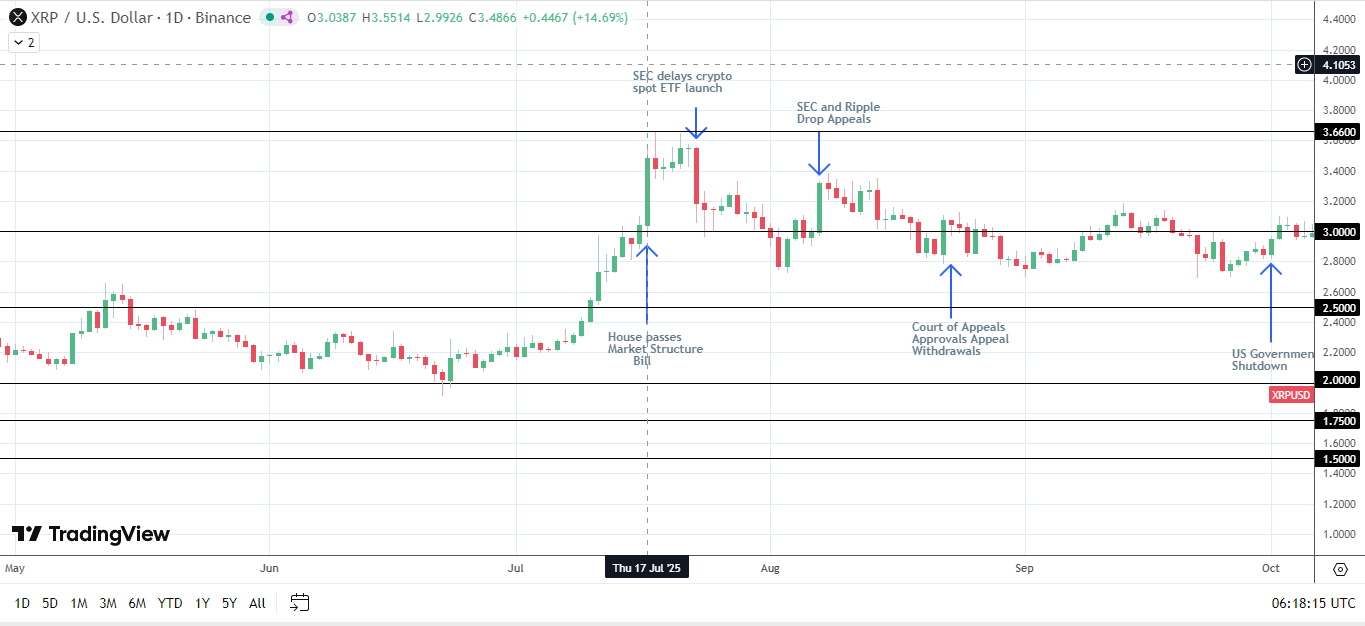
XRP jumped 14.69% on July 17 in response to the US House of Representatives passing the Market Structure Bill to the Senate.
Considering these tailwinds, the short-term (1-4 weeks) outlook has turned bullish, with a $2 price target. The medium-term (4-8 weeks) and longer-term (8-12 weeks) outlooks remain constructive, with price targets of $2.5 and $3.0, respectively.
Downside Risks to the Bullish Scenario
Several scenarios could challenge the bullish outlooks. These include:
- The Bank of Japan announces a neutral interest rate of between 1.5% and 2.5% and the need to combat inflation aggressively.
- US economic data and Fed speakers temper bets on a March rate cut.
- The MSCI delists digital asset treasury companies (DATs). Delistings would likely reduce interest in XRP as a treasury reserve asset.
- US Senate opposes the Market Structure Bill.
- XRP-spot ETFs report outflows.
These scenarios would likely send XRP toward $1.75, indicating a bearish trend reversal.
In summary, the short-term outlook has turned cautiously bullish as fundamentals override the bearish technicals. Meanwhile, the medium- to longer-term outlooks are constructive.
Financial Analysis
Technical Outlook: EMAs Signal Caution
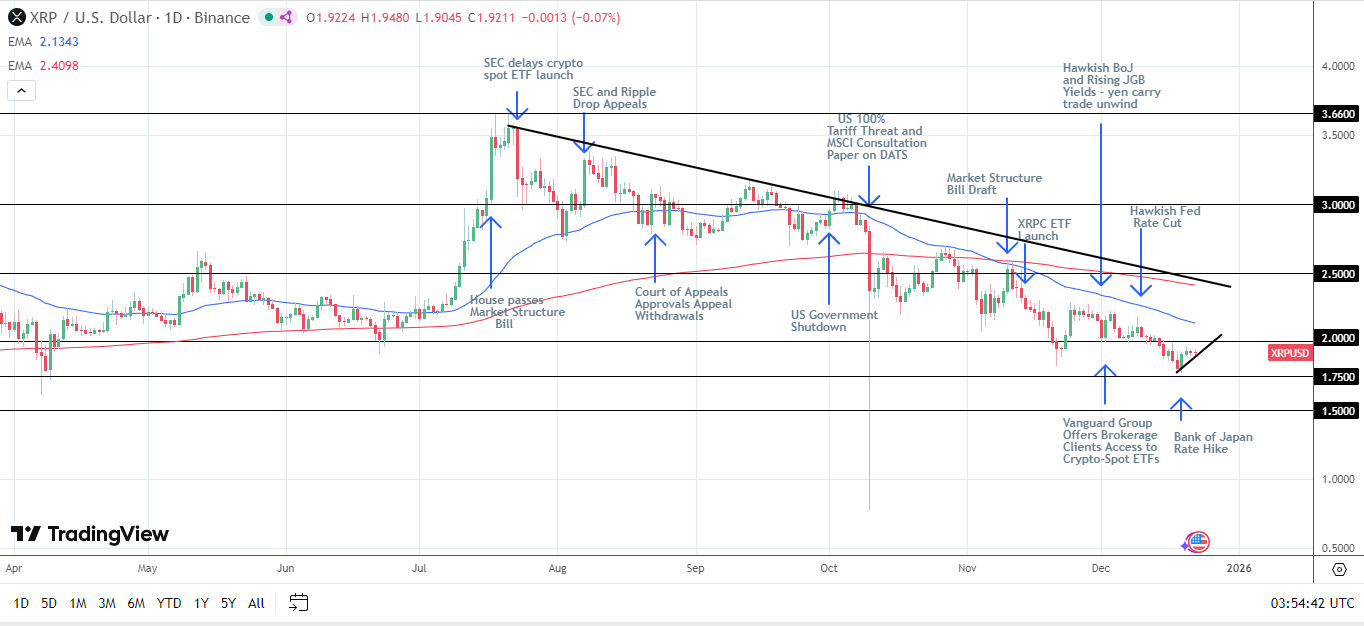
XRP fell 0.58% on Sunday, December 21, partially reversing the previous day’s 1.29% gain to close at $1.9224. The token underperformed the broader crypto market, which gained 0.29%.
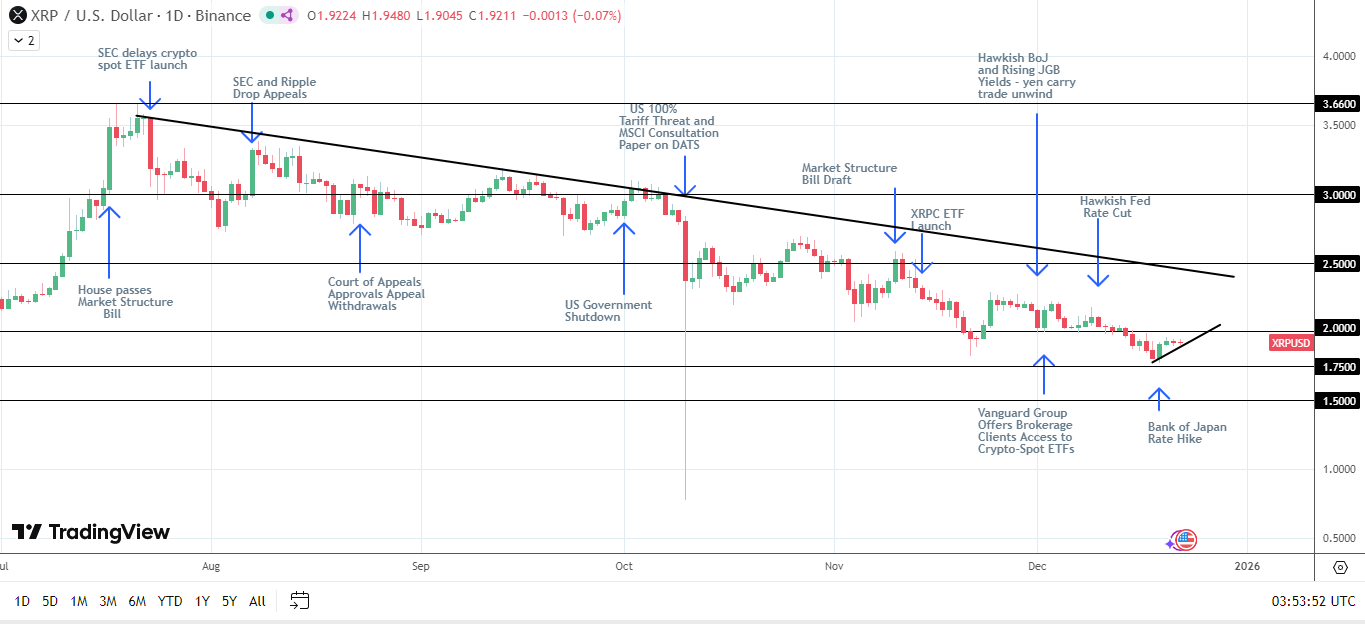
Sunday’s pullback left XRP well below the 50-day and 200-day Exponential Moving Averages (EMAs), signaling a bearish bias. While technicals remain bearish, fundamentals are increasingly outweighing the technical structure.
Key technical levels to watch include:
- Support levels: $1.75, and then $1.50.
- 50-day EMA resistance: $2.1343.
- 200-day EMA resistance: $2.4098.
- Resistance levels: $2, $2.5, $3.0, and $3.66.
Looking at the daily chart, a break above the $2 psychological level would pave the way to the 50-day EMA. A sustained move through the 50-day EMA would signal a near-term bullish trend reversal, bringing the 200-day EMA and the $2.5 resistance level into play.
A breakout above the EMAs would affirm the medium-term outlook, and the longer-term (8-12 weeks) $3.0 price target.
Fundamental Indicators: BoJ, Fed, and ETF Demand
Near-term price drivers include:
- XRP-spot ETF flow trends.
- US economic indicators and March Fed rate cut bets.
- US crypto-related legislative developments.
- The BoJ’s neutral interest rate.
Bullish Structure Formation: What Happens if XRP Reclaims $2.0?
Last week’s rebound indicated a bullish structure formation, signaling a bullish short- to medium-term outlook. A breakout above $2.0 would support a move toward the upper trendline and the $2.5 resistance level. A sustained break above the upper trendline would indicate a bullish trend reversal, reinforcing the price targets.
- Medium-Term (4-8 weeks); $2.5.
- Longer-term (8–12 weeks) target of $3.0.
However, rejection at the $2.0 psychological level and a drop below the lower trendline would invalidate the bullish short- to medium-term outlook, and signal a bearish trend reversal.
Outlook: $2.0 Remains the Pivot Level
Looking ahead, XRP-spot ETF flows and sentiment toward the BoJ and the Fed’s policy outlooks will dictate near-term trends. Rising bets on a March Fed rate cut and hopes for a BoJ neutral rate of between 1% and 1.25% would boost demand for risk assets.
Meanwhile, the Market Structure Bill will be under the spotlight in January, potentially kickstarting a 2026 breakout.
In summary, strong institutional demand for XRP-spot ETFs and the US legislative developments suggest a medium-term (4–8 weeks) move to $2.5. A March Fed rate cut and the Senate passing the Market Structure Bill would support the longer-term (8–12 weeks) price target of $3.0.
Meanwhile, over the 6-12 month timeline, a return to the all-time high $3.66 would bring $5 into play.